Overview: The Semrock 2018 Master Catalog provides comprehensive information on optical filters and components, emphasizing availability, customization, and rapid delivery. It highlights a 10-year warranty and offers various purchasing options, including online quoting and ordering.
Ordering and Shipping: Orders for in-stock products received by noon EST are shipped the same day. Domestic shipping is via UPS Ground or 2-day, with options for direct carrier billing using customer shipping accounts. Purchase orders can be placed online or via email/fax, with credit applications required for new customers.
Distributor Network: A complete list of US and international distributors is available online, facilitating global access to Semrock products.
Product Innovations: The catalog introduces new products such as expanded LED filter sets, image-splitting dichroics for super-resolution, and expanded filters for optogenetics and neuroscience. The SearchLight app, available on iOS and Android, aids in evaluating optical filters.
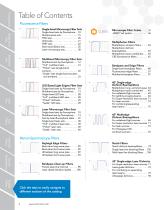
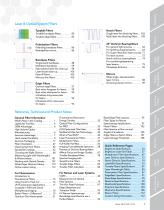
Technical Information: The catalog includes detailed specifications for various filter types, including single-band, multiband, and laser microscopy filter sets. It also covers multiphoton filters, bandpass and edge filters, and dichroic beamsplitters.
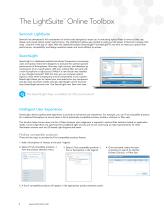
Tools and Resources: The LightSuite toolbox, including SearchLight and MyLight, assists users in evaluating optical filters' performance and compatibility. These tools are designed to enhance user experience and streamline the selection process.
Commitment to Excellence: Semrock is part of IDEX Health & Science's new Optics Center of Excellence in Rochester, NY, which aims to integrate optical technologies and expand manufacturing and design capabilities.
Product Selection and Tools: Semrock provides a range of tools to assist in selecting the appropriate optical filters. The MyLight tool allows users to simulate filter performance under various conditions, while the SearchLight Optimization Calculator helps designers assess the impact of spectral edge locations on system performance. The SearchLight App is available for mobile devices, enabling offline session saving and synchronization.
Company Expertise and Product Benefits: Semrock, a unit of IDEX Health & Science, is renowned for its high-performance optical filters used in life sciences and medical diagnostics. Their filters are known for their brightness, durability, and spectral sophistication, leading to faster measurements and reduced downtime. The company offers both standard catalog solutions and custom designs, ensuring lot-to-lot consistency and high-volume production capabilities.
Design and Manufacturing Capabilities: Semrock's design engineers are experts in various fields, enabling rapid design turnaround using proprietary software. Their modeling toolbox ensures high confidence in engineering designs, minimizing system redesigns. The company supports high-volume manufacturing and rapid prototyping, with industry-leading lead times and scalability.
Product Capabilities and Custom Solutions: Semrock produces a variety of filters, including fluorescence, Raman spectroscopy, and laser-line filters. They offer custom solutions with specific wavelength functionalities and sizes, ensuring high-volume production and custom sizing options.
Durability and Reliability: Semrock filters meet rigorous U.S. Military and international standards for environmental and physical durability. Their ion-beam-sputtered hard coatings provide exceptional reliability, backed by a ten-year warranty. The filters are resistant to humidity, temperature, and optical damage, ensuring no burn-out and no need for periodic replacement.
Performance and Innovation: Semrock's filters are known for their high transmission, precise wavelength accuracy, and optimized blocking, resulting in better contrast and faster measurements. The company continues to innovate, holding numerous patents and offering advanced filter sets for various applications.
Customer Support and Policies: Semrock offers a 30-day test drive for standard filters, allowing returns if not satisfied. They provide custom sizing options and ensure consistent batch-to-batch performance. Pricing and availability are subject to change, with details available on their website.
Filter Specifications: The document lists several filter sets, including GFP, FITC, YFP, TRITC, Cy3, TXRED, mCherry, Cy5, Cy5.5, Cy7, IRDYE800, and ICG. Each set is described with its excitation and emission wavelengths, dichroic edge, part numbers, and pricing. The "-ZERO" sets denote zero pixel shift performance.
Technical Notes: The document highlights the use of VersaChrome filters for ratiometric imaging with Fura-2, emphasizing the flexibility and speed of tunable excitation sources. It also discusses the advantages of BrightLine filters in UV fluorescence applications, noting their high transmission and reliability compared to traditional filters.
Applications: The document covers applications in FISH (Fluorescence In Situ Hybridization) and densely multiplexed imaging, emphasizing the importance of minimizing crosstalk between fluorophores. It provides examples of assays using BrightLine FISH filter sets, such as PathVysion, AneuVysion, UroVysion, and M-FISH, highlighting their role in genetic screening and cancer diagnostics.
Packaging and Data: Semrock's packaging solutions for filters are described, focusing on cleanliness and recyclability. The document assures that the published spectra are actual measured data, ensuring the filters meet expected specifications.
Quantum Dot Nanocrystals: Quantum dot nanocrystals are highlighted for their high brightness and photostability, making them suitable for applications requiring high sensitivity and long-term stability. The document emphasizes the importance of using optimized filters, such as the BrightLine® filter sets, for effective imaging with quantum dots. These filters are designed to maximize excitation efficiency while minimizing interference from other fluorophores like DAPI.
FRET Imaging: FRET is described as a technique for studying molecular interactions at a very small scale. The document details several FRET filter sets optimized for different fluorophore pairs, such as CFP/YFP and GFP/RFP. These sets are designed for dual-wavelength imaging and are available in configurations that minimize imaging artifacts and enhance speed.
Multicolor Fluorescence: A comparison is made between Semrock's BrightLine Quad-band "Pinkel" filter set and a leading competitor's set, highlighting the superior brightness and contrast of the Semrock filters. These filters are designed for high-speed, sequential imaging of multiple fluorophores.
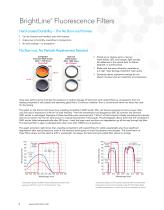
BrightLine Basic Sets: The document introduces BrightLine Basic filter sets as a cost-effective alternative to premium filters, offering hard-coated performance at soft-coated prices. These sets are suitable for routine applications and provide high brightness and contrast without burn-out.
LED-Optimized Filter Sets: LED-based light engines have replaced traditional arc lamps due to their efficiency and longer lifespan. However, traditional filter sets are not optimized for LED spectra, leading to reduced brightness. Semrock has developed LED-optimized filter sets that align with LED spectral peaks, improving transmitted energy and signal quality significantly, especially in the Cy5 band.
Benefits of BrightLine LED Filter Sets: These new filter sets offer excellent signal quality, reduced complexity and cost, and a wide selection of configurations. They support single-band, multiband, Pinkel, and Sedat configurations, making them versatile for various imaging needs.
Technical Notes: The document provides guidance on the correct orientation of filters to maximize transmission and minimize autofluorescence. It includes instructions for orienting housed and unhoused filters, emphasizing the importance of aligning filters correctly to the light source.
Product Notes: The document details the design and benefits of the BrightLine LED filter sets, which are spectrally aligned to popular LED light engines. These sets offer significant improvements in fluorescence signal and are designed for easy integration into existing systems.
Specifications: The document lists several filter sets, including Triple-band and Quad-band Pinkel Sets, with specific excitation and emission wavelengths. For example, the LED-CFP/YFP/mCherry-3X-A set includes excitation wavelengths of 438/24, 509/22, and 578/21 nm, and emission wavelengths of 475/22, 543/22, and 702/197 nm.
Configurations: Three main configurations are discussed: Full Multiband, Pinkel, and Sedat. The Full Multiband configuration uses multiband filters for exciter, emitter, and dichroic beamsplitter, suitable for direct visualization. The Pinkel configuration uses single-band exciters with multiband emitter and dichroic filters, offering high-speed, high-contrast imaging. The Sedat configuration uses single-band exciters and emitters with a multiband dichroic beamsplitter, providing the best image fidelity.
Technical Insights: The document highlights the advantages of using BrightLine® Multiband Fluorescence Sets, which include high transmission, blocking, and edge steepness for superior imaging. The filters are made with durable hard-coating technology, ensuring 'no burn-out' performance.
Recommendations: For achieving bright, clean images, the document suggests selecting appropriate filter sets based on the specific imaging requirements. It also emphasizes the importance of using advanced multiband optical filter technology for simultaneous multicolor imaging.
Pricing: The document provides base prices for various filter sets, such as $1,565 for the Triple-band Pinkel Set and $2,045 for the Quad-band Pinkel Set.
Filter Sets:- Triple-Band Sedat Set: Includes filters for cyan, yellow, and red fluorescence with specific excitation and emission wavelengths. Suitable for CFP, YFP, and HcRed fluorophores.
- Quad-Band Sedat Set: Covers blue, green, orange, and red fluorescence, compatible with DAPI, FITC, TRITC, and Cy5 fluorophores.
- Penta-Band Sedat Set: Adds deep red to the quad-band set, supporting Cy7 fluorophores.
Specifications:- Transmission: Guaranteed >93% for most filters, with typical transmission >97%.
- Angle of Incidence: 0° ± 5° for general filters, 45° ± 1.5° for exciter and emitter specifications.
- Autofluorescence: Low to ultra-low, ensuring minimal background noise.
- Durability: Hard-coated technology ensures long lifespan and resistance to high optical intensities.
Microscope Compatibility: Filters are compatible with major brands like Leica, Nikon, Olympus, and Zeiss, with specific cube designations and pricing provided.
Pixel Shift: The document explains the concept of pixel shift and how BrightLine® –ZERO™ filters are designed to minimize this effect, ensuring precise image registration for multi-color composite images.
Technical Notes: Discusses the advantages of BrightLine® filters, including their construction from a single piece of glass with hard coatings, which reduces pixel shift and improves imaging performance.
Additional Information: The document includes references to online resources for spectra graphs, ASCII data, and installation videos, as well as details on laser filter sets optimized for specific laser lines.
Specifications: The document lists several filter sets with their primary fluorophores, excitation and emission wavelengths, and part numbers. Each filter set is designed to optimize signal-to-noise ratio (SNR) and minimize artifacts in TIRF, confocal, PALM, STORM, SIM, and other super-resolution techniques.
Filter Types: - Longpass Filters: These filters allow the passage of longer wavelengths and are suitable for applications requiring the combination of photoactivation and UV sources with normal excitation laser lines.
- Multiband Filters: These include dual-band, triple-band, and quad-band sets, designed to accommodate multiple laser lines and fluorophores, enhancing the versatility of imaging systems.
- Pinkel and Sedat Sets: These sets offer single-band exciters with multiband emitters and beamsplitters, tailored for specific fluorophore combinations.
Technical Insights: The document emphasizes the importance of using hard-coated thin-film filters for laser applications due to their high laser damage threshold and environmental reliability. It also discusses the need for broader excitation filters to accommodate variations in laser output and the significance of high blocking emission filters to ensure dark background signals.
Recommendations: For optimal performance, the document suggests using dichroic beamsplitters with antireflection coatings and substrates with ultra-low autofluorescence. It also highlights the importance of maintaining the flatness of dichroic beamsplitters to avoid optical wavefront distortion.
Cleaning Guidelines: Semrock provides cleaning recommendations for their hard-coated filters, emphasizing the use of unpowdered gloves, eye protection, compressed air, lint-free swabs, and appropriate solvents like Isopropyl Alcohol and Acetone.
Cleaning Procedures for Optical Filters:- Initial Cleaning: Use a moderate air stream at an oblique angle to remove loose particles from the filter surface.
- Deep Cleaning: For stubborn debris, use a lint-free wipe or swab moistened with IPA or Acetone. Clean in a continuous motion, using patterns like a figure 8 or spiral.
- Inspection: Use bright light to inspect the filter for cleanliness. Repeat cleaning if necessary.
- Edge Blackened Filters: Use only IPA or water-based solutions to avoid damaging the edge blackening material.
SearchLight Tool: SearchLight is a tool for optimizing fluorophore, light source, detector, and optical filter combinations in microscopy. It allows users to save and share data securely, enhancing collaboration.
Sputtered Thin-film Coatings:- Deposition Methods: Traditional methods include thermal and e-beam evaporation, with IAD providing more durable coatings. Sputtering offers the highest performance with hard, dense coatings.
- Advantages of Sputtering: Produces low-loss, reliable thin-film layers with high optical-thickness precision. Semrock has advanced this process for high-volume production without compromising quality.
Filter Specifications:- Transmission and Blocking Ranges: Various filters are listed with specific transmission and blocking ranges, glass thickness, and prices.
- Multiphoton Fluorescence Filters: Designed for a wide range of applications, these filters eliminate excitation laser noise and reduce undesired fluorescence noise.
Technical Notes:- Multiphoton LaserMUX Beam Combiners: These filters enable deeper tissue imaging and improved contrast in microscopy, ideal for combining femtosecond pulsed laser beams.
- Coherent Raman Scattering (CRS) Filters: CRS allows for highly specific, label-free chemical and biological imaging with higher sensitivity compared to traditional methods.
Specifications: Each beamsplitter is characterized by its nominal edge wavelength, average reflection and transmission bands, and physical dimensions. The document lists specific part numbers and prices for each product, indicating their suitability for different fluorophore pairs and imaging applications.
Procedures and Recommendations: The document emphasizes the importance of selecting beamsplitters with appropriate flatness and wavefront error (RWE) to ensure optimal image quality. It discusses the impact of substrate bending on transmitted and reflected light, particularly in high-angle incidence applications like 45° dichroic beamsplitters.
Technical Insights: A technical note explains how the flatness of dichroic beamsplitters affects focus and image quality, particularly in applications like Total Internal Reflection Fluorescence (TIRF) microscopy. It provides guidance on choosing filters that minimize wavefront distortion to enhance microscopy performance.
Data and Graphs: The document includes spectral graphs and ASCII data for various filter sets, illustrating their transmission characteristics across different wavelengths. It also presents a plot showing the effect of dichroic curvature on spot size, relevant for imaging applications.
Critical Information: The document highlights the need for high flatness in dichroics used for laser and imaging applications to prevent optical aberrations such as astigmatism. It suggests using laser dichroics for applications requiring minimal focal shift and imaging dichroics for eliminating astigmatism in large beams.
Introduction: This technical note discusses the selection of Semrock dichroic beamsplitters suitable for various microscopy methods, focusing on the importance of wavefront flatness and its impact on image quality.
Wavefront Error and Flatness: Wavefront errors, including transmitted wavefront error (TWE) and reflected wavefront error (RWE), are critical in determining the suitability of dichroic beamsplitters for specific microscopy techniques. Deviations from flatness can cause distortions in the reflected wavefront, affecting image quality.
Microscopy Techniques and Flatness Requirements: Different microscopy techniques have varying requirements for wavefront flatness. For instance, Total Internal Reflection Fluorescence (TIRF) and Stochastic Switching methods like PALM and STORM require critical flatness for both excitation and emission beams. In contrast, widefield fluorescence microscopy is less critical for excitation beam flatness.
Impact of Substrate Bending: Substrate bending can degrade image quality, as demonstrated in the provided image sequence. A lower radius of curvature indicates greater bending and poorer image quality.
Semrock Product Recommendations: Table 2 provides recommendations for Semrock products based on maximum beam diameter values and flatness classifications. These products are designed to minimize wavefront errors and are categorized by their application suitability.
Flatness/RWE Classification: Semrock dichroic beamsplitters are classified into categories based on flatness and RWE, with specific applications and nominal radius of curvature values provided. This classification helps in selecting the appropriate beamsplitter for a given microscopy method.
Product Specifications: Semrock offers a range of dichroic beamsplitters with advanced coatings for durability and minimal wavefront distortion. Specifications include high reflection and transmission rates, steep spectral edges, and optimized performance for various laser wavelengths.
Conclusion: Choosing the right dichroic beamsplitter involves understanding the criticality of wavefront flatness for the specific microscopy method. Semrock provides detailed classifications and product recommendations to aid in this selection process.
Specifications:
1. Transmitted Wavefront Error: Less than λ / 4 RMS at λ = 633 nm, with peak-to-valley error less than 5 times the RMS value within the clear aperture.
2. Beam Deviation: ≤ 10 arcseconds.
3. Anti-reflection Coating: Second surface is AR coated.
4. Flatness: Reflection of a collimated, Gaussian laser beam with waist diameter up to 2.5 mm causes less than one Rayleigh Range of focal shift.
5. Filter Orientation: Reflective coating side should face toward light source and sample.
6. Microscope Compatibility: Compatible with Leica, Nikon, Olympus, and Zeiss microscopes.
Product Details:
1. BrightLine Single-edge Laser Dichroic Beamsplitters: Designed for UV & IR lasers, polarization-insensitive, optimized for 45° use.
2. Laser Dichroic Beamsplitters: Extended reflection down to 350 nm, optimized for fluorescence imaging lasers, with > 98% reflection at laser wavelengths.
3. Laser Multiedge Dichroic Beamsplitters: High reflection at laser wavelengths, steep transitions from reflection to transmission, suitable for advanced microscopy.
4. StopLine Notch Dichroic Beamsplitters: Designed for 45° angle of incidence, reflect incident laser source while allowing other wavelengths to transmit, suitable for CARS applications.
5. LaserMUX Beam Combining Filters: Efficiently combine or separate multiple laser beams at 45° angle of incidence, optimized for multiplexing popular laser lines.
Performance and Durability:
1. Reflection and Transmission: High reflection and transmission performance at popular laser lines, with low loss.
2. Durability: Ion-beam-sputtered, hard-coated technology ensures long filter life and resistance to high optical intensities.
3. Reliability: Tested to MIL-STD-810F and MIL-C-48497A environmental standards.
Additional Tools:
1. SearchLight: A tool for optimizing fluorophore, light source, detector, and optical filter combinations for microscopes, allowing for efficient data sharing and collaboration.
Overview: The document discusses the performance and measurement of optical filters, particularly focusing on the discrepancies between actual and measured spectra due to limitations in spectrophotometer technology. It also introduces Semrock's innovative VersaChrome tunable filters, which offer significant advantages in spectral imaging applications.
Measurement Discrepancies: Optical filters' performance can be affected by physical imperfections and measurement limitations. Three main discrepancies are identified: rounding of sharp spectral features, limited sensitivity, and sideband measurement artifacts. Different measurement methods, including custom-built spectrophotometers, are used to address these issues, but each has its limitations.
Semrock's Measurement Approaches: Semrock employs various measurement techniques to evaluate filter spectra. Method "A" uses a custom-built spectrophotometer optimized for rapid data collection but lacks sensitivity. Method "B" uses a commercial spectrophotometer, showing all noted discrepancies. Methods "C" and "D" improve on "A" by enhancing measurement of steep edges and removing artifacts. Method "E" provides the most accurate results but is not suitable for large-scale quality assurance.
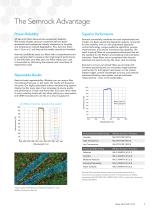
Tunable Bandpass Filters: Thin-film filters are ideal for wavelength selection due to high transmission and steep spectral edges. However, they are "fixed" filters, limiting dynamic filtering capabilities. Semrock's patented tunable filters overcome these limitations by allowing angle tuning without changing spectral performance, maintaining high transmission and steep edges across a wide range of angles.
VersaChrome Filters: These filters offer tunability over a wide wavelength range by adjusting the angle of incidence, maintaining high performance without polarization dependence. They are suitable for applications like fluorescence microscopy and hyperspectral imaging, providing high transmission and simplifying instrumentation complexity.
Applications and Advantages: VersaChrome filters enhance spectral imaging systems by offering high transmission, steep edges, and polarization independence. They are ideal for fluorescence imaging, hyperspectral imaging, and high-throughput spectroscopy, providing significant improvements over conventional filters.
Specifications:- Transmission and Blocking: The filters guarantee high transmission rates (over 90%) across specified wavelength ranges, with blocking optical density (OD) greater than 6 for UV to near-infrared wavelengths.
- Material and Construction: Made from fused silica with sputtered coatings, the filters have precise transverse dimensions (25.2 mm x 35.6 mm) and thickness (2.0 mm), with tolerances of ±0.1 mm.
- Optical Performance: Features include a clear aperture greater than 80%, transmitted wavefront error less than λ/4 RMS at λ = 633 mm, and beam deviation of ≤ 10 arcseconds.
Applications and Usage:- Fluorescence Technology: The filters are essential for optimizing brightness and contrast in fluorescence applications, accommodating new fluorophores with specific bandpass requirements.
- Customizability: Users can combine long-wave pass and short-wave pass filters with a full-spectrum blocking filter to create a desired passband shape, adjustable in real-time to maximize signal-to-noise ratios.
- Versatility: The filters can be angle-tuned to achieve precise cut-on or cut-off wavelengths, with extended blocking capabilities from UV to NIR wavelengths.
Product Range: The document lists various filter models with specific wavelength ranges and transmission characteristics, each priced at $845 or $945 depending on the model.
Technical Note: The document includes a technical note on the effective index of refraction and provides a link to Semrock's online tool for calculating filter configurations.
Specifications:
- Substrate Material: Fused Silica
- Coating Type: Hard ion-beam-sputtered
- Clear Aperture: 80% of glass dimension, Elliptical
- Transverse Dimension: 25.2 x 35.6 mm +/- 0.1mm
- Thickness & Tolerance: 1.05 mm +/- 0.05 mm
- Surface Quality: 60-40 Scratch-dig
Pulse Dispersion:
General Purpose Mirrors do not introduce significant pulse broadening for laser pulses > 1 picosecond, but may cause distortion for shorter pulses, such as femtosecond pulses.
Reliability & Durability:
Mirrors are tested to MIL-STD-810F and MIL-C-48497A standards, ensuring durability and reliability.
Orientation:
Reflective coating side should face towards the light source.
Common Specifications:
- High reflectivity over visible or near-infrared regions
- Ideal for photo-bleaching samples
- Image-splitting flatness with ~100 m radius of curvature
- Proven no burn-out durability
Filter Specifications:
- EdgeBasic Long/Short Wave Pass Filters are suitable for Raman spectroscopy and fluorescence imaging.
- Guaranteed Transmission: > 93% over the passband
- Minimum Transmission: > 85% for 350 – 400 nm
- Substrate Material: Low-autofluorescence optical quality glass
- Surface Quality: 60-40 scratch-dig
RazorEdge Filters:
- Offer steepest edge filters for Raman Spectroscopy
- Transition Width: < 0.5% for E-grade, < 1.0% for U-grade
- Edge Steepness: 0.2% for E-grade, 0.5% for U-grade
Ultraviolet (UV) Raman Spectroscopy:
- UV Raman spectroscopy alleviates limitations of Raman scattering cross sections and signal-to-noise ratio.
- UV lasers enhance Raman-active vibrations through resonance-enhanced Raman scattering.
- High signal-to-noise ratio measurements are possible due to reduced interference from autofluorescence.
Overview: The document provides detailed information on RazorEdge® Short Wave Pass Raman Edge Filters, which are ideal for Anti-Stokes Raman applications. These filters are part of the RazorEdge family, known for their steep edge filters designed to attenuate laser lines while maintaining high transmission rates.
Specifications: The filters are designed to attenuate laser lines by six orders of magnitude with an edge steepness of 0.5% of the laser wavelength. They are available in various wavelengths, including 532.0 nm, 561.4 nm, 632.8 nm, and 785.0 nm, with specific part numbers and prices listed for each.
Performance: The document highlights the complementary nature of RazorEdge and MaxLine® filters, which are ideal for Raman spectroscopy. The MaxLine filter cleans up the excitation laser light, while the RazorEdge filter removes the laser line from scattered light, allowing efficient transmission of desired wavelengths.
Technical Details: The RazorEdge filters are characterized by high blocking at laser wavelengths (> 6 OD) and high passband transmission (> 93%). They are constructed using ion-beam-sputtered, hard-coated technology, ensuring durability and reliability.
Applications: RazorEdge filters are used in Raman spectroscopy, which is applicable in various industries such as chemical, pharmaceutical, and semiconductor fields. The document describes different types of Raman instrumentation, including Raman microscopes, traditional laboratory spectrometers, and Raman micro-probe analyzers.
Filter Types: The document explains the use of different filter types in Raman systems, including Laser-line filters, Edge Filters, and Notch Filters. It discusses the advantages of using Edge Filters over Notch Filters for certain applications.
Conclusion: RazorEdge filters, along with MaxLine filters, provide a high-performance solution for Raman spectroscopy applications, offering steep edge performance and high transmission rates, making them suitable for precise and efficient light filtering in various scientific and industrial applications.
Overview: The document provides detailed information on various optical filters offered by Semrock, including MaxLine Laser-line Filters, MaxDiode Laser Diode Clean-up Filters, and Near Infrared Bandpass Filters. These filters are designed for high transmission and precise blocking of unwanted wavelengths, making them suitable for applications in fluorescence, spectroscopy, and laser-based instrumentation.
MaxLine Laser-line Filters: These filters offer high transmission rates exceeding 90% at the laser line, with steep edges for effective blocking of wavelengths differing by as little as 1% from the laser wavelength. They are available in various standard laser wavelengths and are constructed with hard dielectric coatings for durability. The filters are tested to meet military standards for reliability.
MaxDiode Laser Diode Clean-up Filters: Designed for diode lasers, these filters maintain high transmission over the laser's possible wavelengths while blocking out-of-band noise. They are ideal for OEM manufacturers and researchers using diode lasers for fluorescence excitation and other spectroscopic applications.
Near Infrared Bandpass Filters: These filters are optimized for near-IR wavelengths, particularly for retina-safe lasers in the 1.5 μm range. They are suitable for applications such as laser radar, remote sensing, and laser-induced breakdown spectroscopy. The filters offer high transmission and precise blocking, with specifications similar to MaxLine filters.
Technical Specifications: The document includes detailed specifications for each filter type, including transmission rates, bandwidth, blocking ranges, angle of incidence, temperature dependence, and laser damage thresholds. The filters are constructed using ion-beam-sputtered, hard-coating technology for enhanced durability.
Graphical Data: The document contains graphs demonstrating the performance of the filters, showing transmission rates and optical density across various wavelengths. These graphs highlight the filters' ability to maintain high transmission and effective blocking close to the laser line.
Optical Density and Transmission: Optical Density (OD) is a measure used to describe the transmission of light through optical filters, particularly when transmission is very low. It is defined as the negative logarithm (base 10) of the transmission. The document provides rules for converting between OD and transmission, such as multiplying or dividing the transmission by two or ten, which corresponds to subtracting or adding 0.3 and 1 in OD, respectively.
Edge Filters vs. Notch Filters: The document compares edge filters and notch filters, highlighting their advantages in Raman instrumentation. Edge filters have steep transitions and do not require angle tuning, while notch filters allow simultaneous measurement of Stokes and Anti-Stokes signals and offer greater angle-tunability.
Laser Damage Threshold: The document discusses the Laser Damage Threshold (LDT) for optical filters, which varies based on laser type (pulsed, continuous-wave, or quasi-cw). It explains that damage from long-pulse lasers is often due to dielectric breakdown, while cw lasers cause thermal damage. Quasi-cw lasers are treated similarly to cw lasers regarding LDT.
Technical Notes and White Papers: The document includes abstracts of technical notes and white papers on topics such as wavefront error control in microscopy, super-resolution microscopy, and the use of optical filters in laser-based fluorescence microscopes. It also discusses the benefits of tunable filters and the impact of dichroic beamsplitters on image quality.
Pixel Shift in Fluorescence Microscopy: This section discusses the issue of pixel shift in multicolor imaging within fluorescence microscopy. Pixel shift occurs when individual images do not align precisely, leading to inaccuracies in representing biological phenomena. The document explains the optical physics behind pixel shift and provides considerations for designing optical filter sets with minimal pixel shift.
Practical Aspects of Mirror Usage in Optical Systems for Biology: This part addresses the selection of mirrors in biological optics setups. It provides practical information on flat dielectric mirrors and outlines key design considerations and specifications for choosing the appropriate mirror for biological optical systems.
Multimodal NLO Imaging: Nonlinear optical (NLO) imaging is highlighted as a powerful technique in biomedical optics. The document discusses the role of ultrafast lasers, high-performance optical filters, and high-sensitivity detectors in enhancing NLO imaging. It also covers commonly used fluorophores in NLO fluorescence imaging.
Understanding Polarization: This section aims to demystify the concept of light polarization, explaining what it is, how it is described, and its significance in optical systems. It also covers how polarization is controlled by optical components.
How to Calculate Luminosity, Dominant Wavelength, and Excitation Purity: The document provides a method for calculating the color observed through an optical filter using the CIE 1931 Color Specification System.
Measurement of Optical Filter Spectra: This section discusses the challenges in accurately measuring the spectral characteristics of thin-film interference filters and suggests optimal measurement approaches to reduce errors and improve system performance.
Additional Information: Semrock offers a rapid custom-sizing service for optical filters, with most custom sizes available within a week. The company is RoHS & REACH compliant and ISO 9001:2015 certified, offering a ten-year warranty and a 30-day return policy for standard catalog products. Custom sizing options are detailed, with specific dimensions and tolerances provided.







 QuickStart™ Flow Sensor