
- Catalogs
- Indie Distribution GmbH
- Air sampling at working height in aseptic cleanrooms

Air sampling at working height in aseptic cleanrooms
Air sampling at working height in aseptic cleanrooms
Maintaining cleanliness in aseptic cleanrooms is essential in biotechnology, pharmaceuticals, and stem cell research. This requires strict air quality management to comply with GMP regulations, with passive air sampling playing a crucial role in monitoring microbiological air quality to ensure product integrity.
Regulatory Framework
Cleanroom standards are vital for product safety in the pharmaceutical industry. Key regulations include ISO 14644, which mandates a monitoring plan based on a three-dimensional definition of measuring points, and Annex 1:2022, which specifies sampling points for sterile medicinal products. Additional guidelines from VDI 2083 and FDA cGMP emphasize measuring particle concentration at specified heights.
Definition of Air Quality
Air quality is determined by airborne particle concentration, with maximum permissible counts defined for various sizes. Microbiological monitoring is necessary to prevent contamination, involving controls for both viable and non-viable particulates. Annex 1 stresses a comprehensive monitoring program to evaluate asepsis.
Definition of Working Height
"Working height" is the height at which critical activities occur near the product. It is crucial for air quality monitoring, with guidelines suggesting a range between 0.8 to 1.5 meters, and specific standards like Scottish GxP specifying 1 meter.
Motivation Behind GMP Requirements
Technical Perspective: Measuring air velocity at working height ensures effective airflow and contamination removal.
Microbiological Perspective: Regular monitoring at working height is necessary as it is where contamination is most likely.
Occupational Safety Perspective: Air sampling at working height assesses particle pollution exposure, reducing health risks for personnel.
Conclusion
Air sampling at working height is critical for GMP compliance and product integrity. Preferred measurement heights align with regulations, transitioning from two-dimensional to three-dimensional strategies. Clear documentation and standardized equipment are recommended for reliable air quality monitoring.
Best Practice for Passive Air Sampling
Two solutions are highlighted: sedimentation plate stands for central areas and wall-mountable holders for space-efficient sampling near walls. Both support GMP compliance but have specific use considerations.
Catalog excerpts
Air sampling at working height in aseptic cleanrooms: GMP compliance and best practices indie distribution GmbH . Germany Chausseestr. 86 10115 Berlin [email protected]
Open the catalog to page 1
Air sampling at working height in aseptic cleanrooms In highly sensitive production areas such as biotechnology, pharmaceuticals or stem cell research, cleanliness in aseptic cleanrooms is of crucial importance. In these critical environments, where the smallest impurities can drastically affect product integrity, very strict air quality management is required in accordance with current GMP regulations. We will look at technical, regulatory, and health aspects, understanding their impact on product quality. Additionally, we will emphasize that this approach goes beyond regulatory compliance –...
Open the catalog to page 2
Air sampling at working height in aseptic cleanrooms What does the GMP-requirements state? I. Regulatory framework In an international context, cleanroom standards are essential for ensuring product safety and quality in the pharmaceutical industry. The performance of particle concentration measurements, including viable particles by active and passive air sampling at working height, is an important component that is already included in the initial qualification of cleanrooms. Various regulatory authorities have established requirements for this in their standards: ISO 14644 This standard indicates...
Open the catalog to page 3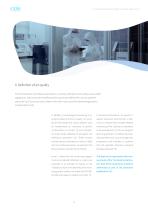
Air sampling at working height in aseptic cleanrooms II. Definition of air quality The concentration of airborne particles is a primary indicator of air quality across GMP regulations. Maximum permissible particle counts are defined for various particle sizes such as 0.5 µm per cubic meter of air, which are crucial for preventing product contamination [13]. In addition, microbiological monitoring is re- In the technical literature, “air quality” in quired to determine the air quality. For exam- aseptic cleanroom environments is defi- ple the FDA states that control systems must ned as a measure...
Open the catalog to page 4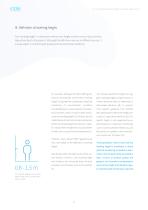
Air sampling at working height in aseptic cleanrooms III. Definition of working height The “working height” in cleanrooms refers to the height at which most critical activities take place close to the product. Although the definition may vary in different sources, it is a key aspect in monitoring air quality and environmental conditions. For example, although the FDA CGMP guide- The Chinese specialist Zhonglin Xu sug- lines do not explicitly use the term “working gest a working height in range of 0.8 to 1.5 height”, the guidelines contextually imply that meters above the floor, as referenced...
Open the catalog to page 5
Air sampling at working height in aseptic cleanrooms I. Technical perspective According to Annex 1 of the EU GMP guidelines, the air velocity in the breathing zone of personnel in cleanrooms must be measured at the working height. The breathing zone is defined as the immediate vicinity of the head and upper torso of the personnel. This is where the air inhaled and exhaled by personnel is most likely to be contaminated. In addition, this area of the room contains transfer openings, such as procedure gloves, rapid transfer ports (RTP) and production line doors, such as isolators or RABS (Restricted...
Open the catalog to page 6
Air sampling at working height in aseptic cleanrooms In the pursuit of achieving excellence in GMP In summary, the adoption of specified compliance and ensuring this integrity of air devices for traceable and reproducible air quality within cleanrooms, the importance sampling, such as floor stands and wall- especially of air sampling at the designated mounted holders, is integral to the relia- working height cannot be overstated. ble and precise monitoring of air quality at the working height. This practice is es- A preferred measurement height between1 sential not only for upholding GMP com-...
Open the catalog to page 7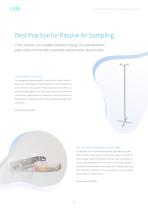
Air sampling at working height in aseptic cleanrooms Best Practice for Passive Air Sampling In this context, two notable solutions emerge: the sedimentation plate stand and the wall-mountable sedimentation plate holders. Sedimentation Plate Stand The equipment type exemplifies a typical floor stand utilized in passive air sampling, particularly effective in central cleanroom areas and near critical points. These stands facilitate GMP-compliant working heights for air sampling. However, considerations include their spatial footprint in cleanrooms and the potential for displacement or toppling,...
Open the catalog to page 8
Air sampling at working height in aseptic cleanrooms [1] International Organization for Standardization (ISO), 2015 ISO 14644-2:2015 Cleanrooms and associated controlled environments - Part 2: Monitoring to provide evidence of cleanroom performance related to air cleanliness by particle concentration, Section 4.3.5. [2] European Commission, 2022 EudraLex - The Rules Governing Medicinal Products in the European Union, Volume 4, Annex 1: Manufacture of Sterile Medicinal Products, Section 4.28. [3] European Commission, 2020 Draft Revision of Annex 1 of EudraLex Volume 4, Section 4.32. [4] Association...
Open the catalog to page 9