

Inion GTR™ Tack

Inion GTR™ Tack
The Inion GTR™ Biodegradable Tacks are designed for use with biodegradable membranes to secure them in place during surgical procedures. They are specifically indicated for periodontal defect treatments, pre-implant and peri-implant surgeries, and covering bone defects and empty sockets. Made from degradable copolymers, these tacks break down in the body into alpha-hydroxy acids, which are naturally metabolized.
Benefits
- Fast and easy application with a single-use or reusable Tack Applicator.
- The applicator features both angled and straight ends for easy access to surgical sites.
- Immediate placement after drilling, eliminating the need for sutures.
Product Information
- Biodegradable, eliminating the need for removal surgery.
- Retains approximately 80% of initial strength 8 weeks post-implantation.
- Made from safe, synthetic biomaterials.
Instructions for Use
1. Carefully open the dispenser to avoid dislodging tacks.
2. Attach the Tack to the Applicator by pressing firmly until a popping sound is heard.
3. Secure the membrane in position and drill through it into the bone.
4. Use the loaded Tack Applicator to press the tack into the hole, applying pressure to the head when using the angled end.
5. Slightly tilt the Applicator to release it.
Product Variants
- TCK-2011: Includes 4 tacks, 1 drill, and 1 single-use tack applicator.
- TCK-2013: Includes 4 tacks.
- INS-9051: Drill for tacks.
- INS-9052: Reusable tack applicator.
Contact Information
INION OY, Lääkärinkatu 2, FI-33520 Tampere, FINLAND
Tel: +358-10-830 6600, Fax: +358-10-830 6601, Email: [email protected]
INION INC, 2800 Glades Circle, Suite 138, Weston, FL 33327, USA
Toll-free Tel: 866-INION-US, Tel: 954-659-9224, Fax: 954-659-7997
Catalog excerpts
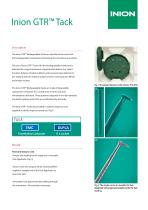
Inion GTR™ Tack Description The Inion GTR™ Biodegradable Tacks are intended to be used with the biodegradable membrane by fastening the membrane in position. The use of Inion GTR™ Tacks with the biodegradable membrane is indicated for surgical treatment of periodontal defects (e.g. class II furcation defects, intrabony defects and recession type defects), for pre-implant and peri-implant surgery and for covering bone defects and empty sockets. Fig. 1 The plastic dispenser with 4 Tacks, TCK-2013 The Inion GTR™ Biodegradable Tacks are made of degradable copolymers composed of L-Lactide acid, D-lactic acid, and trimethylene carbonate. These polymers degrade in vivo by hydrolysis into alpha-hydroxy acids that are metabolized by the body. The Inion GTR™ Tacks are provided in a plastic dispenser and supplied as sterile, single use products. (Fig.1) Tack TMC Trimethylene Carbonate Benefit Fast and easy to use -Simple Tack loading by the single use or reusable Tack Applicator (Fig. 2) -Easy to reach the surgical site by choosing either angled or straight end of the Tack Applicator to insert the Tack -Immediate Tack placement after drilling through the membrane - No suturing is necessary Fig. 2 The single use (a) or reusable (b) Tack Applicator with angled and straight end
Open the catalog to page 1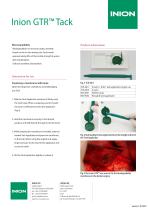
Inion GTR™ Tack Product information Biocompatibility -Biodegradable: no removal surgery needed; based on the in vitro testing, the Tacks retain approximately 80% of their initial strength 8 weeks after implantation -Safe and synthetic biomaterials Instruction for use Fastening a membrane with tacks Open the dispenser carefully to avoid dislodging 4 tacks, 1 drill, 1 tack applicator, single-use 4 tacks Drill for tacks Reusable tack applicator 1. Take the Tack Applicator and press it firmly onto (a) the Tack head. When a popping sound is heard, the tack is well fastened onto the Applicator (Fig.4)...
Open the catalog to page 2All Inion catalogs and technical brochures
 Inion Freedom™ Drill Taps
4 Pages
 Inion BioRestore™ Syringe
2 Pages
 Inion® ACL Instrument Set
8 Pages
 Inion S-2™ Surgical
18 Pages
 Inion OTPS™ Plating Sytem
8 Pages
 Inion FreedomPin™
4 Pages
 Inion S-1™ System
10 Pages
 Inion FreedomSystem
11 Pages


Archived catalogs
 Inion BioRestore™
8 Pages
- Bone plate
- Compression plate
- Orthopedic surgery instrument kit
- Distal compression plate
- Compression bone screw
- Drill bit
- Forearm compression plate
- Bone substitute
- General purpose compression bone screw
- Radius compression plate
- Cannulated compression bone screw
- Arthrodesis plate
- Non-locking compression plate
- Orthopedic surgery bone substitute
- Suture anchor
- Synthetic bone substitute
- Granules bone substitute
- Foot compression bone screw
- Cancellous compression bone screw
- Headless compression bone screw