
- Catalogs
- Innobiochips SAS
- lower carbon footprint

lower carbon footprint
1 /1Page
lower carbon footprint
1 /1Page
Catalog excerpts
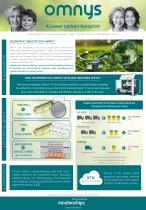
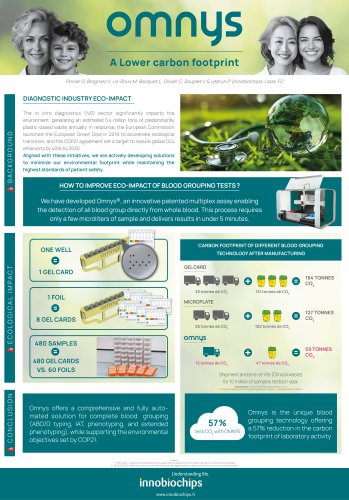
DIAGNOSTIC INDUSTRY ECO-IMPACT CONCLUSION ■ 'b ECOLOGICAL IMPACT ■ •* BACKGROUND The in vitro diagnostics (IVD) sector significantly impacts the environment, generating an estimated 5.4 million tons of predominantly plastic-based waste annually. In response, the European Commission launched the European Green Deal in 2019 to accelerate ecological transition, and the COP21 agreement set a target to reduce global CO2 emissions by 40% by 2030. Aligned with these initiatives, we are actively developing solutions to minimize our environmental footprint while maintaining the highest standards of patient safety. HOWTO IMPROVE ECO-IMPACT OF BLOOD GROUPING TESTS? We have developed Omnys®, an innovative patented multiplex assay enabling the detection of all blood group directly from whole blood. This process requires only a few microliters of sample and delivers results in under 5 minutes. CARBON FOOTPRINT OF DIFFERENT BLOOD GROUPING TECHNOLOGY AFTER MANUFACTURING Shipment and end-of-life (Clinical waste) for 10 million of samples tested / year. Assumptions: 1 ton of DASRI generates 934kg of C02 1.8 tons of material to be transported generates 421g/km - average distance 1000 km Omnys offers a comprehensive and fully automated solution for complete blood grouping (ABO/D typing, IAT, phenotyping, and extended phenotyping), while supporting the environmental objectives set by COP21. Omnys is the unique blood grouping technology offering a 57% reduction in the carbon footprint of laboratory activity 1: FR2405844 : Dispositif et procede de centrifugation pour la detection de microparticules dans un echantillon biologique 2 : WO2021156391: Method for capturing and identifying cellular agglutinates for detecting multiplex anti-erythrocyte antibodies Understanding life.
Open the catalog to page 1All Innobiochips SAS catalogs and technical brochures
 omnys analyzer
1 Page
 omnys results example
1 Page
 Omnys ecosystem
4 Pages
 Omnys
4 Pages
- Detection kit
- Blood detection kit
- Analysis software
- Control software
- Reporting software
- Laboratory software
- Antigen detection kit
- Research detection kit
- Traceability software
- Data management software
- Recording software
- Server-based software
- Image analysis software
- Data analysis software
- Research software
- Quality control software
- Medical research detection kit
- Emergency software
- Doctor's office software
- Data logging software