

Inogen One vs. Continuous Flow
Inogen One vs. Continuous Flow
Continuous flow (CF) oxygen therapy is commonly used for long-term oxygen therapy (LTOT) patients. However, studies indicate that 30-50% of these patients experience clinically significant nocturnal desaturation, even when well-managed during the day. The American Thoracic Society recommends increasing nighttime CF oxygen flows by 1 lpm to counteract decreased minute ventilation during sleep.
Pulse Dose Oxygen Delivery (PDOD)
PDOD is an alternative to CF, delivering oxygen in response to the patient's breathing pattern. It adjusts the oxygen bolus based on respiratory rate, potentially providing more effective nocturnal oxygenation than CF. The Inogen One devices are designed to deliver oxygen efficiently during the first two-thirds of the inspiratory cycle, minimizing waste in anatomical dead space.
Inogen One Technology
The Inogen One devices, including the G2 and G3 models, are designed for use during all activities, including sleep. They feature high sensitivity to detect breaths and adjust bolus size during sleep when respiratory rates decrease. This ensures adequate oxygen delivery despite changes in breathing patterns.
Clinical Studies and Efficacy
Several studies have demonstrated the clinical efficacy of PDOD systems like the Inogen One. These studies show that PDOD can maintain equivalent oxygen saturation levels compared to CF during various activities, including sleep. The Inogen One has been validated through numerous clinical studies, making it a reliable choice for LTOT patients.
Specifications and Features
The Inogen One G2 and G3 are lightweight, portable oxygen concentrators with adjustable flow settings. They are designed for continuous use, including travel, and are approved for use on airlines. The devices offer simple controls, an easy-to-read display, and flexible power options for convenience.
Catalog excerpts

Up to 50% of continuous flow oxygen therapy patients experience clinically significant nocturnal desaturation. 1
Open the catalog to page 1
Continuous Flow Oxygen Delivery & Sleep A number of theories and studies are published surrounding long term oxygen therapy (LTOT) during sleep. Many LTOT patients have been shown to experience clinically significant nocturnal desaturation. This holds true even for some LTOT users considered well managed on their prescribed LTOT setting while awake. While continous flow (CF) may have been traditionally seen as standard practice, it is not without flaws. Scientific data has revealed 30-50% of CF patients experience clinically significant desaturation during sleep1 ; not a great track record for...
Open the catalog to page 2
Evolution of Oxygen Delivery Pulse dose oxygen delivery (PDOD) is a logical extension and application of low flow oxygen delivery. Although prescriptions are typically written in liters per minute (1 lpm), all low flow oxygen devices actually deliver a volume of oxygen to the patient. The volume of oxygen delivered is simply a result of the fixed flow of the gas over time. As an example, a patient prescribed 2 lpm of oxygen via nasal cannula does not actually inspire 2 full liters of oxygen. The net volume of the inspired oxygen delivered to a patient over the course of a minute is a product...
Open the catalog to page 3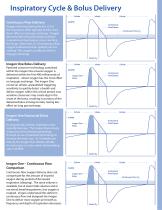
Inspiratory Cycle & Bolus Delivery Exhale Continuous Flow Delivery 20 BPM Anatomical Dead Space Oxygen delivered during the first 2/3 of the inspiratory effort typically has the most direct affect on lung gas exchange. Oxygen delivered after this point tends to remain in anatomical dead spaces, never reaching the lungs. More than 2/3 of continuous flow oxygen is delivered when patients are not inhaling. This oxygen contributes little to lung gas exchange. Inogen One Bolus Delivery Patented conserver technology contained within the Inogen One ensures oxygen is delivered within the first 400 milliseconds...
Open the catalog to page 4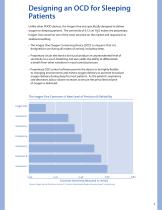
Designing an OCD for Sleeping Patients Unlike other PDOD devices, the Inogen One was specifically designed to deliver oxygen to sleeping patients. The sensitivity of 0.12 cm H2O makes the proprietary Inogen One conserver one of the most sensitive on the market and responsive to shallow breathing. • The Inogen One Oxygen Conserving Device (OCD) is unique in that it is designed for use during all modes of activity, including sleep. • Proprietary circuit electronics don’t just produce an unprecedented level of sensitivity to a user’s breathing, but also yields the ability to differentiate a breath...
Open the catalog to page 5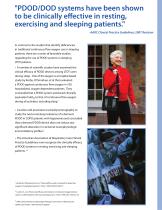
"PDOD/DOD systems have been shown to be clinically effective in resting, exercising and sleeping patients." -AARC Clinical Practice Guidelines; 2007 Revision In contrast to the studies that identify deficiencies in traditional continuous flow oxygen use in sleeping patients, there are a series of favorable studies regarding the use of PDOD systems in sleeping LTOT patients. • A number of scientific studies have examined the clinical efficacy of PDOD devices among LTOT users during sleep. One of the largest is a hospital based study by Kerby, O’Donahue, et al that evaluated a PDOD against continuous...
Open the catalog to page 6
Inogen has completed and published more clinical data surrounding the Inogen One than any other available oxygen therapy product. Inogen Specific Research 1. Stegmaier JP. Chatburn RL, Lewarski JS. “Determination of an Appropriate Nocturnal Setting for a Portable Oxygen Concentrator with Pulsed-Dosed Delivery.” Abstract. Respir Care November 2006;51(11): 1305. Summary: The purpose of this study was to determine if a single titration of oxygen using a POC during ambulation/exercise would provide an appropriate setting for nocturnal use. The results suggested that an oxygen setting selection based...
Open the catalog to page 7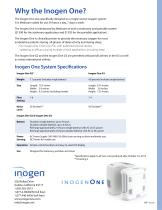
Why the Inogen One? The Inogen One was specifically designed as a single-source oxygen system. It is Medicare coded for use 24 hours a day, 7 days a week. The Inogen One is reimbursed by Medicare as both a stationary and portable system (E1390 for the stationary application and E1392 for the portable application). The Inogen One is clinically proven to provide the necessary oxygen for most ambulatory patients during all phases of daily activity and during sleep. • The Inogen One is the only POC with published clinical studies validating its efficacy during multiple clinical applications, including...
Open the catalog to page 8All Inogen catalogs and technical brochures
 Inogen One G2 Single Sheet
2 Pages
 Inogen One G2 Brochure
9 Pages