

Isis

Isis
The device measures 22.0 cm in width, 13.0 cm in depth, and 29.0 cm in height, weighing 2.90 kg. It features an internal rechargeable Li-ion battery with a 14.4 Vdc 4.0 A/h capacity, lasting 10 hours in cardiac rhythm recognition mode or delivering at least 200 shocks at 200 Joules. The battery takes 5 hours to fully charge and is powered by a 100-240V/50-60Hz supply. Long-term storage above 35ºC can reduce battery life. Defibrillation scales are preset at 150 J for adults and 50 J for children. The device stores 100 events or 2 hours of ECG records and operates continuously with a maximum rhythm analysis time of 20 seconds.
The operational temperature range is 0 to 50ºC, and storage is 0 to 70ºC. Humidity levels for both operation and storage range from 10 to 95% RH without condensation.
The device uses a biphasic truncated exponential waveform, with shock application via multifunctional adhesive pads. It features automatic adult/child selection based on pad type and automatic charge command upon arrhythmia detection. Maximum charging times are under 6 seconds for 200 Joules. The maximum output voltage is 1500 V, and the current is 60 A at 25 ohms.
The device complies with several standards, including NBR IEC 60601-1, EN 60601-1, and ANSI/AAMI DF80, ensuring safety and electromagnetic compatibility.
The AED ISIS operates with a single button, providing voice-guided instructions for diagnosis and shock application. It features a self-explanatory panel with visual indicators, artificial intelligence for accurate diagnosis, and a minimum of 200 shocks capability. The device is portable, reliable, and resistant to falls, with event recording and PC connectivity for data management.
Catalog excerpts
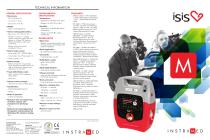
TECHNICAL INFORMATION GENERAL SPECIFICATIONS • imensions: D ENVIRONMENTAL SPECIFICATIONS • emperature: T • nternal rechargeable battery: I - - Type: Li-ion, 14.4 Vdc 4.0 A/h. - - Duration: 10 hours in cardiac rhythm recognition mode (full load battery) or at least 200 shocks in 200 Joules (battery under good conditions). - - Battery full load time (fully unloaded): 5 hours. • attery loader source: B -- Power supply 100 – 240V/50-60Hz. -- Consumption (max.): Power supply 1 A. -- Output: 24 Vdc, 1.5 A. -- Operational: 10 to 95% RH, without condensation. -- Storage: 10 to 95% RH, without condensation. DEFIBRILLATOR • ave form: W -- Biphasic truncated exponential. wave form parameters set according to the patient’s impedance. • hock application: S -- By multifunctional adhesive pads. • ommands: C -- Front Panel button (on/off). • attery storage: B - - Battery storage for long periods under temperatures above 35ºC will reduce the battery’s capacity and abbreviate its useful life. • reset defibrillation scales: P -- Adult: 1st shock 150 J, subsequent shocks 200 J. -- Child: 50 J. • nternal memory storage: I -- 100 events or 2 hours of ECG record. • lassification: C -- Internal Energized Equipment. -- CF type. • dult/Child Selection: A -- Automatic by the type of pads. • harge command: C -- Automatic after identifying arrhythmias that should receive shock. • hock command: S -- Front Panel button, when blinking. • aximum charging time: M -- 50 Joules: < 2 seconds -- 150 Joules: < 4 seconds -- 200 Joules: < 6 seconds -- Continuous Operation. • aximum time since beginning M of rhythm analysis until promptness for discharge: • aximum output voltage: M -- 1500 V • aximum time since beginning of M the operation until promptness for discharge at the maximum energy: • aximum output current: M STANDARDS -- NBR IEC 60601-1:1997 (IEC606011:1995), Medical Electrical Equipment – Part 1 – General Requirements for Safety. -- EN 60601-1:1990, (Amendment, A1:1993, A2:1995, A13:1996) (IEC 60601-1:1988, A1:1991, A2:1995), Medical electrical equipment - Part 1 General Requirements for Safety. -- NBR IEC 60601-1-2:2006 (IEC60601-1-2:2004), Medical Electrical Equipment – Part 1-2 – General Requirements for Safety: Collateral Standard: Electromagnetic Compatibility – Requirements and Tests. -- EN 60601-1-2:2007 (IEC 60601-12:2007), Medical electrical equipment. General requirements for basic safety and essential performance Collateral standard: Electromagnetic compatibility - Requirements and tests. -- ABNT NBR IEC 60601-1-4:2004 (IEC 60601-1-4:2000) Medical Electric Equipment - Part 1-4: General Requirements for Safety: Collateral Standard: Programmable electrical medical systems. -- IEC 60601-1-4:2000 - Medical electrical equipment - Part 1-4: General requirements for safety Collateral standard: Programmable electrical medical systems. -- NBR IEC 60601-2-4:2005 (IEC606012-4:2002), Medical Electrical Equipment - Part 2 - Particular requirements for the safety of Cardiac Defibrillators. -- EN 60601-2-4:2003 (IEC 60601-24:2002), Medical electrical equipment. Particular requirements for safety. Particular requirements for the safety of cardiac defibrillators. -- ANSI/AAMI DF80:2003: Particular requirements for the safety of cardiac defibrillators (including automated external defibrillators). -- NBR IEC/CISP . Instramed Ltda. Rua Beco José Paris, 339 Pavilhão 19 CEP 91140-310 Porto Alegre RS Brasil Phone: +55 (51) 3073 8200 European Representative: Obelis S.A. Bd. Général Wahis 53, 1030 Brussels Belgium Phone: + 32.2.732.59.
Open the catalog to page 1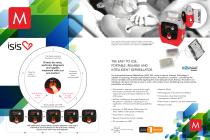
Acts in case of cardiac arrest (ventricular fibrillation and ventricular tachycardia), by voice direction, diagnosis and by automatic and safe application of shock treatment upon activation of a single button. 3 The device evaluates the patient’s condition Place the pads on the patient Directs by voice, performs diagnosis and applies BPM 080 RCP 00:47 treatment with just Coloque as pás no onepaciente. button! tórax do SIGA AS INSTRUÇÕES: The Automated External Defibrillator (AED) ISIS, using its Neural Network Technology is capable of assessing, through sophisticated sensors, the patient’s condition,...
Open the catalog to page 2All Instramed Indústria Médico Hospitalar catalogs and technical brochures
 DUALMAX
4 Pages
 I.on/I.on PRO
4 Pages
 Helios
3 Pages
 eazy-pro
3 Pages
 isis-pro
3 Pages
 eazy
eazy3 Pages
 isis - 2017
3 Pages
 cardiomax
3 Pages
 InMax
InMax2 Pages

Archived catalogs
 CardioMax - M
2 Pages
 ISIS - 2013
2 Pages
- Automatic external defibrillator
- Biphasic external defibrillator
- External defibrillator with monitor
- Semi-automatic external defibrillator
- Holter ECG
- External defibrillator with ECG monitor
- Manual external defibrillator
- 3-channel Holter monitor
- External defibrillator with multi-parameter monitor
- External defibrillator with USB port
- External defibrillator with touchscreen
- Bluetooth external defibrillator
- Waterproof external defibrillator
- Emergency vehicle external defibrillator
- Electric external defibrillator
- Ambulance external defibrillator
- External defibrillator with audible signal
- External defibrillator with CPR help
- External defibrillator with SpO2 monitor