- Catalogs
- Intan Technologies
- RHD2000 series digital electrophysiology interface chip datasheet

RHD2000 series digital electrophysiology interface chip datasheet

RHD2000 series digital electrophysiology interface chip datasheet
Overview: The RHD2000 series by Intan Technologies consists of digital electrophysiology interface chips designed for low-power biopotential monitoring. These chips integrate amplifiers, ADCs, and SPI interfaces, suitable for applications such as neural recording and portable EKG systems.
Features: The chips include a 16-bit ADC with a sampling rate of up to 1.05 MSamples/s, supporting 32 channels at 30 kSamples/s each. They offer low input-referred noise (2.4 µVrms) and adjustable bandwidths. Additional features include electrode impedance measurement, optional DSP high-pass filters, and auxiliary ADC inputs.
Applications: Ideal for miniaturized headstages, wireless electrophysiology experiments, in vitro recording systems, and advanced prosthetic limb controllers.
Chip Variants: The series includes RHD2216, RHD2132, and RHD2164, differing in the number of amplifier inputs and configurations.
Technical Specifications: Operate at a supply voltage of 3.2V to 3.6V, with a nominal voltage of 3.3V. They feature a CMOS or LVDS SPI interface, with specific input and output impedance specifications.
Performance: Demonstrates low noise and minimal crosstalk, with high linearity in signal measurement. Available in 8mm x 8mm QFN packages or as bare die.
Measured Performance Characteristics: Low noise levels in biopotential measurements, effective EKG and EMG signal recording, and neural signal recording capabilities.
Digital Signaling Modes: Utilizes SPI bus communication, supporting both CMOS and LVDS signaling, with LVDS offering reduced noise and power dissipation.
SPI Bus Signals and Timing: Communicates using a four-signal SPI interface, with specific timing specifications for optimal operation.
Command Execution and On-Chip Registers: Details on command execution, calibration, and register configuration, including ADC and amplifier settings.
Key Parameters and Recommendations: Emphasizes proper initialization, register content maintenance, and power optimization.
Impedance Check and Amplifier Bandwidth: Provides configurations for impedance testing and bandwidth settings using on-chip registers.
Supply Voltage Levels and 3.0V Operation: Requires a regulated voltage supply, with specific considerations for 3.0V operation.
ADC Sampling and Configuration: Details on ADC operation and configuration, including voltage reference and capacitor requirements.
Electrode Impedance Testing and Activation: Built-in circuitry for impedance measurement and electrode activation.
Temperature and Supply Voltage Sensors: Includes a temperature sensor and supply voltage measurement capabilities.
Auxiliary ADC Inputs and Digital Output: Provides auxiliary ADC inputs and a user-programmable digital output.
DSP High-Pass Filter and Absolute Value Mode: Features for removing DC offset and outputting absolute values of signals.
Power Dissipation and SPI Command Sequences: Guidelines for estimating power consumption and maintaining steady sampling rates.
Circuit Board Design: Recommendations for PCB design, including layer specifications and capacitor placement.
Specifications and Recommendations: Details on signaling, PCB layout, package dimensions, and legal disclaimers.
Document Revision History: Initial release and subsequent updates with additional information.
Catalog excerpts
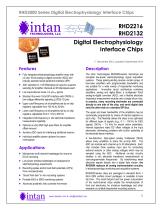
RHD2000 Series Digital Electrophysiology Interface Chips Digital Electrophysiology Interface Chips 11 December 2012; updated 5 September 2013 ♦ Fully integrated electrophysiology amplifier array with on-chip 16-bit analog-to-digital converter (ADC) and industry-standard serial peripheral interface (SPI) ♦ ADC operation to 1.05 MSamples per second; supports sampling 32 amplifier channels at 30 kSamples/s each ♦ Low input-referred noise: 2.4 pVrms typical ♦ Standard four-wire 16-bit SPI interface with CMOS or low-voltage differential signaling (LVDS) I/O pins ♦ Upper cutoff frequency of all amplifiers set by on-chip registers; adjustable from 100 Hz to 20 kHz ♦ Lower cutoff frequency of all amplifiers set by on-chip registers; adjustable from 0.1 Hz to 500 Hz ♦ Integrated multi-frequency in situ electrode impedance measurement capability ♦ Optional on-chip DSP high-pass filters for amplifier offset removal ♦ Auxiliary ADC inputs for interfacing additional sensors. ♦ Individual amplifier power up/down for power minimization Applications ♦ Miniaturized multi-channel headstages for neural or ECoG recording ♦ Low-power wireless headstages or backpacks for electrophysiology experiments ♦ Recording spikes and/or local field potentials (LFPs) from microelectrodes ♦ “Smart Petri dish” in vitro recording systems ♦ Portable EKG or EMG monitoring systems ♦ Advanced prosthetic limb controller front-ends The Intan Technologies RHD2000-series microchips are complete low-power electrophysiology signal acquisition systems. These patent-pending devices contain arrays of low-noise amplifiers with programmable bandwidths and are suitable for a wide variety of biopotential monitoring applications. Innovative circuit architecture combines amplifiers, analog and digital filters, a multiplexed 16-bit analog-to-digital converter (ADC), and a flexible electrode impedance measurement module onto a single silicon chip. In practice, many recording electrodes are connected directly to one side of the chip, and serial digital data exits the other side on a standard SPI bus. The upper and lower bandwidths of the amplifiers may be dynamically programmed by means of internal registers on each chip. This flexibility allows the chips to be optimized for different types of signals (e.g., 0.1 - 100 Hz for EKG signals, 250 Hz - 7.5 kHz for neural action potentials). Internal capacitors reject DC offset voltages at the input electrodes, eliminating problems with built-in potentials at the electrode-tissue interface. A low-distortion, high-speed analog multiplexer (MUX) allows many amplifiers to share the on-chip ADC. The ADC can sample each channel up to 30 kSamples/s. Each chip includes three auxiliary input pins for connecting external sensors or other analog voltages which may be sampled using the ADC. Additional on-chip circuitry enables in situ electrode impedance measurements at user-programmable frequencies. By transforming weak electrode signals directly into a digital data stream, the RHD2000 replaces all analog instrumentation circuitry in electrophysiology monitoring and acquisition systems. RHD2000-series chips are packaged in standard 8mm x 8mm QFN surface mount packages, or available in bare die form. The small footprint and low power consumption of the multi-channel chips enable the miniaturization of front end electronics for miniature headstages and other wearable or portable biopotential recording systems. www.intantech.com • [email protected] intan TECHNO
Open the catalog to page 1
Simplified Chip Diagrams RHD2000-SERIES FAMILY There are three devices in the RHD2000-series electrophysiology interface family: the RHD2216 and RHD2132, which are described in this datasheet, and the RHD2164 which is described in its own datasheet available on the Intan Technologies website. The following table lists the features of these chips: The positive and negative amplifier inputs on the RHD2216 have balanced input impedances; this will provide the best rejection of common-mode noise (most commonly, 50/60 Hz interference) if all electrodes, including reference electrodes, are roughly...
Open the catalog to page 2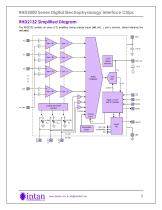
RHD2000 Series Digital Electrophysiology Interface Chips RHD2132 Simplified Diagram The RHD2132 contains an array of 32 amplifiers having unipolar inputs (in0, in1,…) and a common, shared reference line (ref_elec).
Open the catalog to page 3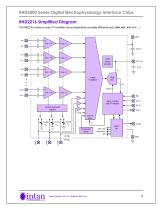
The RHD2216 contains an array of 16 amplifiers having independently accessible differential inputs (in0+, in0—, in1+, ini-,...). analog multiplexer digital controller with SPI interface amplifier bandwidth selection HEI CS SCLK —MOSI MISO temperature sensor misc. chip conliquralian bits reqister tile www.intantech.com • [email protected]
Open the catalog to page 4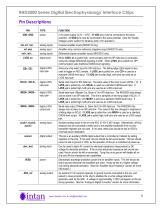
RHD2000 Series Digital Electrophysiology Interface Chips www.intantech.com • [email protected]
Open the catalog to page 5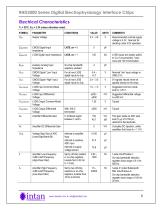
RHD2000 Series Digital Electrophysiology Interface Chips Electrical Characteristics Ta = 25°C, Vdd = 3.3V unless otherwise noted. www.intantech.com • [email protected]
Open the catalog to page 6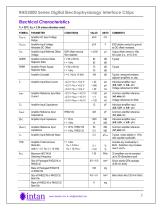
Ta = 25°C, Vdd = 3.3V unless otherwise noted. www.intantech.com • [email protected]
Open the catalog to page 7
RHD2000 Series Digital Electrophysiology Interface Chips Measured Performance Characteristics SAMPLING AMPLIFIERS WITH ON-CHIP ADC Figure 1. Measurement of ±5.0 mV, 100 Hz triangle wave on amplifier channel 1 with ADC running at 30 kS/s per channel, showing large-signal linearity. Amplifier channel 2, also shown, is grounded, showing low noise and lack of crosstalk. Figure 2. Measurement of ±350 µV, 100 Hz triangle wave on amplifier channel 1 with ADC running at 30 kS/s per channel, showing large-signal linearity. Amplifier channel 2, also shown, is grounded, showing low noise and lack of crosstalk....
Open the catalog to page 8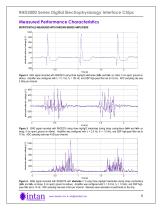
RHD2000 Series Digital Electrophysiology Interface Chips Measured Performance Characteristics BIOPOTENTIALS MEASURED WITH RHD2000-SERIES AMPLIFIERS Figure 4. EKG signal recorded with RHD2216 using three Ag/AgCl electrodes (in0+ and in0– on chest, 5 cm apart; ground on elbow). Amplifier was configured with fL = 0.1 Hz, fH = 100 Hz, and DSP high-pass filter set to 0.6 Hz. ADC sampling rate was 2 kS/s per channel. Figure 5. EMG signal recorded with RHD2216 using three Ag/AgCl electrodes during bicep contractions (in0+ and in0– on bicep, 5 cm apart; ground on elbow). Amplifier was configured with...
Open the catalog to page 9