
- Catalogs
- Integra LifeSciences
- capture high-torque surgical

capture high-torque surgical

capture high-torque surgical
The Integra® Capture™ High-Torque Cannulated Screw System is designed for orthopedic surgeries, specifically for the midfoot and rearfoot. It features self-drilling and self-tapping titanium screws in sizes 4.0, 5.0, and 7.0 mm, ensuring ease of insertion and biocompatibility.
Indications for Use
This system is intended for fracture fixation in long and small bones, arthrodesis of the foot, wrist, and elbow, and osteotomies.
Contraindications
It is not suitable for spinal fixation or in cases of active infection, insufficient bone quality, or conditions that impede healing. It is also contraindicated for patients with foreign body sensitivity or certain tumors.
System Features and Benefits
The system includes partially threaded lag screws for compression, quadruple cutting flutes to eliminate pre-drilling, and optional washers to prevent subsidence in osteopenic bone. The screws are designed for optimal interfragmentary compression.
Surgical Techniques
4.0/5.0 mm Screws:
- Step 1: Debride articular cartilage to expose subchondral bone.
- Step 2: Insert guide pin using a sleeve and confirm with fluoroscopy.
- Step 3: Use a countersink/depth gauge to determine screw length.
- Step 4: Optional drill and tap for dense bone.
- Step 5: Insert screw using a hex driver, confirm with fluoroscopy.
- Step 1: Similar to 4.0/5.0 mm technique.
- Step 2: Use a 3.2 mm guide wire and confirm with fluoroscopy.
- Step 3: Determine screw size using a depth gauge.
- Step 4: Optional drill and tap based on bone quality.
- Step 5: Insert screw with a Torx driver, confirm placement.
Instrument Cleaning
Maintain clean cannulation using a cleaning stylet to prevent instrument malfunction.
Essential Product Information
Implants should not be reused and must be handled carefully to avoid defects. Proper implant selection and postoperative care are crucial to prevent implant failure due to metal fatigue. The implants guide normal healing and are not substitutes for normal body structure.
Specifications and Usage Instructions
The document emphasizes the importance of external support and restricted physical activity until firm bone union is achieved. Patients should be informed about device use and limitations, with warnings about potential complications like bending or breakage if partial weight bearing is required before bone union.
Implant Removal
Surgeons are advised to remove fixation devices once they have served their purpose, especially in younger, more active patients.
Imaging Considerations
The Cannulated Screw System may affect MR imaging quality depending on the pulse sequence used.
Components and Tools
The document lists components and tools included in the 4.0/5.0 mm and 7.0 mm Screw Caddy and Instrument Trays, such as high-torque cannulated screws, washers, guidewires, drivers, taps, drills, and removal tools.
Product Catalog
A detailed catalog of cannulated screws and associated instrumentation is provided, with specific catalog numbers for different sizes and types of screws and washers.
Manufacturer and Contact Information
Contact information for Integra LifeSciences Corporation is provided, including phone numbers and a website for further inquiries or orders. Product availability may vary by region due to local regulatory requirements.
Legal and Regulatory Notices
The document includes warnings about the sale of these products being restricted to physicians and advises consulting product labels and inserts for detailed instructions and warnings.
Catalog excerpts
Integra® Capture™ 4.0/5.0/7.0 mm High-Torque Cannulated Screw System SURGICAL TECHNIQUE
Open the catalog to page 1
The Cannulated Screw System is intended for the following: Fixation of fractures in long bones Fixation of small bones, including but not limited to, those in the foot, patella, ankle, wrist and elbow Arthrodesis of the foot, wrist and elbow Small and long bone osteotomies Contraindications • Not indicated for fixation to the posterior elements of the cervical, thoracic or lumbar spine. • Screws are contraindicated in: active infection, conditions which tend to retard healing such as blood supply limitations, previous infections, insufficient quantity or quality of bone to permit stabilization...
Open the catalog to page 3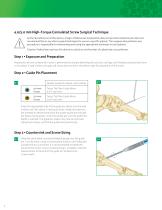
4.0/5.0 mm High-Torque Cannulated Screw Surgical Technique As the manufacturer of this device, Integra LifeSciences Corporation does not practice medicine and does not recommend this or any other surgical technique for use on a specific patient. The surgeon who performs any procedure is responsible for determining and using the appropriate technique in each patient. Caution: Federal law restricts this device to sale by or on the order of a physician or practitioner. Step 1 • Exposure and Preparation Preparation of joint surfaces for fusion is performed by sharply debriding the articular cartilage...
Open the catalog to page 4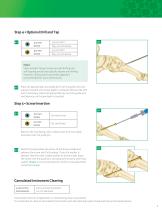
Step 4 • Optional Drill and Tap 4-1 2.8 mm Drill Tap, 4.0 mm Screw 3.6 mm Drill Tap, 5.0 mm Screw Note: Capture High-Torque Screws are self-drilling and self-tapping and do not typically require pre-drilling. However, drilling and occasionally tapping is recommended for use in dense bone. 4-2 Place the appropriate cannulated drill over the guide wire and advance the drill until screw depth is achieved. Remove the drill and, if necessary, place the appropriate tap over the guide wire and advance until screw depth is reached. Step 5 • Screw Insertion 5-1 5-1 Remove the correlating color-coded screw...
Open the catalog to page 5
7.0 mm High-Torque Cannulated Screw Surgical Technique As the manufacturer of this device, Integra LifeSciences Corporation does not practice medicine and does not recommend this or any other surgical technique for use on a specific patient. The surgeon who performs any procedure is responsible for determining and using the appropriate technique in each patient. Caution: Federal law restricts this device to sale by or on the order of a physician or practitioner. Introduction Capture 7.0 mm High-Torque Cannulated Screws are available in short and long distal thread lengths from sizes 80-120 mm....
Open the catalog to page 6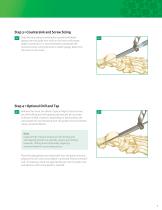
Step 3 •Countersink and Screw Sizing 3-1 Slide the cannulated combination countersink/depth gauge over the guide wire and turn by hand until proper depth is achieved. It is recommended to penetrate the proximal cortex. Using the built-in depth gauge, determine the correct size screw. Step 4 • Optional Drill and Tap 4-1 Remove the trocar pin sleeve. Capture High-Torque screws are self-drilling and self-tapping and typically do not need to be pre-drilled. However, depending on bone quality, the cannulated drill can be placed over the guide wire and inserted using a powered device. Note: Capture...
Open the catalog to page 7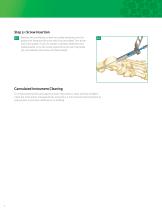
Step 5 • Screw Insertion 5-1 Remove the correlating screw from caddy and place over the guide wire. Advance the screw with the cannulated Torx driver until fully seated. If use of a washer is desired, slide the colorcoded washer on to the screw, place the screw over the guide pin, and advance the screw until fully seated. Cannulated Instrument Cleaning It is important that the cannulation of each instrument is clean and free of debris. Clean the instruments intraoperatively using the 3.2 mm Cannula Cleaning Stylet to help prevent instrument malfunction or binding.
Open the catalog to page 8
Essential Product Information Warnings and Precautions • No metallic surgical implant should be reused. Any metal implant, once used, should be discarded. Even though it appears undamaged, it may already have small defects and internal stress patterns which may lead to fatigue failure. • Correct handling of implant is extremely important. Avoid contouring metallic implants whenever possible. If necessary, or allowed by design, the device should not be bent sharply, reverse bent, notched or scratched. All of these operations can produce defects in the surface finish and internal stress concentrations,...
Open the catalog to page 9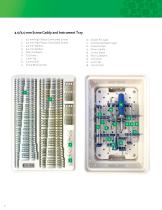
4.0 mm High-Torque Cannulated Screws 5.0 mm High-Torque Cannulated Screws 4.0 mm Washers 5.0 mm Washers Plain Guidewire T25 Driver 5 mm Tap 3.6 mm Drill Screw Removal Tool Double Pin Gage Countersink/Depth Gage Screw Forceps Driver Handle 1.6 mm Stylet Plain Guidewire T20 Driver 4 mm Tap 2.8 mm Drill
Open the catalog to page 10
7.0 mm High-Torque Cannulated Screws 7.0 mm Washers Tissue Protector Trocar Screw Removal Tool Trocar Pin Sleeve 5.2 mm Drill T40 Driver Countersink/Depth Gage Threaded Guidewire Plain Guidewire 3.2 mm Stylet Screw Forceps Tap Rachet Handle
Open the catalog to page 11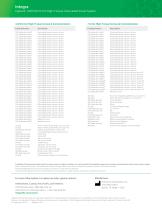
Capture™ 4.0/5.0/7.0 mm High-Torque Cannulated Screw System 4.0/5.0 mm High-Torque Screws & Instrumentation 7.0 mm High-Torque Screws & Instrumentation Catalog Number Catalog Number Cannulated Screw, 5.0 mm x 20 mm Cannulated Screw, 5.0 mm x 22 mm Cannulated Screw, 5.0 mm x 24 mm Cannulated Screw, 5.0 mm x 26 mm Cannulated Screw, 5.0 mm x 28 mm Cannulated Screw, 5.0 mm x 30 mm Cannulated Screw, 5.0 mm x 32 mm Cannulated Screw, 5.0 mm x 34 mm Cannulated Screw, 5.0 mm x 36 mm Cannulated Screw, 5.0 mm x 38 mm Cannulated Screw, 5.0 mm x 40 mm Cannulated Screw, 5.0 mm x 42 mm Cannulated Screw, 5.0...
Open the catalog to page 12All Integra LifeSciences catalogs and technical brochures
 cadence
4 Pages
 DuraGen® Secure
8 Pages
 transducer
2 Pages
 MAYFIELD®
12 Pages
 SurgiMend® Hernia Brochure
8 Pages
 AmnioExcel® OR Sell Sheet
2 Pages
 PyroCarbon Implants
8 Pages
 Wrist Solutions
6 Pages
 Lower Extremity Reconstruction
28 Pages
 Integra® Lighting Solutions
4 Pages
 Integra® CUSA® Excel+
1 Page
 CUSA® Excel+ System
4 Pages
 DuraGen® matrix
2 Pages
 SurgiMend®
6 Pages
 Integra® Tissue Technologies
8 Pages
 DIABETIC SKIN ULCER
16 Pages
 Auragen™ Cortical Electrodes
4 Pages
 DuraGen XS
2 Pages
 Suturable DuraGen™
4 Pages


Archived catalogs
 MAYFIELD® 2
3 Pages
 DuraGen Plus
4 Pages
 Hermetic Plus™
2 Pages
 AccuDrain™
4 Pages
 Oral Surgery
107 Pages
 Catalog - Endodontics
110 Pages
 Catalog - Cassette
36 Pages
 Brochure - Liberator
6 Pages
 Integra® Licox®
2 Pages
 CUSA Excel+
8 Pages
 Pain Management Procedure Trays
26 Pages
 Jarit Sterilization System
11 Pages
 Integra® Camino® Flex
6 Pages
 Camino
10 Pages
 Catalog - Precision Dental
28 Pages
 LICOX
LICOX4 Pages
 Integra Miltex
663 Pages
 Integra VATS
28 Pages
 Cardiovascular
285 Pages
 Padgett
322 Pages
 Integra Podiatry
130 Pages
 Integra Jarit
916 Pages
 Integra Laparoscopic
90 Pages
 Extremity-Reconstructive Surgery
87 Pages
 Integra Ruggles Redmond
242 Pages
 Stereotaxy
28 Pages
 CUSA NXT/Selector
8 Pages
 Neuro Operating Room
177 Pages
 CUSA EXcel
12 Pages
 Neuromonitoring
76 Pages
 MediHoney® Brochure
9 Pages


- Surgery forceps
- Grasping forceps
- Stainless steel forceps
- Retractor
- Reusable forceps
- Electrosurgical forceps
- Surgical retractor
- Tissue grasping forceps
- Curette
- Bipolar forceps
- Ablation forceps
- Headrest
- Stainless steel retractor
- Bayonet forceps
- Veterinary instrument kit
- Operating table headrest
- Micro forceps
- Grasping micro forceps
- Surgery micro forceps
- Spinal retractor