
- Catalogs
- Integra LifeSciences
- Hernia Clinical Classification Scale

Hernia Clinical Classification Scale

Hernia Clinical Classification Scale
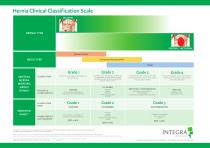
The modified Ventral Hernia Working Group (VHWG) classification system, developed in 2012, aims to predict surgical site occurrences (SSO) after open ventral hernia repair. SSOs include infections, seromas, wound dehiscence, or enterocutaneous fistula formation.
The classification considers different types of mesh materials: Permanent Synthetic, Resorbable Synthetic (Biosynthetic), and Biologic.
- Grade 1: Choice of repair material depends on surgeon and patient factors.
- Grade 2: Increased SSO risk suggests a potential advantage for biologic reinforcement over permanent synthetic materials.
- Grade 3: Permanent synthetic materials are generally not recommended; biologic repair materials may be advantageous.
- Grade 4: Permanent synthetic materials are not recommended; biologic repair materials should be considered.
- Low Risk: Low complication risk, no history of wound infection.
- Co-Morbid: Includes smokers, obese, diabetic, immunosuppressed, or COPD patients.
- Potentially Contaminated: Previous wound infection, stoma presence, or gastrointestinal tract violation.
- Infected: Infected mesh or septic dehiscence.
- Grade 1: Low risk with 14% SSO incidence.
- Grade 2: Co-morbid conditions with 27% SSO incidence.
- Grade 3: Contaminated conditions with 46% SSO incidence, further categorized into Clean-Contaminated, Contaminated, and Dirty.
This document is company confidential and intended for internal training purposes only. It is a product of Integra LifeSciences Corporation.
Catalog excerpts
HERNIA TYPE VENTRAL - INCISIONAL MESH TYPE VENTRAL HERNIA WORKING AThe modified VHWG classification system was developed (2012) to accurately predict surgical site occurrence (SSO) after open ventral hernia repair. SSO was defined as development of an infection, seroma, wound dehiscence, or formation of an enterocutaneous fistula. 1. Breuing K, Butler CE, Ferzoco S, et al. Incisional ventral hernias: review of the literature and recommendations regarding the grading and technique of repair. Surgery 20i0;i48:544e558. 2. Kanters AE, Krpata DM, Blatnik JA, Novitsky YM, Rosen MJ (2012) Modified hernia grading scale to stratify surgical site occurrence after open ventral hernia repairs. Journal of the American College of Surgeons 215 (6): 787-793. INTEGRA LIMIT UNCERTAINTY Integra and the Integra logo are registered trademarks of Integra LifeSciences Corporation or its subsidiaries in the United States and/or other countries. ©2018 Integra LifeSciences Corporation. All rights reserved. Printed in USA. 1028784-1-EN COMPANY CONFIDENTIAL: DO NOT DISTRIBUTE - FOR INTERNAL TRAINING PURPOSES ONLY
Open the catalog to page 1All Integra LifeSciences catalogs and technical brochures
 capture high-torque surgical
12 Pages
 cadence
4 Pages
 DuraGen® Secure
8 Pages
 transducer
2 Pages
 MAYFIELD®
12 Pages
 SurgiMend® Hernia Brochure
8 Pages
 AmnioExcel® OR Sell Sheet
2 Pages
 PyroCarbon Implants
8 Pages
 Wrist Solutions
6 Pages
 Lower Extremity Reconstruction
28 Pages
 Integra® Lighting Solutions
4 Pages
 Integra® CUSA® Excel+
1 Page
 CUSA® Excel+ System
4 Pages
 DuraGen® matrix
2 Pages
 SurgiMend®
6 Pages
 Integra® Tissue Technologies
8 Pages
 DIABETIC SKIN ULCER
16 Pages
 Auragen™ Cortical Electrodes
4 Pages
 DuraGen XS
2 Pages
 Suturable DuraGen™
4 Pages


Archived catalogs
 MAYFIELD® 2
3 Pages
 DuraGen Plus
4 Pages
 Hermetic Plus™
2 Pages
 AccuDrain™
4 Pages
 Oral Surgery
107 Pages
 Catalog - Endodontics
110 Pages
 Catalog - Cassette
36 Pages
 Brochure - Liberator
6 Pages
 Integra® Licox®
2 Pages
 CUSA Excel+
8 Pages
 Pain Management Procedure Trays
26 Pages
 Jarit Sterilization System
11 Pages
 Integra® Camino® Flex
6 Pages
 Camino
10 Pages
 Catalog - Precision Dental
28 Pages
 LICOX
LICOX4 Pages
 Integra Miltex
663 Pages
 Integra VATS
28 Pages
 Cardiovascular
285 Pages
 Padgett
322 Pages
 Integra Podiatry
130 Pages
 Integra Jarit
916 Pages
 Integra Laparoscopic
90 Pages
 Extremity-Reconstructive Surgery
87 Pages
 Integra Ruggles Redmond
242 Pages
 Stereotaxy
28 Pages
 CUSA NXT/Selector
8 Pages
 Neuro Operating Room
177 Pages
 CUSA EXcel
12 Pages
 Neuromonitoring
76 Pages
 MediHoney® Brochure
9 Pages


- Surgery forceps
- Grasping forceps
- Stainless steel forceps
- Retractor
- Reusable forceps
- Electrosurgical forceps
- Surgical retractor
- Tissue grasping forceps
- Curette
- Bipolar forceps
- Ablation forceps
- Headrest
- Stainless steel retractor
- Bayonet forceps
- Veterinary instrument kit
- Operating table headrest
- Micro forceps
- Grasping micro forceps
- Surgery micro forceps
- Spinal retractor