
- Catalogs
- Integra LifeSciences
- PyroCarbon Implants

PyroCarbon Implants

PyroCarbon Implants
PyroCarbon is a specialized form of carbon known for its durability and biocompatibility, making it suitable for orthopedic applications. It is distinct from carbon fibers and is manufactured by coating a graphite substrate with On-X® pure carbon, which is radiolucent, while the core is radiopaque due to tungsten content.
Durability and Wear Characteristics
PyroCarbon exhibits favorable wear characteristics and a modulus of elasticity similar to cortical bone, making it compatible with joint cartilage and bone. It offers non-cemented fixation through bone apposition. Laboratory tests show PyroCarbon's superior wear resistance compared to metallic alloys and polymers, with minimal wear into cortical bone even after extensive cyclical testing.
Biocompatibility and Bone Compatibility
PyroCarbon's micro-porous structure enhances bone fixation without cement, promoting appositional bone growth. Its elastic modulus is similar to bone, reducing stress shielding and potential bone resorption. PyroCarbon is less damaging to cartilage and bone joint tissues than metal alloys, preserving cartilage and extending joint functionality.
Cartilage Friendliness
Studies indicate that PyroCarbon causes significantly less wear damage to cartilage compared to metal alloys, with a 92% cartilage survivorship probability after 18 months, compared to 20% with metallic alloys.
Conclusion
Decades of research and clinical outcomes support PyroCarbon as a durable and biocompatible material for orthopedic implants. Integra continues to innovate in PyroCarbon technology for extremity surgery.
Contact Information
For more information or to place an order, contact Integra at 311 Enterprise Drive, Plainsboro, NJ 08536, USA. Phone: 800-997-4868 (USA), 609-936-5400 (outside USA), Fax: 888-980-7742. Website: integralife.com
Catalog excerpts
INTEGRA LIMIT UNCERTAINTY
Open the catalog to page 1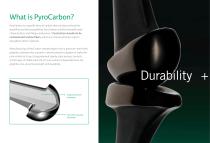
What is PyroCarbon? PyroCarbon is a specific form of carbon that has been tailored for durability and biocompatibility. PyroCarbon exhibits favorable wear characteristics and fatigue endurance.9 PyroCarbon should not be confused with carbon fibers, which are minute particles used to strengthen other materials. Manufacturing a PyroCarbon implant begins with a precision-machined graphite substrate that contains 1 atomic percent tungsten to make the core visible on X-ray. Using patented steady-state process controls, a thick layer of radiolucent On-X® pure carbon is deposited onto the graphite core,...
Open the catalog to page 2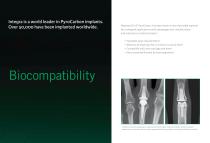
Integra is a world leader in PyroCarbon implants. Over 50,000 have been implanted worldwide. Patented On-X® PyroCarbon has been shown to be a favorable material for orthopedic applications with advantages over metallic alloys and polymers as it demonstrates:9 • • • • Favorable wear characteristics9 Modulus of elasticity that is similar to cortical bone1 Compatible with joint cartilage and bone2 Non-cemented fixation by bone apposition1 Uniform lucent line represents radiolucent PyroCarbon coating. Sclerotic bone formation adjacent to lucent line demonstrates appositional bone growth, encasing...
Open the catalog to page 3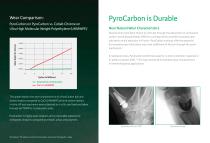
Wear Comparison: PyroCarbon on PyroCarbon vs. Cobalt Chrome on Ultra High Molecular Weight Polyethylene (UHMWPE)1 Near Natural Wear Characteristics Natural joints have been shown to lubricate through the adsorption of surfactants surface-active phospholipids (SAPL) to cartilage which provides boundary layer lubrication and a reduction in friction. PyroCarbon surfaces offer the potential for boundary layer lubrication and a low coefficient of friction through the same mechanism.5 Wear Depth (in inches) In laboratory tests, PyroCarbon performed superior to other prosthetic materials in its ability...
Open the catalog to page 4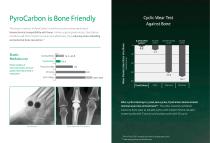
PyroCarbon is Bone Friendly Cyclic Wear Test Against Bone Elastic modulus of metal and ceramic are much greater than that of bone or PyroCarbon. Cortical Bone PyroCarbon Titanium Alloy Zirconia CoCr Alloys Wear Penetration Rate into Bone The elastic modulus of PyroCarbon is similar to cortical bone resulting in biomechanical compatibility with bone. Unlike surgical grade metals, PyroCarbon transfers load from implant to bone more effectively, thus reducing stress shielding and potential bone resorption.1,6 After cyclical testing to 5,000,000 cycles, PyroCarbon demonstrated minimal wear into cortical...
Open the catalog to page 5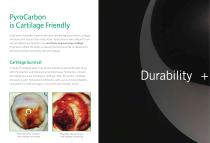
PyroCarbon is Cartilage Friendly PyroCarbon has been shown to be much less damaging to native cartilage and bone joint tissues than metal alloys. PyroCarbon’s low surface friction and nonadhesive properties may contribute to preserving cartilage. PyroCarbon offers the ability to extend the functional life of these joints and thus transform extremity hemiarthroplasty. Cartilage Survival A study of cartilage wear in 45 canine acetabula was performed using both PyroCarbon and metal alloy hip prostheses. PyroCarbon showed remarkably less wear damage to cartilage. After 18 months, cartilage articulating...
Open the catalog to page 6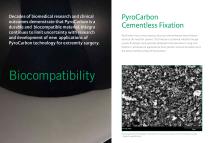
Decades of biomedical research and clinical outcomes demonstrate that PyroCarbon is a durable and biocompatible material. Integra continues to limit uncertainty with research and development of new applications of PyroCarbon technology for extremity surgery. PyroCarbon Cementless Fixation PyroCarbon has a micro-porous structure that enhances bone fixation without the need for cement. This fixation is achieved initially through a press fit design using specially designed instrumentation. Long term fixation is achieved via appositional bone growth as bone remodels up to the bone-friendly surface...
Open the catalog to page 7
References 1. Klawitter, J “Replacing joints with pyrolytic carbon.” Joint replacement technology Ed. Peter A Revell. Woodhead Publishing, 2008, 651 2. Cook SD, Thomas KA, Kester MA, “Wear Characteristics of the Canine Acetabulum Against Different Femoral Prostheses,” JBJS, 1989; 71-B(2): 189-197. 3. Yongxing Qiu, Nolan B. Holland, Mark Ruegsegger and Roger Marchant, Biomimetic Engineering of Non-Adhesive Glycocalyx-Like Surface Using Oligosaccharide Surfactant Polymers, Nature, 392:799-801 (1998) 4. Crawford, et. al.,”The Role of SAPL as a Boundary Lubricant in Prosthetic Joints.” Tribology...
Open the catalog to page 8All Integra LifeSciences catalogs and technical brochures
 capture high-torque surgical
12 Pages
 cadence
4 Pages
 DuraGen® Secure
8 Pages
 transducer
2 Pages
 MAYFIELD®
12 Pages
 SurgiMend® Hernia Brochure
8 Pages
 AmnioExcel® OR Sell Sheet
2 Pages
 Wrist Solutions
6 Pages
 Lower Extremity Reconstruction
28 Pages
 Integra® Lighting Solutions
4 Pages
 Integra® CUSA® Excel+
1 Page
 CUSA® Excel+ System
4 Pages
 DuraGen® matrix
2 Pages
 SurgiMend®
6 Pages
 Integra® Tissue Technologies
8 Pages
 DIABETIC SKIN ULCER
16 Pages
 Auragen™ Cortical Electrodes
4 Pages
 DuraGen XS
2 Pages
 Suturable DuraGen™
4 Pages


Archived catalogs
 MAYFIELD® 2
3 Pages
 DuraGen Plus
4 Pages
 Hermetic Plus™
2 Pages
 AccuDrain™
4 Pages
 Oral Surgery
107 Pages
 Catalog - Endodontics
110 Pages
 Catalog - Cassette
36 Pages
 Brochure - Liberator
6 Pages
 Integra® Licox®
2 Pages
 CUSA Excel+
8 Pages
 Pain Management Procedure Trays
26 Pages
 Jarit Sterilization System
11 Pages
 Integra® Camino® Flex
6 Pages
 Camino
10 Pages
 Catalog - Precision Dental
28 Pages
 LICOX
LICOX4 Pages
 Integra Miltex
663 Pages
 Integra VATS
28 Pages
 Cardiovascular
285 Pages
 Padgett
322 Pages
 Integra Podiatry
130 Pages
 Integra Jarit
916 Pages
 Integra Laparoscopic
90 Pages
 Extremity-Reconstructive Surgery
87 Pages
 Integra Ruggles Redmond
242 Pages
 Stereotaxy
28 Pages
 CUSA NXT/Selector
8 Pages
 Neuro Operating Room
177 Pages
 CUSA EXcel
12 Pages
 Neuromonitoring
76 Pages
 MediHoney® Brochure
9 Pages


- Surgery forceps
- Grasping forceps
- Stainless steel forceps
- Retractor
- Reusable forceps
- Electrosurgical forceps
- Surgical retractor
- Tissue grasping forceps
- Curette
- Bipolar forceps
- Ablation forceps
- Headrest
- Stainless steel retractor
- Bayonet forceps
- Veterinary instrument kit
- Operating table headrest
- Micro forceps
- Grasping micro forceps
- Surgery micro forceps
- Spinal retractor