

- Company
- Products
- Catalogs
- News & Trends
- Exhibitions
Locking plate systems

Locking plate systems
The locking plate systems are made from titanium and Ti6Al4V, adhering to ISO 5832-2 and ISO 5832-3 standards. Key characteristics include anatomically pre-formed plate design, secure fusion of plate and screw through patented thread, and protection of surrounding tissue. The system allows for early mobilization with stable fixation.
Medical Author and Reference Hospitals
The surgical technique is authored by Prof. Dr. Dr. h.c. mult. Wilhelm Friedl, based on extensive surgical experience. Reference hospitals include Rotkreuzklinik Wertheim, Klinikum Aschaffenburg-Alzenau, Greifswald University Hospital, Krankenhaus Rummelsberg, 108 Military Central Hospital in Vietnam, and Ufa emergency hospital.
Perioperative Considerations
Preoperative steps include obtaining signed consent, clarifying secondary illnesses, checking clinical results, and ensuring appropriate anesthesia information. X-ray images in at least two planes are required, and hair removal from the surgery site may be necessary.
Surgical Technique
The general surgical technique involves the placement of the locking plate and temporary fixation using Kirschner wires. Screw insertion requires the use of a drill guide for mono-axial locking plates, while a protection sleeve can be used for polyaxial plates. The screw length is determined using a gauge, and screws are inserted into the drilled core hole with a screwdriver.
Specific Aspects and Cautions
Mono-axial locking plates have a fixed angle for screw insertion, while polyaxial plates allow for multiple angles. It is advised to use three screws at both the proximal and distal portions of the plate. Screws should not be placed directly into the fracture gap to avoid instability. When bending plates, a maximum angle of 15° should not be exceeded to prevent weakening. Care should be taken to avoid burrs when cutting plates and wires.
General Information
For more information, users are directed to the INTERCUS website or can request instructions in paper form. Contact details for INTERCUS GmbH and INTERCUS Vertriebs GmbH are provided for further inquiries.
Catalog excerpts

Surgical technique General handling of the locking plate systems
Open the catalog to page 1
Surgical technique General handling Index Material . . . . . . . . . . . . . . . . . . . . . . . . . . . . . . . . . . . . . . . 5 Characteristics . . . . . . . . . . . . . . . . . . . . . . . . . . . . . . . . . . . . 5 Medical author of the surgical technique . . . . . . . . . . . . . . . . . . . . . . 5 Reference hospitals . . . . . . . . . . . . . . . . . . . . . . . . . . . . . . . . . 5 Perioperative . . . . . . . . . . . . . . . . . . . . . . . . . . . . . . . . . . . . 6 SURGICAL TECHNIQUE GENERAL SURGICAL TECHNIQUE – ON THE HANDLING OF SCREWS IN LOCKING PLATE SYSTEMS Screw insertion:...
Open the catalog to page 3
Polyaxial locking thread – patent no.: 10 2005 015 C S 496
Open the catalog to page 4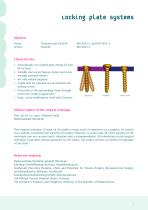
Locking plate systems Material Plates Titanium and Ti6Al4V ISO 5832-2 and ISO 5832-3 Screws Ti6Al4V ISO 5832-3 Characteristics »» Anatomically pre-formed plate design for best fit on bone »» Variable and secure fusion of plate and screw through patented thread »» No cold-welded implants »» Combi hole for optional use of standard and locking screws »» Protection of the surrounding tissue through innovative surgical approaches »» Early, active mobilization with stable fixation polyaxial standard mono-axial Medical author of the surgical technique Prof. Dr. Dr. h.c. mult. Wilhelm Friedl Rotkreuzklinik...
Open the catalog to page 5
Surgical technique General handling Mono-axial and polyaxial locking systems Perioperative »» Presence of the signed information regarding the operation including statement of the risks »» Clarification of secondary illnesses, including long-term therapy with bridging/pausing of blood thinning where applicable »» Checking clinical results including clarification of the vascular status »» Anaesthesia information including local pain catheters where applicable »» X-ray images in at least two planes »» Hair removal from the surgery site if re
Open the catalog to page 6
GENERAL SURGICAL TECHNIQUE – ON THE HANDLING OF SCREWS IN LOCKING PLATE SYSTEMS Placement of the locking plate, temporary fixation of the plate using Kirschner wires as required and X-rays (image intensifier monitoring). Screw insertion: Screwing the drill guide into the respective threaded hole. Note! The use of the drill guide is mandatory for mono-axial locking plates. In contrast, a simple protection sleeve can also be used for polyaxial locking plates. Drilling using a drill. The appropriate drill bits can be found in the corresponding set. The drill bit diameter matches the core diameter...
Open the catalog to page 7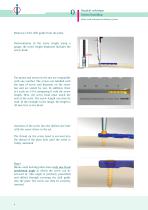
Surgical technique General handling Mono-axial and polyaxial locking systems Removal of the drill guide from the plate. Determination of the screw length using a gauge, the screw length displayed includes the screw head. The plates and screws in the sets are compatible with one another. The screws are labelled with the type of screw and diameter on the screw bar and are sorted by size. In addition, there is a scale on it for comparing it with the screw length. Here, the screw head must touch the end of the scale. The screw length can then be read. In the example in the image, the length is 20...
Open the catalog to page 8
Note! With the polyaxial threaded holes, the screws with the conical head thread can be interlocked at their vertical main axis and at 4 further positions that are rotated around the main axis at an angle of 10°. As an alternative, standard screws can be used for mono-axial and polyaxial locking holes. (See characteristics on page 5) Caution! Where possible, always use three screws at the proximal and distal portion of the plate. Caution! The screws may not be placed directly into the fracture gap as this may result in instability or even material fatigue. Caution! When tailoring the plate to...
Open the catalog to page 9
General information When using all our products, please follow the Instructions for the use of medical devices made by INTERCUS GmbH. This is available on our website www.intercus.de or can be requested from us in paper form. Personal notes
Open the catalog to page 10
Hersteller und Vertrieb Manufacturer and distributor INTERCUS GmbH Zu den Pfarreichen 5 07422 Bad Blankenburg GERMANY INTERCUS Vertriebs GmbH In der Flecke 22 - 23 07422 Bad Blankenburg GERMANY Vertrieb Distributor
Open the catalog to page 12All Intercus catalogs and technical brochures
 Cannulated screws
2 Pages
 TALARLOCK - PANTALARLOCK
16 Pages

- Bone plate
- Compression plate
- Metallic compression plate
- Locking compression plate
- Distal compression plate
- Compression bone screw
- Metallic compression bone screw
- Proximal compression plate
- Arthrodesis nail
- Lateral compression plate
- Forearm compression plate
- Medial compression plate
- Tibia compression plate
- Metallic intramedullary nail
- Radius compression plate
- Humerus compression plate
- Arthrodesis plate
- Cannulated compression bone screw
- Proximal fixation intramedullary nail
- Metallic arthrodesis plate