
- Catalogs
- InterSystems
- If you have multiple EMRs, you have multiple mismatched patient records


If you have multiple EMRs, you have multiple mismatched patient records

If you have multiple EMRs, you have multiple mismatched patient records
Duplicate patient records are a significant issue in healthcare, leading to increased costs and impacting patient care. This document discusses the prevalence of mismatched records, their consequences, and the importance of implementing a comprehensive Enterprise Master Patient Index (EMPI).
Duplicate records result in billing errors, accounts receivable problems, care delays, and unnecessary testing. Nearly 20% of hospital CIOs have reported adverse events due to patient mismatches. Best practice suggests maintaining a duplicate rate below 5%.
Having multiple Electronic Medical Records (EMRs) often leads to multiple patient records for the same individual, increasing the risk of mismatched records. A true EMPI is essential for accurate patient identification and linking information across systems.
Poorly managed records can lead to poor communication, missed laboratory results, unnecessary testing, negative litigation outcomes, and reduced patient satisfaction scores. Nearly 25% of EMR-based MPIs have duplicate rates exceeding 10%.
The ONC SAFER Guides recommend implementing an EMPI across all organizational areas to ensure a comprehensive view of patient records. Over-reliance on embedded data-matching algorithms can be ineffective, as shown by wide variance in patient matching capabilities.
The average cost to correct a duplicate record is $963, and repeat tests and treatment delays add approximately $1100 to the cost of care.
Accurate patient identification is crucial for achieving strategic healthcare goals. Effective patient identity management is necessary for patient-centric care, population health, and value-based reimbursement.
InterSystems HealthShare Patient Index offers an automated solution for identity management, integrating into provider workflows to prevent duplicate records and ensure accurate patient data across systems.
Catalog excerpts

If you have multiple EMRs, you have multiple mismatched patient records Duplicate patient records impact patient care and productivity Mismatched Records are Pervasive Multiple EMRs = multiple patient records for the SAME patient. If you register patients in multiple systems, you have duplicate patient records. Best practice duplicate rate is below have duplicate rates Mismatched Records are Costly Duplicate records cost the organization beyond time and materials (T&M): billing errors, accounts receivable problems, care delays and duplicate testing also add to the cost of duplicate records. The average cost in T&M to correct a duplicate record Repeat tests and treatment delays associated with duplicate records added Mismatched Records Affect Quality of Care Nearly one-fifth of hospital CIOs say they can attribute at least one adverse event to a patient mismatch within the last year.5 Duplicate records impacted the quality of care in Mismatched Records Damage Your Reputation Duplicate medical records lead to: ■ Poor communications between healthcare providers and their patients ■ Higher risk of missing important laboratory results ■ Higher likelihood that patients are subjected to unnecessary testing ■ Negative litigation outcomes and higher malpractice costs ■ Negative patient experiences that lower HCAPS scores Poor e g Avera nt Excelle Relying on Your EMR Does Not Work A common mistake is over-reliance on the data-matching algorithms embedded within business or clinical systems. An ONC survey of EMR-based MPIs found wide variance in quality and effectiveness of patient matching capabilities.7 An EMR with a poorly maintained or MPI will contaminate all other linked systems Nearly of hospital CIOs were unsure how their exchange partner was approaching data matching 8 A True EMPI Across All Your Systems is Essential A true Enterprise Master Patient Index provides accurate identification of the patient and links all related information to that patient within and across all systems. The ONC SAFER Guides recommend the implementation of an EMPI 9 across all areas of the organization. Summary Accurate patient identification is a key 10 to achieving the Triple Aim and enables the success of all strategic initiatives. Patient-centric care, population health, accountable care, patient engagement and value-based reimbursement are just buzzwords without effective patient identity management. view of the patient’s record across al
Open the catalog to page 1
HeathShare Patient Index The Patient Identity Solution InterSystems HealthShare Patient® Index provides an automated solution to the challenges of identity management. Embedded within provider workflows, it can recognize the creation of a duplicate record and trigger corrective action to protect against medical errors or adverse events. Within an information exchange, advanced probabilistic and deterministic logic supports the efficient and automatic creation of accurate, comprehensive, multi-source patient records. “Patient matching is the main reason we went with HealthShare in the first place....
Open the catalog to page 2All InterSystems catalogs and technical brochures
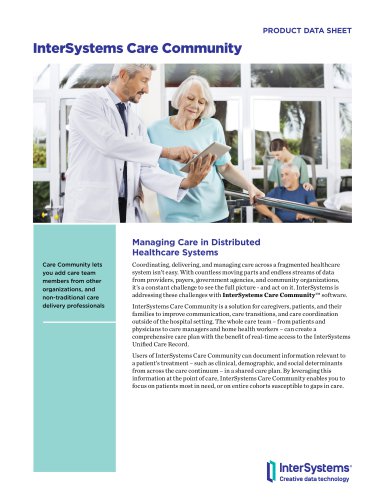 InterSystems Care Community
4 Pages
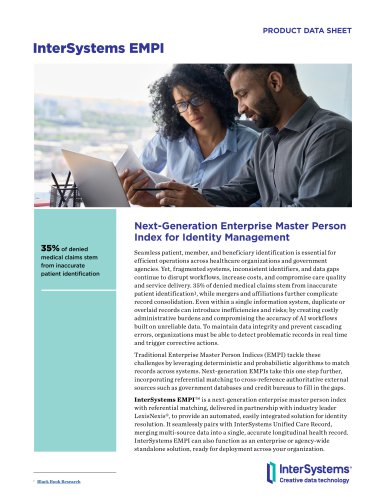 InterSystems EMPI
3 Pages
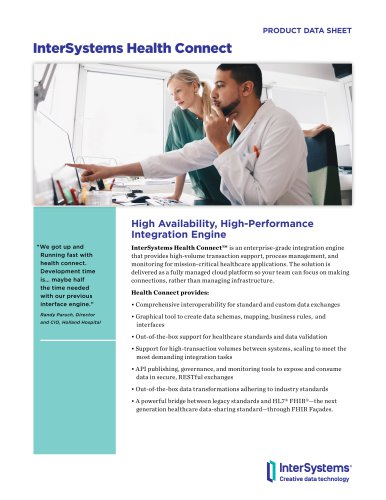 InterSystems Health Connect
4 Pages
Archived catalogs
 ARIES
ARIES8 Pages
 TrakCare Lab Enterprise
8 Pages
 Unified Care Record
4 Pages
 TrakCare Brochure
24 Pages
 TrakCare LAB
8 Pages
 InterSystems IRIS Data Platform
12 Pages
 InterSystems IRIS for Health
4 Pages
 HealthShare® Care Community
4 Pages
 HealthShare® Health Connect
4 Pages


- Analysis software
- Control software
- Reporting software
- Monitoring software
- Planning software
- Online software
- Traceability software
- Software module
- AI-assisted software
- Artificial intelligence software
- Sharing software
- Real-time software
- Data analysis software
- EMR software
- Security software
- Medical management system
- Medical software module
- Navigation software
- Interoperability software
- Data exchange software