
- Catalogs
- InterSystems
- AN INTERSYSTEMS WHITE PAPER Creating Sustainable 21st Century Health Systems: eHealth and Health Information Technology


AN INTERSYSTEMS WHITE PAPER Creating Sustainable 21st Century Health Systems: eHealth and Health Information Technology

AN INTERSYSTEMS WHITE PAPER Creating Sustainable 21st Century Health Systems: eHealth and Health Information Technology
Key Components of eHealth Strategy:
- Shared virtual care records for improved planning and communication.
- Modern patient care systems for safe and effective care.
- Coordinated care plans to boost patient engagement.
- Comprehensive analytics for documenting effectiveness and supporting research.
Challenges and Opportunities: The document notes that the success of 20th-century medicine has increased lifespans, leading to higher demand for health and social services. It underscores the need for sustainable healthcare models that effectively manage chronic diseases and promote preventive care.
Imagining a Sustainable Model: A model focusing on health rather than just healthcare is proposed, encouraging healthy behaviors and preventive care. The importance of a comprehensive virtual care record shared across communities to support coordinated care is emphasized.
Viable eHealth Model: Four critical elements are identified:
- A shared virtual care record as the foundation.
- Agility at the point of service with appropriate technology for each care team member.
- Shared care plans and timely notifications for coordinated care.
- Continuous measurement and improvement to ensure effective care delivery.
Conclusion: The document concludes that a coordinated, distributed care model integrating social care and engaging patients is essential for sustainable 21st-century health systems. It highlights potential cost savings and improved care outcomes through effective use of information technology.
Introduction: The document discusses the importance of a community-wide record for performance measurement in healthcare, emphasizing integrated treatment pathways and clinical decision support within hospitals, facilitated by a unified Electronic Medical Record (EMR) system. Outside the hospital, a shared care plan is essential for the distributed care team, reflecting patient values and engaging them in care management.
Actionable Analytics: The significance of analytics in healthcare is highlighted, with quality and performance measures deemed crucial for managing healthcare systems. A shared virtual record should include analytics capabilities to support reporting, metrics, and dashboards, aiding in performance measurement and improvement.
Continuous Value and Case Study: The eHealth vision is described as compelling yet challenging, with Northwell Health serving as a case study. Northwell Health leverages existing EMR technology to operate as a coordinated care entity, enhancing care coordination and management through a shared virtual record.
Steps for Developing an eHealth Strategy: The document outlines a practical approach to designing an eHealth strategy:
- Step 1: Document the starting point by gathering baseline metrics.
- Step 2: Create a connected health record by implementing a community-wide virtual care record solution.
- Step 3: Foster patient and provider engagement through outreach programs and peer champions.
- Step 4: Enhance the EMR with next-generation technology and careful planning.
- Step 5: Continuously measure, monitor, improve, and repeat to enhance care processes.
Conclusion: The document concludes by addressing the need for a new healthcare environment where healthcare is a team activity, patients are partners, and sustainable funding is ensured. It emphasizes eliminating information silos, aligning around a common plan, and continuously learning and improving the system. InterSystems' solutions are highlighted as tools for transforming and improving care globally.
Catalog excerpts

AN INTERSYSTEMS WHITE PAPER Creating Sustainable 21st Century Health Systems: eHealth and Health Information Technology Health | Business | Government
Open the catalog to page 1
Creating Sustainable 21st Century Health Systems: eHealth and Health Information Technology Executive Summary The aging of the world’s population combined with the growth of chronic medical conditions is bringing relentless pressure to bear on health systems globally, even as consumer expectations are increasing. As nations around the world seek to address this challenge, they are exploring the ways in which information technology can help them drive healthcare improvements and innovation. Our frame of reference is more than 30 years of global health information technology experience, with systems...
Open the catalog to page 2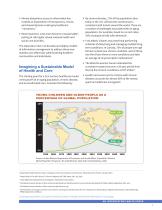
■ Almost ubiquitous access to information has created an expectation of transparency, choice, and shared decision-making by healthcare ■ Most important, costs have become unsustainable2, putting at risk highly valued national health and social care priorities. The imperative now is to develop and deploy models of information management to address these new realities cost-effectively while fostering healthier Imagining a Sustainable Model The starting point for a 21st century healthcare model is the growth of an aging population, chronic disease, and uncoordinated care. Considerthe following:...
Open the catalog to page 3
To ensure sufficient healthcare resources for the future, we need to create a more sustainable model — one that shifts the focus from healthcare to health, and from treating infectious disease to effectively managing chronic disease through a tightly coordinated, distributed care team that includes and engages the patient. A sustainable model encourages healthy behaviors and preventive care across the population to reduce the incidence of disease. And it harnesses information technology to promote safe, high-quality evidenced-based care in the most appropriate settings across the continuum. The...
Open the catalog to page 4
environment is not possible across a care continuum involving a growing array of disparate organizations. The community-wide model has different stakeholders, regulatory context, processes, IT systems, and often funding. Consider, for example, the need to incorporate social services such as child protection into a community care process; these providers do not and will not use an EMR, yet they need to be able to connect all the dots for a given patient. Second, the right tool for the job: agility at the point of service Optimal population health management requires safe, high-quality care for...
Open the catalog to page 5
Regardless of the approach, all clinical team members must ultimately have the information they need to deliver care efficiently, adopt best practices, and communicate effectively. Third, do the right thing: the shared care plan We all want to do the right thing for the health of our communities. The Institute for Healthcare Improvement (IHI) describes this as the “Triple Aim” — excellent quality, optimal costs, and improved population health13. But given the distributed nature of the care team, the need for close communication, and the rapid introduction of new diagnostics and therapies, it...
Open the catalog to page 6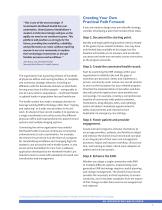
“This is one of the most strategic IT investments Northwell Health has ever undertaken. [InterSystems] HealthShare’s modern architectural design will give us the agility we need as we continue to grow. This platform will position us strongly for the future, providing the scalability, reliability, and performance we need, without requiring anyone in our care community to replace their technology investments or disrupt familiar processes and workflows.” John Bosco, CIO, Northwell Health (formerly North Shore-LIJ Health System) The organization has a growing network of hundreds of physician offices...
Open the catalog to page 7
Step 5: Measure-Monitor-Improve-Repeat. At each step along the path to a mature eHealth program, there will be opportunities to enhance and improve care processes, drive efficiencies, enhance patient satisfaction, and learn from experience. The essence of a learning health system is continuous measurement and improvement. Conclusion Nations everywhere are facing the realities of a new healthcare environment — one in which healthcare is a team activity, patients are equal partners in the care continuum, and new approaches are needed to ensure sustainable funding for increased demands. An eHealth...
Open the catalog to page 8All InterSystems catalogs and technical brochures
 InterSystems Care Community
4 Pages
 InterSystems EMPI
3 Pages
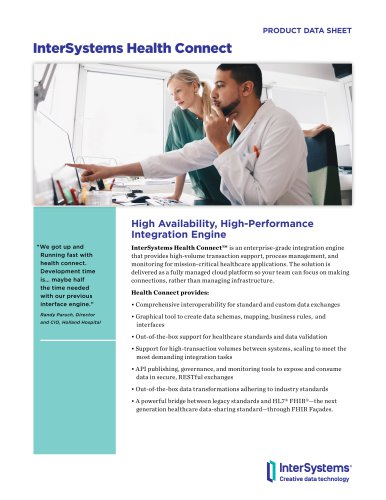 InterSystems Health Connect
4 Pages
Archived catalogs
 ARIES
ARIES8 Pages
 TrakCare Lab Enterprise
8 Pages
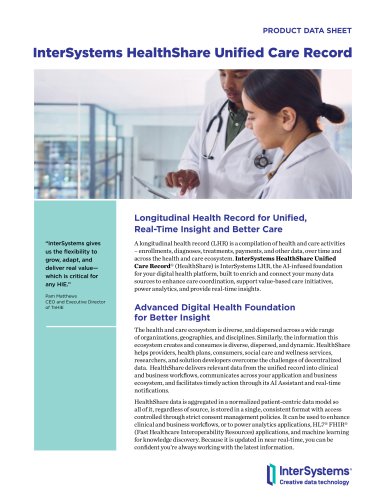
 Unified Care Record
4 Pages
 TrakCare Brochure
24 Pages
 TrakCare LAB
8 Pages
 InterSystems IRIS Data Platform
12 Pages
 InterSystems IRIS for Health
4 Pages
 HealthShare® Care Community
4 Pages
 HealthShare® Health Connect
4 Pages


- Analysis software
- Control software
- Reporting software
- Monitoring software
- Planning software
- Online software
- Traceability software
- Software module
- AI-assisted software
- Artificial intelligence software
- Sharing software
- Real-time software
- Data analysis software
- EMR software
- Security software
- Medical management system
- Medical software module
- Navigation software
- Interoperability software
- Data exchange software