


Flatone

Flatone
Catalog excerpts
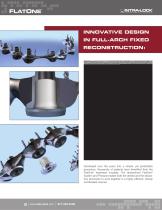
INNOVATIVE DESIGN IN FULL-ARCH FIXED RECONSTRUCTION: Developed over the years into a simple, yet predictable procedure, thousands of patients have benefited from the FlatOne® treatment modality. The streamlined FlatOne® System and Protocol enable both the dentist and the laboratory technician to work together in a highly efficient, closely coordinated manner.
Open the catalog to page 2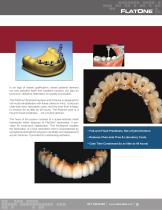
In an age of instant gratification, dental patients demand not only beautiful teeth and excellent function, but also an economic, definitive restoration as quickly as possible. The FlatOne® Abutment System and Protocol is designed for full mouth rehabilitation with these criteria in mind. It reduces chair-side time, laboratory costs, and the time from surgery to function (to as little as 48 hours). The finished case is a full-arch fixed prosthesis… not a hybrid denture. The heart of the system consists of a screw-retained metal framework which attaches to FlatOne® abutments. It provides for cross-arch...
Open the catalog to page 3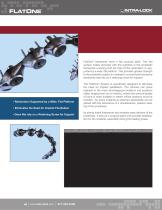
FlatOne® Abutments have a flat occlusal table. This flat surface mates precisely with the cylinders in the prosthetic framework ensuring that the load of the restoration is supported by a wide, flat platform. This provides greater strength to the prosthetic system in contrast to conventional two-piece abutments that rely on a retaining screw for support. • Restoration Supported by a Wide, Flat Platform • Eliminates the Need for Implant Parallelism • Does Not rely on a Retaining Screw for Support The FlatOne® System is specifically designed to eliminate the need for implant parallelism. The clinician...
Open the catalog to page 4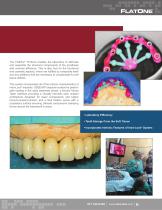
The FlatOne® Protocol enables the laboratory to fabricate and assemble the structural components of the prosthesis with extreme efficiency. This is also true for the functional and cosmetic aspects, which are fulfilled by composite teeth and any additions that are necessary to compensate for soft tissue defects. This system incorporates all of the intrinsic characteristics of Intra-Lock® implants: OSSEAN® bioactive surface for predictable healing in the early treatment phase, a ferrule/ Morse Taper interface providing a virtually hermetic seal, implant architecture designed for lower compression...
Open the catalog to page 5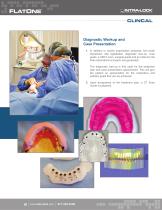
CLINCAL Diagnostic Workup and Case Presentation 1. In addition to routine examination protocols, full mouth impression, bite registration, diagnostic wax-up, scan guide, a CBCT scan, surgical guide and an index for the final restorations/occlusion are generated. The diagnostic wax-up is first used for the treatment plan and case presentation appointment. This will give the patient an appreciation for the restorative and esthetic goals that can be achieved. 2. Upon acceptance of the treatment plan, a CT Scan Guide is prepared.
Open the catalog to page 6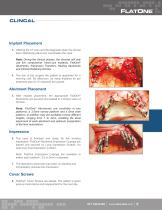
Implant Placement 3. Utilizing the CT scan and the diagnostic data, the clinical team definitively plans and coordinates the case. Note: During the clinical phases, the clinician will only use five components: Intra-Lock Implants, FlatOne® Abutments, Impression Transfers, Healing Abutments and Clinical Retaining Screws. 4. The day of the surgery the patient is appointed for a morning visit. By afternoon, as many implants as per treatment plan (6-10 implants) are placed. Abutment Placement 5. After implant placement, the appropriate FlatOne® Abutments are secured and seated to a torque value of...
Open the catalog to page 7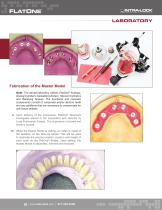
Fabrication of the Master Model Note: The dental laboratory utilizes FlatOne® Analogs, Analog Cylinders, Castable Cylinders, Titanium Cylinders and Retaining Screws. The functional and cosmetic components consist of composite and/or denture teeth and any additions that are necessary to compensate for soft tissue defects. 9. Upon delivery of the impression, FlatOne® Abutment Analogsare placed in the impression and secured by Long Impression Screws. The impression is boxed and stone is poured. 10. While the Master Model is setting, an index is made of the dentition on the Wax-Up Model. This will...
Open the catalog to page 8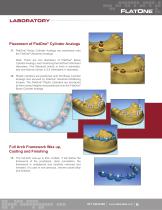
Placement of FlatOne® Cylinder Analogs 11. FlatOne® Brass Cylinder Analogs are positioned onto the FlatOne® Abutment Analogs. Note: There are two diameters of FlatOne® Brass Cylinder Analogs, each matching the FlatOne® Abutment diameters. One Standard (which is 5mm in diameter), and one Narrow (which is 3.5 millimeters in diameter). 12. Plastic cylinders are positioned onto the Brass Cylinder Analogs and secured by FlatOne® Abutment Retaining Screws. The FlatOne® Plastic Cylinders are shortened to their correct heights and positioned over the FlatOne® Brass Cylinder Analogs . Full Arch Framework...
Open the catalog to page 9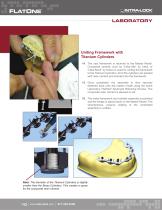
Uniting Framework with Titanium Cylinders 14. The cast framework is returned to the Master Model. Composite cement, such as “Ceka-Site” by Ceka, or “Ultra-Bond” by Kulzer is used for uniting the framework to the Titanium Cylinders. All of the cylinders are painted with resin cement and inserted into the framework. 15. Once completed, the assembly is then securely fastened back onto the master model using the same Laboratory FlatOne® Abutment Retaining Screws. The composite resin cement is allowed to set. 16. The metal framework and cylinder assembly is polished and the bridge is placed back on...
Open the catalog to page 10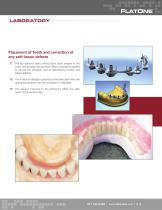
Placement of Teeth and correction of any soft tissue defects 17. Pre-cut denture teeth, which have been seated in the index, are brought into position. Resin material is applied to secure the dentition and to esthetically correct soft tissue deficits. 18. The FlatOne® Bridge is placed on the articulator with the opposing dentition and the occlusion is adjusted. 19. The case is returned to the clinician’s office the after noon of the second day.
Open the catalog to page 11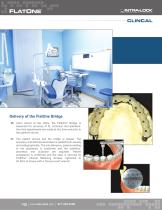
Delivery of the FlatOne Bridge 20. Upon arrival at the office, the FlatOne® Bridge is inspected for accuracy of fit, occlusion and esthetics. Any final adjustments are made at this time and prior to the patient’s arrival. 21. The patient arrives and the bridge is placed. The accuracy of all clinical parameters is verified both visually and radiographically. The simultaneous, passive seating of the prosthesis is confirmed and the esthetics, phonetics and occlusion are adjusted. Patient acceptance is confirmed and the case is secured by FlatOne® Clinical Retaining Screws, tightened to 20 Ncm of torque...
Open the catalog to page 12All Intra-Lock International, Inc. catalogs and technical brochures
 Intra-Lock® Implants
29 Pages
 Gold&Blue
28 Pages
 Conic
Conic6 Pages
 MILD 3.75mm
2 Pages
 MILD 3.0
12 Pages
 MDL 15°
4 Pages
 MDL
MDL6 Pages
 index
index72 Pages
 gold-and-blue
28 Pages
 L-PRF
L-PRF6 Pages
 Blossom
8 Pages
- Implant abutment
- Titanium implant abutment
- Straight implant abutment
- Dental surgery instrument kit
- Dental implant
- Titanium dental implant
- Benchtop centrifuge
- Internal implant abutment
- Straight dental implant
- Hexagonal implant abutment
- Screw implant abutment
- Dental implant analog
- Collection kit
- Internal hexagon implant abutment
- Straight dental implant analog
- Dental screwdriver
- Microtube centrifuge
- Stainless steel dental implant analog
- One-piece dental implant
- Blood collection kit