


CAS

CAS
- Preface: ITS. GmbH provides cannulated screws for trauma surgery, focusing on minimally invasive techniques with low-profile heads to reduce soft tissue irritation.
- Properties: The screws are made from TiAl6V4 ELI material, are self-drilling, self-tapping, and cannulated for guided insertion, featuring various thread types for easy removal and reduced inflammation risk.
- Indications: Suitable for fractures of the Radius, Ulna, Tarsal, Talus, Calcaneus, and more.
- Equipment: Includes guide wires, washers, and cannulated screwdrivers for different screw sizes.
- Contraindications: Not recommended for diaphyseal fractures of long bones, advanced osteoporosis, obesity, or non-compliant patients.
- Time of Operation: Can be performed as primary (within hours post-trauma) or secondary (after swelling reduces).
- Specific Screw Techniques: Detailed procedures for screws ranging from D=2.7mm to D=7.3mm, including indications, optional drilling, temporary fixation with K-Wire, and screw placement.
- Postoperative Treatment: Guidelines for weight bearing and brace use depending on fracture type and location.
- Individual Tray Configuration: Customizable surgical trays based on user needs.
- Order List and Reconditioning Manual: Detailed ordering information and equipment reconditioning guidelines.
- Patella: Partial weight bearing at 66 lbs from week 0-6, full weight bearing at week 6-8 with isometric quadriceps exercises.
- Proximal Tibia: Knee bandage for ligament fixation, partial weight bearing at 33 lbs from week 4-8, increasing to 66 lbs at week 6-10, full weight bearing at week 10-14.
- Malleolus: Partial weight bearing at 33 lbs from week 0-4, increasing to 66 lbs at week 4-6, full weight bearing after week 6.
- Calcaneus: Removable plaster cast used, partial weight bearing at 33 lbs from week 0-6, increasing to 66 lbs at week 6-10, full weight bearing after week 10-16.
- Cortical Screws: Available in diameters (2.7mm, 3.5mm) and lengths (12mm to 70mm) with short or variable threads.
- Cancellous Screws: Available in diameters (4.0mm, 4.5mm, 6.5mm, 7.3mm) and lengths (16mm to 120mm) with short, variable, or fully threaded options.
- Washers: Available in flat and curved designs with different outer and inner diameters.
- Depth Gauges and Guide Wires: Various sizes available for calibrated guide wires.
- Guide Wires: Steel, various diameters and lengths, with thread.
- Screwdrivers: Cannulated, various sizes and lengths.
- Trocar and Tissue Protection Sleeve: Specific dimensions and features.
Reconditioning Manual:
Guidelines for reconditioning non-sterile implants and reusable instruments, including indications for medical personnel, intended use, side effects, warnings, and preventive measures.
Intended Use:
Implants temporarily stabilize bone segments until consolidation, after which they can be removed.
Warnings and Preventive Measures:
- Follow packaging instructions and use implants only once.
- Avoid surface damage and alterations to implants.
- Regular postoperative examinations are necessary.
- Do not combine implants from different producers.
- MRI use with steel implants is prohibited.
- Follow safety measures when handling contaminated products.
- Use steam sterilization and avoid metal brushes for cleaning.
Recycling Instructions:
- Remove surface dirt and rinse hollow parts immediately after use.
- Use appropriate cleaning agents and follow manufacturer guidelines.
- Automatic cleaning is preferred over manual cleaning.
- Ensure thorough rinsing and drying of instruments.
Checking, Maintenance, and Inspection:
- Inspect instruments for dirt and ensure proper lubrication and mobility.
- Follow packaging and sterilization guidelines to ensure sterility.
Sterilization:
- Use fractionated pre-vacuum procedure for steam sterilization.
- Follow WHO guidelines for sterilization if CJD contamination is suspected.
Disposal and Responsibility:
- Follow hospital guidelines for disposal.
- Ensure returned products to I.T.S. GmbH are cleaned and sterilized.
Patient Information:
- Patients should be informed about post-implantation behavior and report any negative changes.
Symbols and Standards:
- Various symbols indicate prescription, single use, sterilization methods, and compliance with standards like ISO 13485 and ISO 17664.
Contact Information:
- I.T.S. USA contact details provided for further inquiries.
Catalog excerpts

Implants trauma Cannulated Screws
Open the catalog to page 1
CAUTION: Federal Law (USA) restricts this device to sale by or on the order of a board certified physician. WARNING: If there is no sufficient bone healing, wrong or incomplete postoperative care, implant might break. Attention: The ITS. cannulated screws - except for the Dens Axis screw - are not suitable for use in the spinal column. The indication range for cannulated screws may vary according to the bone quality and physique of the patient.
Open the catalog to page 2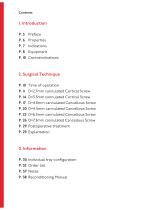
1. Introduction P. 5 Preface P. 6 Properties P. 7 Indications P. 8 Equipment P. 10 Contraindications 2. Surgical Technique P. 10 Time of operation P. 11 D=2.7mm cannulated Cortical Screw P. 14 D=3.5mm cannulated Cortical Screw P. 17 D=4.0mm cannulated Cancellous Screw P. 20 D=4.5mm cannulated Cancellous Screw P. 23 D=6.5mm cannulated Cancellous Screw P. 26 D=7.3mm cannulated Cancellous Screw P. 29 Postoperative treatment P. 29 Explantation 3. Information P. 30 Individual tray configuration P. 32 Order list P. 37 Notes P. 38 Reconditioning Manual
Open the catalog to page 3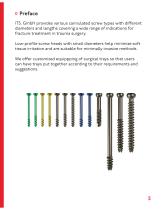
Preface ITS. GmbH provides various cannulated screw types with different diameters and lengths covering a wide range of indications for fracture treatment in trauma surgery. Low-profile screw heads with small diameters help minimize soft tissue irritation and are suitable for minimally invasive methods. We offer customized equippping of surgical trays so that users can have trays put together according to their requirements and suggestions.
Open the catalog to page 5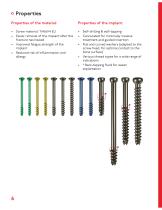
Properties Properties of the material: • Screw material: TiAl6V4 ELI • Easier removal of the implant after the fracture has healed • Improved fatigue strength of the implant • Reduced risk of inflammation and allergy • Self-drilling & self-tapping • Cannulated for minimally invasive treatment and guided insertion • Flat and curved washers (adapted to the screw head, for optimal contact to the bone surface) • Various thread types for a wide range of indications • * Back-tapping flank for easier explantation
Open the catalog to page 6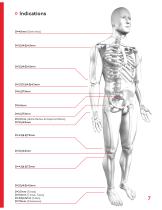
Indications D=4.0mm (Dens Axis) D=6.5mm D=6.5/7.3mm D=2.7mm (distal Radius & Scaphoid Bone) D=3.5/4.0mm D=3.5/4.0/4.5mm D=2.7mm (Tarsal) D=3.5mm (Tarsal, Talus) D=4.0/4.5mm (Talus) D=7.3mm (Calcaneus)
Open the catalog to page 7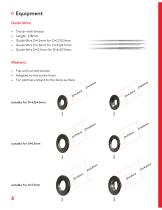
Equipment Guide Wire: • • • • • Trocar with thread Length: 228mm Guide Wire D=1.2mm for D=2.7/3.5mm Guide Wire D=1.6mm for D=4.0/4.5mm Guide Wire D=3.2mm for D=6.5/7.3mm Washers: • Flat and curved version • Adapted to the screw head • For optimal contact to the bone surface
Open the catalog to page 8
Screwdriver: • Cannulated • Screwdriver, WS 2.5mm for D=2.7/3.5/4.0/4.5mm (Lengths: 120mm and 170mm for Dens Axis Screw) • Screwdriver, WS 5.0mm for D=6.5/7.3mm (Length: 100mm) Surgical Technique
Open the catalog to page 9
Diaphyseal fractures of long bones In advanced osteoporosis Obesity Lack of patient compliance Time of operation • Primary: Within the first hours after trauma • Secondary: After detumescence, intermediate fixation with external fixation or extension
Open the catalog to page 10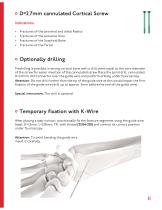
D=2.7mm cannulated Cortical Screw Indications: • • • • Fractures of the proximal and distal Radius Fractures of the proximal Ulna Fractures of the Scaphoid Bone Fractures of the Tarsal Optionally drilling Predrilling is possible in strong cortical bone with a drill point equal to the core diameter of the screw for easier insertion of the cannulated screw Place the spiral drill, cannulated, D=2.0mm, AO Connector over the guide wire and perform drilling under fluoroscopy. Attention: Do not drill further than the tip of the guide wire as this would impair the firm fixation of the guide wire (drill...
Open the catalog to page 11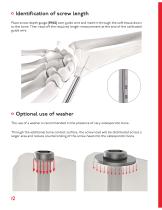
Identification of screw length Place screw depth gauge (59162) over guide wire and insert it through the soft tissue down to the bone. Then read off the required length measurement at the end of the calibrated guide wire. Optional use of washer The use of a washer is recommended in the presence of very osteoporotic bone. Through the additional bone contact surface, the screw load will be distributed across a larger area and reduce countersinking of the screw head into the osteoporotic bone.
Open the catalog to page 12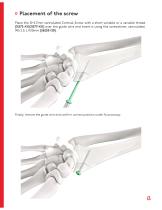
Placement of the screw Place the D=2.7mm cannulated Cortical Screw with a short variable or a variable thread (31272-XX/31277-XX) over the guide wire and insert it using the screwdriver, cannulated, WS 2.5, L=120mm (56253-120). Finally, remove the guide wire and confirm correct position under fluoroscopy.
Open the catalog to page 13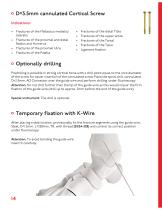
D=3.5mm cannulated Cortical Screw Indications: • Fractures of the Malleolus medialis/ lateralis • Fractures of the proximal and distal Radius and Humerus • Fractures of the proximal Ulna • Fractures of the Patella Fractures of the distal Tibia Fractures of the upper ankle Fractures of the Tarsal Fractures of the Talus Ligament fixation Optionally drilling Predrilling is possible in strong cortical bone with a drill point equal to the core diameter of the screw for easier insertion of the cannulated screw Place the spiral drill, cannulated, D=2.5mm, AO Connector over the guide wire and perform...
Open the catalog to page 14
Identification of screw length Place screw depth gauge (59162) over guide wire and insert it through the soft tissue down to the bone. Then read off the required length measurement at the end of the calibrated guide wire. Optional use of washer The use of a washer is recommended in the presence of very osteoporotic bone. Through the additional bone contact surface, the screw load will be distributed across a larger area and reduce countersinking of the screw head into the osteoporotic bone.
Open the catalog to page 15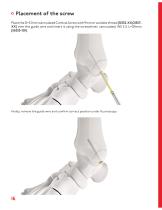
Placement of the screw Place the D=3.5mm cannulated Cortical Screw with 9mm or variable thread (31352-XX/31357XX) over the guide wire and insert it using the screwdriver, cannulated, WS 2.5, L=120mm (56253-120). Finally, remove the guide wire and confirm correct position under fluoroscopy.
Open the catalog to page 16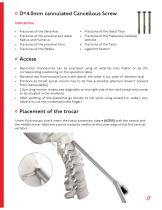
D=4.0mm cannulated Cancellous Screw Indications: • Fractures of the Dens Axis • Fractures of the proximal and distal Radius and Humerus • Fractures of the proximal Ulna • Fractures of the Patella • Fractures of the distal Tibia • Fractures of the Malleolus medialis/ lateralis • Fractures of the Talus • Ligament fixation Access • Reposition manoeuvres can be practised using an external halo fixator or by the corresponding positioning on the operation table • Standard two fluoroscopys (one in the lateral, the other in a.p. path of radiation rays) • Entrance to throat spinal column has to be free...
Open the catalog to page 17All I.T.S. catalogs and technical brochures
 CTN - Cannulated Tibia Nail
28 Pages
 ufs
ufs1 Page
 DHL
DHL2 Pages
 ITS
ITS2 Pages
 SCL
SCL32 Pages
 SLS
SLS24 Pages
 OL - Olecranon Locking Plate
24 Pages
 PHL
PHL24 Pages
 PHLs
PHLs20 Pages
 CLS
CLS28 Pages
 ACLS
ACLS20 Pages
 CFN
CFN32 Pages
 OLS
OLS24 Pages
 SR Sacral Rods
20 Pages
 HCS
HCS24 Pages
 TOS Twist-Off Screw
20 Pages
 TLS
TLS20 Pages
 PRS-RX
32 Pages
 HLS
HLS20 Pages
 ES
ES20 Pages
 SR
SR20 Pages
 FL
FL24 Pages
 PL - Pilon Locking Plate small
12 Pages
 FLS
FLS24 Pages
 PFL
PFL20 Pages
 DTL
DTL24 Pages
 HTO
HTO24 Pages
 PTL
PTL32 Pages
 DFL
DFL32 Pages
 FCN
FCN20 Pages
 HOL
HOL24 Pages
 CAL
CAL20 Pages
 DUL
DUL24 Pages


Archived catalogs


- Bone plate
- Compression plate
- Metallic compression plate
- Locking compression plate
- Titanium compression plate
- Distal compression plate
- Compression bone screw
- Metallic compression bone screw
- Proximal compression plate
- Arthrodesis nail
- Forearm compression plate
- Lateral compression plate
- Medial compression plate
- Tibia compression plate
- General purpose compression bone screw
- Metallic intramedullary nail
- Humerus compression plate
- Radius compression plate
- Cannulated compression bone screw
- Arthrodesis plate