


FCN

FCN
The document discusses the Flexible Children Nail (FCN) system, used in pediatric medullary fixation for shaft fractures. The nails are designed to be both elastic and stable, facilitating early weight-bearing and reducing hospital stays. They come in various lengths and diameters to accommodate different pediatric needs.
The FCN system provides elastic fracture fixation with minimal skin incision and closed procedure insertion. It preserves fracture hematoma for natural healing and offers optional distal locking for enhanced stability.
Indications include easily stabilizable fractures and certain pathological fractures. Contraindications include pathological fractures with unknown malignancy, infections, and non-compliance.
The system converts thrust and shear forces into beneficial axial forces, promoting rapid fracture consolidation through callus formation. Locking options prevent implant migration.
The procedure involves pre-surgical positioning, nail insertion through a small incision, and fluoroscopy guidance. Postoperative care includes mobilization with crutches, with explantation after 6-9 months.
The document includes an order list for various nail sizes and instruments, along with a reconditioning manual for cleaning, disinfection, and sterilization, emphasizing steam sterilization and avoiding abrasive materials.
Guidelines for reconditioning medical devices stress proper cleaning, disinfection, and handling to maintain implant and instrument integrity.
Instruments should be cleaned with a pH-neutral agent or a combined cleaning and disinfectant solution, such as Sekusept® Aktiv 2% by ECOLAB. Follow manufacturer guidelines on concentration, temperature, and exposure time. Use non-foaming agents for ultrasound cleaning and maintain a pH range of 4.5 - 10.5. Rinse thoroughly with tap water and dry immediately.
If using a cleaning agent without disinfectant properties, a separate disinfection step is necessary. Use a VAH-listed disinfectant and ensure thorough drying.
Inspect instruments for cleanliness and functionality. Lubricate movable parts with authorized products and check for ease of assembly. Follow standard packaging guidelines using sterile barrier systems.
Sterilize instruments using the fractionated pre-vacuum procedure according to EN 285 or EN 13060 and EN ISO 17665. Recommended steam sterilization parameters are 134°C for 5 to 18 minutes, especially if contamination with CJD pathogens is suspected.
Hospitals must adhere to their disposal guidelines. Instruments returned to I.T.S. GmbH must be cleaned, disinfected, inspected, and sterilized, with a decontamination confirmation.
Instructions are validated for reconditioning medical devices. Reconditioners must validate and routinely inspect their processes. Deviations from instructions should be evaluated for efficiency and potential negative impacts.
Patients should be informed about post-implantation care and the importance of reporting any negative changes or incidents affecting the implant.
The document includes symbols for prescription, single use, sterilization methods, and other relevant information. Contact details for I.T.S. GmbH are provided for further inquiries.
Catalog excerpts

Implants trauma Flexible Children Nail
Open the catalog to page 1
1. Introduction P. 5 Preface P. 6 Screw P. 6 Properties P. 7 Indications & Contraindications P. 8 Biomechanics 2. Surgical Technique P. 9 Instruments P. 9 Presurgical P. 10 Surgical Technique P. 11 Postoperative treatment P. 11 Explantation P. 11 Summary 3. Information P. 13 Order list P. 16 Reconditioning Manual P. 18 Notes
Open the catalog to page 3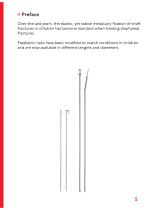
Preface Over the last years, the elastic, yet stable medullary fixation of shaft fractures in children has become standard when treating diaphyseal fractures. Paediatric nails have been modified to match conditions in children and are now available in different lengths and diameters.
Open the catalog to page 5
61273-100 Spiral Drill, D=2.7mm, L=l00mm, AO Connector conic, self-holding ♦ Elastic, yet stable fracture fixation ♦ Small skin incision ♦ Implant insertion at a side distant to the fracture (closed procedure) ♦ Fracture haematoma is left untouched (healing) ♦ Short hospital stay ♦ Distal lock for increased stability possible ♦ Version with loop and hook
Open the catalog to page 6
Indications & Contraindications Indications: • Ideal in cases of easily stabilisable fractures such as transverse or short oblique fractures of the medial diaphyseal area. • Also suitable for borderline indications in difficultly stabilisable fractures, long oblique fractures, rotation or fragmented fractures, at least of the upper extremity. • Pathologically benign fractures (e.g. juvenile bone cysts) Contraindications: • Pathological fractures without identification of the malignant/benign character, particulary in cases of malignant tumours • Existing infections in the fracture zone and operation...
Open the catalog to page 7
Biomechanics • The principle of the paediatric medullary nail is based on an “elastic, yet stable fixation”. • Due to the tolerance of the medullary nail to micro-movement, forces causing thrust and shear that may have negative impact on fracture healing will mainly be transformed into axial powers beneficial for fracture healing (pressure and traction). • Due to early movement (muscle tension) and weight-bearing, such positive powers will even be enhanced. As a consequence, rapid fracture consolidation based on extensive callus formation is observed. • Locking for increased stability is possible,...
Open the catalog to page 8
Instruments • The instruments are used to introduce the nails of different lengths (13 - 14cm) and diameters (2.0mm, 2.5mm, 3.0mm, 3.5mm and 4.0mm) into the medullary cavity. • The instruments provide easy handling, comply with needs of shaft fracture treatment in children and thus allow for rapid and profound repair. Presurgical • The patient is positioned with the leg isolated and covered with drapes (or on an extension table) using at least one fluoroscopy in order to display both planes simultaneously. • Identification of the nail length is either performed using the fluoroscopy under consideration...
Open the catalog to page 9
Surgical Technique • After skin incision, soft tissue is bluntly separated and then the drilling hole is established with the nail being carefully introduced into the created opening. • Using the awl, the drilling hole is established above the epiphysis maintaining a distance that allows for additional locking above the epiphyseal plate. • Perform the same procedure on the other side. • Then, both nails are being successively introduced beyond the fracture gap under fluoroscopy guidance. • In femoral fractures: • The medial nail is anchored in the femoral neck, the lateral nail under the greater...
Open the catalog to page 10
Postoperative treatment • Mobilization with forearm crutches, while increasing weight-bearing (depending on pain). Explantation After 6-9 months (depending on age and fracture), the material is removed using appropriate removal instruments. Retraction hook Summary The elastic stable feather nail is the ideal paediatric medullary nail when repairing shaft fractures in growing bones. Due to implant insertion at a distant site, the fracture can be stabilized without impairment of the periosteum or the fracture haematoma. The 3-point support offers sufficient stability. The optional distal lock prevents...
Open the catalog to page 11
Order list Children‘s Nail, D=2.0mm, L=130mm, with hook Children‘s Nail, D=2.0mm, L=140mm, with hook Children‘s Nail, D=2.0mm, L=150mm, with hook Children‘s Nail, D=2.0mm, L=160mm, with hook Children‘s Nail, D=2.0mm, L=170mm, with hook Children‘s Nail, D=2.0mm, L=180mm, with hook Children‘s Nail, D=2.0mm, L=190mm, with hook Children‘s Nail, D=2.0mm, L=200mm, with hook Children‘s Nail, D=2.0mm, L=210mm, with hook Children‘s Nail, D=2.5mm, L=150mm, with hook Children‘s Nail, D=2.5mm, L=160mm, with hook Children‘s Nail, D=2.5mm, L=170mm, with hook Children‘s Nail, D=2.5mm, L=180mm, with hook Children‘s...
Open the catalog to page 13
Spiral Drill, D=2.7mm, L=100mm, AO Connector Sterilization Tray, Children‘s Nail, Implants Sterilization Tray, Children‘s Nail, Instruments
Open the catalog to page 14
Reconditioning Manual The information below should help you in reconditioning medical devices. IMPORTANT INDICATIONS FOR DOCTORS & OPERATING THEATRE PERSONNEL This instruction leaflet refers to all supplied non-sterile implants and all reusable instruments from I.T.S. GmbH. Detailed information for the identification of the product (such as system classification, cat. no.) can be found in the product identification code and/ or on the packaging label. Make sure that you are familiar with the possible application, combinability and correct handling of the product. Please note that product systems...
Open the catalog to page 16
Manual disinfection If a cleaning agent without a disinfectant effect is used, separate disinfection must be carried out after manual cleaning. (Order: Decontamination for staff protection, cleaning, disinfection). Equipment: Commercially available disinfectant authorised for use with medical products from the VAH list. Manufacturer‘s information, e.g. concerning concentration, temperature and exposure time should be followed. The steps described in the table above also apply. Patient Information Implantation has consequences for the discomfort, mobility and general life circumstances of the...
Open the catalog to page 17All I.T.S. catalogs and technical brochures
 CTN - Cannulated Tibia Nail
28 Pages
 ufs
ufs1 Page
 DHL
DHL2 Pages
 ITS
ITS2 Pages
 SCL
SCL32 Pages
 SLS
SLS24 Pages
 OL - Olecranon Locking Plate
24 Pages
 PHL
PHL24 Pages
 PHLs
PHLs20 Pages
 CLS
CLS28 Pages
 ACLS
ACLS20 Pages
 CFN
CFN32 Pages
 OLS
OLS24 Pages
 SR Sacral Rods
20 Pages
 HCS
HCS24 Pages
 TOS Twist-Off Screw
20 Pages
 TLS
TLS20 Pages
 PRS-RX
32 Pages
 HLS
HLS20 Pages
 ES
ES20 Pages
 SR
SR20 Pages
 FL
FL24 Pages
 PL - Pilon Locking Plate small
12 Pages
 FLS
FLS24 Pages
 PFL
PFL20 Pages
 DTL
DTL24 Pages
 HTO
HTO24 Pages
 PTL
PTL32 Pages
 DFL
DFL32 Pages
 CAS
CAS40 Pages
 HOL
HOL24 Pages
 CAL
CAL20 Pages
 DUL
DUL24 Pages


Archived catalogs


- Bone plate
- Compression plate
- Metallic compression plate
- Locking compression plate
- Titanium compression plate
- Distal compression plate
- Compression bone screw
- Metallic compression bone screw
- Proximal compression plate
- Arthrodesis nail
- Forearm compression plate
- Lateral compression plate
- Medial compression plate
- Tibia compression plate
- General purpose compression bone screw
- Metallic intramedullary nail
- Humerus compression plate
- Radius compression plate
- Cannulated compression bone screw
- Arthrodesis plate