


HCS

HCS
The ITS Headless Compression Screws are designed for fracture treatment in trauma surgery and orthopedics. They feature a special head design to minimize soft tissue irritation and allow for minimally invasive procedures. Available in diameters ranging from 2.0 to 7.5mm, they cover a wide range of indications.
Properties
The screws are self-drilling, self-tapping, and cannulated for guided insertion. Made from TiAl6V4 ELI material, they offer improved fatigue strength and reduced risk of inflammation and allergy. The design includes a back-tapping flank for easier explantation and optimized compression between the head and shaft threads.
Instruments
The document lists various instruments required for the procedure, including guide wires, screwdrivers, cannulated spiral drills, depth gauges, and cortical counter sinks, each tailored to specific screw diameters.
Indications & Contraindications
Indications include fractures, corrective osteotomies, and pseudoarthrosis. Contraindications include advanced osteoporosis, infections in the fracture zone, and lack of patient compliance. The operation should be performed within hours after trauma or after swelling subsides.
Surgical Technique
The procedure involves temporary fixation with a K-Wire, optional predrilling, and the use of a cortical counter sink for solid bone. The screw is placed over the guide wire and inserted with a torque-shank. Postoperative treatment includes immediate physical therapy and gradual weight-bearing.
Postoperative Treatment
Physical therapy begins immediately, with partial weight-bearing allowed. Full weight-bearing is recommended after 10-16 weeks, following radiographic verification of bone healing.
Explantation
Implant removal is possible after bone healing, facilitated by the absence of cold welding. The procedure involves following the old scar and using the appropriate screwdriver.
Dotize® Technology
Dotize® involves anodization to improve the implant's surface properties, reducing inflammation risk and enhancing fatigue resistance. Two types of anodization are described, each with specific benefits and limitations.
Order List
The document provides a comprehensive list of available headless compression screws and associated instruments, detailing sizes and part numbers.
Reconditioning Manual
Guidelines for reconditioning medical devices are provided, emphasizing the importance of familiarization with product application and handling. Implants are single-use, and regular postoperative follow-ups are recommended.
Specifications and Recommendations
Ensure precise positioning and fastening of connections between implants and instruments during operations. MRI use with steel implants is prohibited; consult the MRI scanner manufacturer. Follow preventive measures when handling contaminated medical products; use protective gear like gloves. Adhere to stricter safety requirements for recycling medical products in certain countries. Non-sterile products must be prepared according to instructions before use. Avoid metal brushes for cleaning; use nylon brushes instead. Steam sterilization is recommended.
Procedures for Cleaning and Sterilization
Reusable instruments can be prepared repeatedly with minimal effects if procedures are followed. Instruments with aluminum can be damaged by alkaline cleaning agents. Remove surface dirt with disposable cloths; rinse hollow parts with saline solution if reconditioning follows immediately. Use washer-disinfectors conforming to EN ISO 15883 for automatic cleaning. Manual cleaning should be avoided unless necessary; use authorized cleaning agents and soft brushes. Instruments should be soaked in cleaning agents and disinfectants as per manufacturer instructions. Rinse thoroughly with running water and dry immediately.
Inspection and Maintenance
Inspect instruments for dirt and ensure movable parts function correctly. Use authorized lubricants for movable mechanisms. Ensure instruments can be easily reassembled.
Sterilization
Instruments should be laid out for steam access during sterilization. Use fractionated pre-vacuum procedure for sterilization, following EN 285 and EN ISO 17665.
Disposal and Responsibility
Follow hospital guidelines for disposal. Instruments returned to I.T.S. GmbH must be cleaned, disinfected, inspected, and sterilized.
Patient Information
Patients should be informed about post-implantation behavior and the importance of reporting any negative changes or accidents.
Symbols and Standards
Various symbols indicate prescription, single use, expiry date, sterilization methods, and compliance with standards like ISO 13485 and ISO 17664.
Catalog excerpts

Implants trauma Headless Compression Screw
Open the catalog to page 1
ATTENTION: The ITS. Headless Compression Screw are not suitable for use in the spinal column. The indication range for cannulated screws may vary according to the bone quality and physique of the patient.
Open the catalog to page 2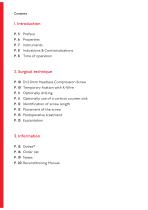
1. Introduction P. 5 Preface P. 6 Properties P. 7 Instruments P. 8 Indications & Contraindications P. 8 Time of operation 2. Surgical technique P. 10 D=2.0mm Headless Compression Screw P. 10 Temporary fixation with K-Wire P. 11 Optionally drilling P. 11 Optionally use of a cortical counter sink P. 12 Identification of screw length P. 12 Placement of the screw P. 13 Postoperative treatment P. 13 Explantation 3. Information P. 15 Dotize® P. 16 Order list P. 19 Notes P. 20 Reconditioning Manual
Open the catalog to page 3
Preface The Headless Compression Screws of ITS. with different diameters and lengths covering a wide range of indications for fracture treatment in trauma surgery and orthopedics. The special head design minimizes soft tissue irritation and enables a minimal invasive method.
Open the catalog to page 5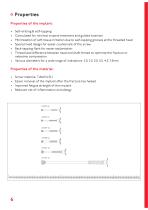
Properties Properties of the implant: • • • • • • Self-drilling & self-tapping Cannulated for minimal invasive treatment and guided insertion Minimization of soft tissue irritation due to self-tapping grooves at the threaded head Special head design for easier countersink of the screw Back-tapping flank for easier explantation Thread lead difference between head and shaft thread to optimize the fracture or osteotmy compression • Various diameters for a wide range of indications: 2.0, 2.5, 3.0, 3.5, 4.3, 7.5mm Screw material: TiAl6V4 ELI Easier removal of the implant after the fracture has healed...
Open the catalog to page 6
Guide Wires: 35094-100-H Guide Wire D=0.9mm for HCS D=2.0, 2.5, 3.0, 3.5mm 35164-150-h Guide Wire D=1.6mm for HCS D=4.3mm 35204-228-H Guide Wire D=2.0mm for HCS D=7.5mm Torque-Shank T7x80 for HCS D=2.0, 2.5mm Torque-Shank T7x80, cannulated for HCS D=2.0, 2.5mm Torque-Shank T9x100 for HCS D=3.0, 3.5mm Torque-Shank T9x100, cannulated for HCS D=3.0, 3.5mm Hexagon-Shank WS 2.5mm, cannulated for HCS D=4.3mm Hexagon-Shank WS 5.0mm, cannulated for HCS D=7.5mm Cannulated Spiral Drill: Spiral Drill, Cannulated, D=1.5mm for HCS D=2.0mm Spiral Drill, Cannulated, D=1.75mm for HCS D=2.5mm Spiral Drill, Cannulated,...
Open the catalog to page 7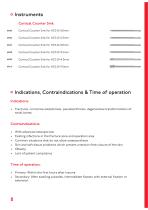
Cortical Counter Sink: 63405 Cortical Counter Sink for HCS D=2.0mm 63406 Cortical Counter Sink for HCS D=2.5mm 63407 Cortical Counter Sink for HCS D=3.0mm 63408 Cortical Counter Sink for HCS D=3.5mm 63409 Cortical Counter Sink for HCS D=4.3mm 63410 Cortical Counter Sink for HCS D=7.5mm o Indications, Contraindications & Time of operation Indications: ♦ Fractures, corrective osteotomies, pseudoarthrosis, degenerative transformations of small bones Contraindications: ♦ With advanced osteoporosis ♦ Existing infections in the fracture zone and operation area ♦ Common situations that do not allow...
Open the catalog to page 8
Surgical technique
Open the catalog to page 9
D=2.0mm Headless Compression Screw Example of use of a D=2.0mm Headless Compression Screw on metacarpal bone II and metatarsal bone I. Temporary fixation with K-Wire After placing a stab incision, provisionally fix the fracture segments using guide wire, steel, D=0.9mm, L=100mm, TR (35094-100-H). Subsequent control under fluoroscopy. Attention: To avoid bending the guide wire insert it carefully.
Open the catalog to page 10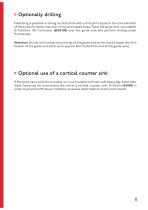
Optionally drilling Predrilling is possible in strong cortical bone with a drill point equal to the core diameter of the screw for easier insertion of the cannulated screw. Place the spiral drill, cannulated, D=1.5/1.0mm, AO Connector (61152-100) over the guide wire and perform drilling under fluoroscopy. Attention: Do not drill further than the tip of the guide wire as this would impair the firm fixation of the guide wire (drill up to approx. 5mm before the end of the guide wire). Optional use of a cortical counter sink If the bone has a solid bone quality or is surrounded with less soft tissue...
Open the catalog to page 11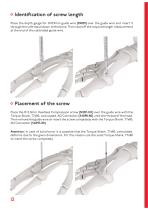
Identification of screw length Place the depth gauge for D=0.9mm guide wire (59029) over the guide wire and insert it through the soft tissue down to the bone. Then read off the required length measurement at the end of the calibrated guide wire. Placement of the screw Place the D=2.0mm Headless Compression screw (31207-XX) over the guide wire with the Torque-Shank, T7x80, cannulated, AO Connector, (54098-80) until the thread of the head. Then remove the guide wire an insert the screw completely with the Torque-Shank, T7x80, AO Connector (54097-80). Attention: In case of solid bone, it is possible...
Open the catalog to page 12
Finally, confirm correct position under fluoroscopy. Postoperative treatment • • • • Physical therapy immediately following surgery (no immobilization required) Partial weight-bearing Full weight-bearing after week 10-16 Weight-bearing after radiographic verification of the healed bone ATTENTION: The postoperative treatment may vary depending on the patient‘s age, bone quality or type of fracture. Explantation • Removal is possible, if desired by the patient. This is facilitated by the fact that cold welding never occurs. • Implant removal is performed after radiographic verification, vice versa...
Open the catalog to page 13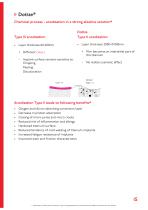
Dotize® Chemical process - anodization in a strong alkaline solution* Dotize Type II anodization • Layer thickness 2000-10 000nm + Film becomes an interstitial part of the titanium + Different colors - Implant surface remains sensitive to: Chipping Peeling Discoloration - No visible cosmetic effect Anodization Type II leads to following benefits* • • • • • • • • Oxygen and silicon absorbing conversion layer Decrease in protein adsorption Closing of micro pores and micro cracks Reduced risk of inflammation and allergy Hardened titanium surface Reduced tendency of cold welding of titanium implants...
Open the catalog to page 15
Headless Compression Screw, Cannulated, D=2.0mm, L=I0mm Headless Compression Screw, Cannulated, D=2.0mm, L=12mm Headless Compression Screw, Cannulated, D=2.0mm, L=14mm Headless Compression Screw, Cannulated, D=2.0mm, L=16mm Headless Compression Screw, Cannulated, D=2.0mm, L=18mm Headless Compression Screw, Cannulated, D=2.0mm, L=20mm Headless Compression Screw, Cannulated, D=2.0mm, L=22mm Headless Compression Screw, Cannulated, D=2.0mm, L=24mm Headless Compression Screw, Cannulated, D=2.0mm, L=26mm Headless Compression Screw, Cannulated, D=2.0mm, L=28mm Headless Compression Screw, Cannulated,...
Open the catalog to page 16All I.T.S. catalogs and technical brochures
 CTN - Cannulated Tibia Nail
28 Pages
 ufs
ufs1 Page
 DHL
DHL2 Pages
 ITS
ITS2 Pages
 SCL
SCL32 Pages
 SLS
SLS24 Pages
 OL - Olecranon Locking Plate
24 Pages
 PHL
PHL24 Pages
 PHLs
PHLs20 Pages
 CLS
CLS28 Pages
 ACLS
ACLS20 Pages
 CFN
CFN32 Pages
 OLS
OLS24 Pages
 SR Sacral Rods
20 Pages
 TOS Twist-Off Screw
20 Pages
 TLS
TLS20 Pages
 PRS-RX
32 Pages
 HLS
HLS20 Pages
 ES
ES20 Pages
 SR
SR20 Pages
 FL
FL24 Pages
 PL - Pilon Locking Plate small
12 Pages
 FLS
FLS24 Pages
 PFL
PFL20 Pages
 DTL
DTL24 Pages
 HTO
HTO24 Pages
 PTL
PTL32 Pages
 DFL
DFL32 Pages
 CAS
CAS40 Pages
 FCN
FCN20 Pages
 HOL
HOL24 Pages
 CAL
CAL20 Pages
 DUL
DUL24 Pages


Archived catalogs


- Bone plate
- Compression plate
- Metallic compression plate
- Locking compression plate
- Titanium compression plate
- Distal compression plate
- Compression bone screw
- Metallic compression bone screw
- Proximal compression plate
- Arthrodesis nail
- Forearm compression plate
- Lateral compression plate
- Medial compression plate
- Tibia compression plate
- General purpose compression bone screw
- Metallic intramedullary nail
- Humerus compression plate
- Radius compression plate
- Cannulated compression bone screw
- Arthrodesis plate