


PFL

PFL
The PROlock Fibula Locking Plate is designed for the osteosynthesis of distal fibula fractures, featuring flexible screw placement and a multi-directional locking mechanism. Made from titanium, it enhances fatigue strength and reduces risks of cold welding and inflammation.
Specifications
The plate is available in left/right versions with options of 4, 6, or 8 holes. Screws are made from TiAl6V4 ELI, with cortical screws at 2.7mm diameter and cancellous screws at 3.0mm diameter.
Indications & Contraindications
Indicated for dislocated ankle fractures (Weber B+C). Contraindications include infections, obesity, and lack of patient compliance. Surgery can be performed immediately post-injury or after swelling subsides.
Surgical Technique
Pre-operative preparation involves patient positioning and anesthesia. Implantation includes a lateral incision, fracture cleaning, and plate fixation with screws. Postoperative care involves splinting and physical therapy, with implant removal possible after 1.5 years.
Material Properties
The titanium plate offers improved fatigue strength and reduced allergy risk. The Dotize® anodization process enhances surface hardness and reduces cold welding.
Reconditioning Manual
Guidelines for cleaning and sterilizing non-sterile implants and reusable instruments emphasize the use of soft brushes and steam sterilization. Automatic cleaning is preferred, with manual methods as a secondary option.
Warnings
Implants are single-use and should not be altered. Regular follow-ups are necessary, and MRI use with steel implants is prohibited. Proper handling and cleaning are crucial to maintain implant integrity.
Cleaning and Disinfection
Follow manufacturer’s instructions regarding concentration, temperature, and exposure time. Ensure all visible dirt is removed; repeat cleaning if necessary. Use authorized lubricants for movable mechanisms.
Inspection and Maintenance
Inspect instruments for cleanliness and functionality. Check mobility of parts and ease of reassembly.
Packaging
Delivery packaging is for transport only. The hospital is responsible for assembly, inspection, and packaging according to standards using sterile barrier systems.
Sterilization
Arrange instruments for steam access. Dismantle instruments for sterilization. Use fractionated pre-vacuum procedure per EN 285/EN 13060 and EN ISO 17665. Recommended steam sterilization: 134°C for 5-18 minutes.
Disposal
Follow hospital guidelines. Dispose of instruments that are worn or improperly functioning.
Responsibility for Lent Instruments
Ensure proper care to extend service life. Return instruments to I.T.S. GmbH with confirmation of decontamination.
Important Information
Reconditioning instructions are validated by the manufacturer. Reconditioners must ensure effective reconditioning and validate processes.
Patient Information
Inform patients about post-implantation behavior and the importance of reporting changes or accidents.
Symbols
Includes prescription, single use, expiry date, sterilization methods, order number, material, package content, size, and instructions.
Contact Information
ITS. GmbH, Autal 28, 8301 Lassnitzhöhe, Austria. Tel: +43 (0) 316 / 211 21 0, Email: [email protected]
Catalog excerpts

Implants trauma PROlock Fibula Locking Plate
Open the catalog to page 1
All ITS plates are preformed anatomically as a matter of principle. If adjustment of the plate to the shape of the bone is required, this is possible by carefully bending gently in one direction once. Particular care is required when bending in the region of a plate hole, as deformation of the plate may lead to a failure of the locking mechanism. The plate must not be buckled or bent several times. This is particularly important in the case of titanium implants, to prevent material fatigue and subsequent failure. The method of bending is the conscious responsibility of the operating doctor; I.T.S....
Open the catalog to page 2
1. Introduction P. 5 Preface P. 6 Screws P. 7 Properties P. 8 Indications & Contraindications P. 8 Time of operation 2. Surgical Technique P. 10 Pre-operative patient preparation P. 10 Implantation P. 11 Postoperative treatment P. 11 Explantation P. 11 Case studies 3. Information P. 13 Locking P. 13 Dotize® P. 14 Order list P. 16 Reconditioning Manual P. 18 Notes
Open the catalog to page 3
Preface The PROlock Fibula Locking Plate is a proven osteosynthesis system for various fractures of the distal fibula. The special feature of this implant is the free choice of screw placement. The user is able to set any desired screw in any hole either locking or non-locking screw (except oblong hole). The free choice of screw angulation (+/- 15°, see page 13) provides an advantage in fracture treatment, especially in the case of complex fractures.
Open the catalog to page 5
Spiral Drill, D=2.0mm, L=100mm, AO Connector Self-holding sleeve, Screwdriver, Torque 9 Cancellous Screw, locking, D=3.0mm Spiral Drill, D=2.0mm, L=100mm, AO Connector Self-holding sleeve, Screwdriver, Torque 9
Open the catalog to page 6
Properties Properties of the material: • Plate material: Titanium • Material of screws: TiAl6V4 ELI • Easier removal of the implant after the fracture has healed • Improved fatigue strength of the implant • Reduced risk of cold welding • Reduced risk of inflammation and allergy Multi-directional Locking Anatomical plate design Ideal positioning due to oblong hole Left/right version Plate lengths: 4, 6, 8-hole
Open the catalog to page 7
Indications, Contraindications & Time of operation Indications: • Dislocated ankle-fractures group B+C according to Weber (with or without comminuted zones) Existing infections in the fracture zone and operation area Common situations that do not allow osteosynthesis Obesity Lack of patient compliance Time of operation: • Immediately after injury • After regression of the swelling
Open the catalog to page 8
Surgical Technique
Open the catalog to page 9
Pre-operative patient preparation • Supine position • Primary Tourniquet • General or regional anesthesia Sterile washing and covering Typical distal fibula approach (lateral incision) Uncovering and cleaning of the fracture Open reduction and temporary fixation with clamps Temporary fixation with a lag screw possible Positioning of the anatomically formed fibula plate (left/right) to the reduced distal fibula and fixation with a D=2.7mm Cortical Screw through the oblong hole Fluoroscopic control of the reduction and plate position in a/p and lateral view Fill distal plate holes with D=3.0mm...
Open the catalog to page 10
Postoperative treatment • Splinted shank for 2 weeks • Physical therapy • 6-8 weeks rest Explantation If desired by the patient, the implant can be removed. Removal should be performed at the earliest 1 1/2 years later or after radiographic verification of the healed bone. The problem of cold welding was resolved by using a special surface treatment (for further information see page 13). Case studies
Open the catalog to page 11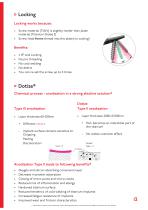
Locking Locking works because: • Screw material (TiAlV) is slightly harder than plate material (Titanium Grade 2) • Screw head forms thread into the plate (no cutting) ± 15° and Locking No pre threading No cold welding No debris You can re-set the screw up to 3 times Dotize® Chemical process - anodization in a strong alkaline solution* Dotize Type II anodization • Layer thickness 2000-10 000nm + Film becomes an interstitial part of the titanium + Different colors - Implant surface remains sensitive to: Chipping Peeling Discoloration - No visible cosmetic effect Dotize® Type - II Anodization Type...
Open the catalog to page 13
Order list Fibula Plate PROlock, 4-hole, Right 21221-4 Fibula Plate PROlock, 4-hole, Left 21222-4 Fibula Plate PROlock, 6-hole, Right 21221-6 Fibula Plate PROlock, 6-hole, Left 21222-6 Fibula Plate PROlock, 8-hole, Right 21221-8 Fibula Plate PROlock, 8-hole, Left 21222-8 Cancellous Screw, Locking, D=3.0mm, L=10mm Cancellous Screw, Locking, D=3.0mm, L=12mm Cancellous Screw, Locking, D=3.0mm, L=14mm Cancellous Screw, Locking, D=3.0mm, L=16mm Cancellous Screw, Locking, D=3.0mm, L=18mm Cancellous Screw, Locking, D=3.0mm, L=20mm Cortical Screw, D=2.7mm, L=10mm Cortical Screw, D=2.7mm, L=12mm Cortical...
Open the catalog to page 14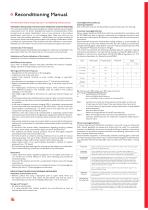
Reconditioning Manual The information below should help you in reconditioning medical devices. IMPORTANT INDICATIONS FOR DOCTORS & OPERATING THEATRE PERSONNEL This instruction leaflet refers to all supplied non-sterile implants and all reusable instruments from I.T.S. GmbH. Detailed information for the identification of the product (such as system classification, cat. no.) can be found in the product identification code and/ or on the packaging label. Make sure that you are familiar with the possible application, combinability and correct handling of the product. Please note that product systems...
Open the catalog to page 16
Manual disinfection If a cleaning agent without a disinfectant effect is used, separate disinfection must be carried out after manual cleaning. (Order: Decontamination for staff protection, cleaning, disinfection). Equipment: Commercially available disinfectant authorised for use with medical products from the VAH list. Manufacturer‘s information, e.g. concerning concentration, temperature and exposure time should be followed. The steps described in the table above also apply. Patient Information Implantation has consequences for the discomfort, mobility and general life circumstances of the...
Open the catalog to page 17All I.T.S. catalogs and technical brochures
 CTN - Cannulated Tibia Nail
28 Pages
 ufs
ufs1 Page
 DHL
DHL2 Pages
 ITS
ITS2 Pages
 SCL
SCL32 Pages
 SLS
SLS24 Pages
 OL - Olecranon Locking Plate
24 Pages
 PHL
PHL24 Pages
 PHLs
PHLs20 Pages
 CLS
CLS28 Pages
 ACLS
ACLS20 Pages
 CFN
CFN32 Pages
 OLS
OLS24 Pages
 SR Sacral Rods
20 Pages
 HCS
HCS24 Pages
 TOS Twist-Off Screw
20 Pages
 TLS
TLS20 Pages
 PRS-RX
32 Pages
 HLS
HLS20 Pages
 ES
ES20 Pages
 SR
SR20 Pages
 FL
FL24 Pages
 PL - Pilon Locking Plate small
12 Pages
 FLS
FLS24 Pages
 DTL
DTL24 Pages
 HTO
HTO24 Pages
 PTL
PTL32 Pages
 DFL
DFL32 Pages
 CAS
CAS40 Pages
 FCN
FCN20 Pages
 HOL
HOL24 Pages
 CAL
CAL20 Pages
 DUL
DUL24 Pages


Archived catalogs


- Bone plate
- Compression plate
- Metallic compression plate
- Locking compression plate
- Titanium compression plate
- Distal compression plate
- Compression bone screw
- Metallic compression bone screw
- Proximal compression plate
- Arthrodesis nail
- Forearm compression plate
- Lateral compression plate
- Medial compression plate
- Tibia compression plate
- General purpose compression bone screw
- Metallic intramedullary nail
- Humerus compression plate
- Radius compression plate
- Cannulated compression bone screw
- Arthrodesis plate