


PL - Pilon Locking Plate small

PL - Pilon Locking Plate small
Catalog excerpts

PILON LOCKING PLATE small emergency team for broken bones®
Open the catalog to page 1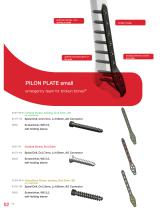
optional locking - non locking in shaft optimal reconstruction of the joint PILON PLATE small emergency team for broken bones® Cortical Screw, locking, D=3.5mm, SH Spiral Drill, D=2.7mm, L=100mm, AO Connector Screwdriver, WS 2.5, self-holding sleeve Spiral Drill, D=2.7mm, L=100mm, AO Connector Screwdriver, WS 2.5, self-holding sleeve Cancellous Screw, locking, D=4.2mm, SH Spiral Drill, D=2.5mm, L=180mm, AO Connector Screwdriver, WS 2.5, self-holding sleeve smaller design locking between screws and plate
Open the catalog to page 2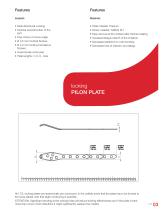
• Multi-directional Locking • Free choice of screw angle • Anatomically contoured • Plate lengths: 4, 6, 8 - hole • Plate material: Titanium • Easy removal of the implant after fracture healing • Increased fatigue strenth of the implants • Decreased addiction to cold Ponding • Decreased risk of infection and allergy Ml lllllll MM lllllll Mill llllllllllllllllllllllll MM lllllll Mill MlllllllllllIlM All I.T.S. locking plates are anatomically pre-contoured. In the unlikely event that the plate has to Pe formed to the Pone please note that slight contouring is possiPle. ATTENTION: Significant Pending...
Open the catalog to page 3
Locking Pilon Plate for the treatment of complex fractures of the tibial pilon Fractures of the tibial pilon of AO classification C2 and C3 present a serious problem for the reposition of the fracture, and especially for stabilization of the reposition results until healing has occurred. Collapsing of comminuted zones or partial lysis of cortical bone chips or cancellous often lead to defective positions in the upper ankle joint despite exact primary reposition. For this reason we developed a locking Pilon Plate in 2002. It consists of titanium, is low profile and is anatomically contoured in...
Open the catalog to page 4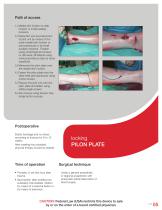
Path of access 1.) Medial skin incision or stab incision or small auxiliary incisions. 2.) Reduction and reconstruction of joint unit by means of the small medial skin incision or percutaneously or by small auxiliary incisions. Fixation using small-fragment screws or drill wires; fill defects using corticocancellous chips or bone substitute. 3.) Maneuver the pilon plate over the medial skin incision. 4.) Fasten the pilon plate onto the tibial shaft percutaneously using cortex screws. 5.) Reduce the joint unit onto the pilon plate and fasten using stable-angle screws. 6.) Skin closure using tension-free...
Open the catalog to page 5
Results Up to now, persons treated with locking Pilon Plates have been men between the ages of 29 and 50. These include both fresh pilon fractures and corrections after deformed healed fractures. The fresh fractures were all C3 fractures, and the corrections were C3- and A2- fractures after primary treatment with locking pin. In all cases closure of the wound was achieved and primary healing took place. The cases which we have observed up to now have shown no change of reposition results or correction results up to bony consolidation, which occurred between 8 and 12 weeks postoperatively Up to...
Open the catalog to page 6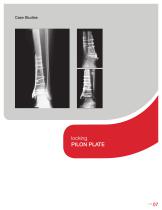
Case Studies locking PILON PLATE
Open the catalog to page 7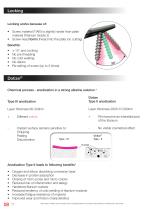
Locking Locking works because of: • Screw material (TiAlV) is slightly harder than plate material (Titanium Grade 2) • Screw head forms thread into the plate (no cutting) Benefits: • • • • • ± 15° and Locking No pre threading No cold welding No debris Re-setting of screw (up to 3 times) Dotize® Chemical process - anodization in a strong alkaline solution * Type III anodization Dotize Type II anodization Different colors Film become an interstitial part of the titanium Implant surface remains sensitive to: Chipping Peeling Type - III Discoloration No visible cosmetical effect Dotize® Type - II...
Open the catalog to page 8
Sterilization Manual The following remarks should serve as a guideline in the sterilization of medical products. IMPORTANT INDICATIONS FOR DOCTORS AND OPERATING THEATRE PERSONNEL This instruction leaflet refers to all supplied nonsterile implants and all reusable instruments from I.T.S. GmbH. Detailed information for the identification of the product (such as system classification, cat. no.) can be found in the product identification code and/ or on the packaging label. Make sure that you are familiar with the possible application, combinability and correct handling of the product. Please note...
Open the catalog to page 10
Disinfection Equipment: Commercially available disinfectants authorized for use with medical products e.g. MEDICLEAN FORTE) can be used (but only according to the instructions of the disinfectant producer). In the case of automatic cleaning, a final rinse cycle at 90 °C for 5 minutes can be carried out at the end to provide thermal disinfection. Drying Drying as part of the cleaning/ disinfection cycle should not exceed 110 °C. Checking, Maintenance and Inspection • Each instrument or implant is to be inspected carefully to make sure that all visible dirt has been removed. If any ingrained dirt...
Open the catalog to page 11
I.T.S. USA LLC 1778 Park Avenue N, Suite 200 Maitland, FL 32751 © I.T.S. GmbH Graz/Austria 2012. Subject to technical alterations, errors and misprints excepted.
Open the catalog to page 12All I.T.S. catalogs and technical brochures
 CTN - Cannulated Tibia Nail
28 Pages
 ufs
ufs1 Page
 DHL
DHL2 Pages
 ITS
ITS2 Pages
 SCL
SCL32 Pages
 SLS
SLS24 Pages
 OL - Olecranon Locking Plate
24 Pages
 PHL
PHL24 Pages
 PHLs
PHLs20 Pages
 CLS
CLS28 Pages
 ACLS
ACLS20 Pages
 CFN
CFN32 Pages
 OLS
OLS24 Pages
 SR Sacral Rods
20 Pages
 HCS
HCS24 Pages
 TOS Twist-Off Screw
20 Pages
 TLS
TLS20 Pages
 PRS-RX
32 Pages
 HLS
HLS20 Pages
 ES
ES20 Pages
 SR
SR20 Pages
 FL
FL24 Pages
 FLS
FLS24 Pages
 PFL
PFL20 Pages
 DTL
DTL24 Pages
 HTO
HTO24 Pages
 PTL
PTL32 Pages
 DFL
DFL32 Pages
 CAS
CAS40 Pages
 FCN
FCN20 Pages
 HOL
HOL24 Pages
 CAL
CAL20 Pages
 DUL
DUL24 Pages


Archived catalogs


- Bone plate
- Compression plate
- Metallic compression plate
- Locking compression plate
- Titanium compression plate
- Distal compression plate
- Compression bone screw
- Metallic compression bone screw
- Proximal compression plate
- Arthrodesis nail
- Forearm compression plate
- Lateral compression plate
- Medial compression plate
- Tibia compression plate
- General purpose compression bone screw
- Metallic intramedullary nail
- Humerus compression plate
- Radius compression plate
- Cannulated compression bone screw
- Arthrodesis plate