


SLS

SLS
The Straight Locking Plates System by ITS is designed for shaft fractures, offering flexibility in screw placement and angulation. The plates are anatomically preformed and can be bent once in one direction. Care is needed to avoid deformation near plate holes to prevent locking mechanism failure.
Pre-operative Preparation: Involves patient preparation and exposure using x-ray fluoroscopy. Anesthesia can be general or regional, with a tourniquet applied if necessary.
Plate Insertion: Used for anatomical reconstruction and corrective osteotomies. Contraindications include advanced osteoporosis, infections, and lack of patient compliance. Temporary fixation is achieved with guide wires, verified under fluoroscopy.
Screw Placement: Specific drill guides and screwdrivers are used for inserting cortical and locking screws. Locking screws should not be placed close to the fracture.
Drainage is recommended for 12-24 hours, followed by bandage dressing for two weeks. Physical therapy is advised for 5-7 weeks. Implant removal can be considered after 6 months to 1.5 years, post radiographic verification of healing.
The plates are made of titanium, and screws are made of TiAl6V4 ELI. The implants offer improved fatigue strength, reduced risk of cold welding, and inflammation. The Dotize® anodization process enhances surface properties, reducing protein adsorption and increasing fatigue resistance.
Detailed ordering information is provided for various plate sizes and associated screws and instruments.
Cortical screws are available in lengths from 20mm to 90mm, all with a diameter of 4.5mm. Locking cortical screws have similar dimensions. Cancellous screws, both locking and threaded, have a diameter of 5.9mm and lengths from 16mm to 90mm. Additional tools include screwdrivers, spiral drills, depth gauges, and sterilization trays.
Guidelines for reconditioning medical devices emphasize understanding product identification and handling. Implants are for temporary stabilization and should be removed after consolidation.
Determined by current medical practices. No allergic reactions have been identified with titanium implants, but steel implants may cause allergies.
- Follow packaging instructions and use implants only once.
- Avoid surface damage and alterations to implants.
- Do not combine implants from different producers.
- Regular postoperative examinations are necessary.
- Use MRI with caution and consult the manufacturer.
- Handle contaminated products with care and use protective measures.
- Non-sterile products must be prepared thoroughly before use.
- Use steam for sterilization and avoid metal brushes for cleaning.
Automatic cleaning and disinfection should be performed using a washer-disinfector conforming to EN ISO 15883 standards. Manual cleaning is less effective and should be avoided unless necessary. Instruments should be inspected for cleanliness and functionality before packaging and sterilization.
Use the fractionated pre-vacuum procedure for sterilization, ensuring steam reaches all surfaces. Follow EN 285 and EN ISO 17665 standards.
Disposal should follow hospital guidelines. Hospitals are responsible for the maintenance and inspection of instruments lent by I.T.S. GmbH.
Instruments that are no longer functioning correctly due to wear, misuse, or improper care must be disposed of. Medical products returned to I.T.S. GmbH require cleaning, disinfection, inspection, and final sterilization, accompanied by a decontamination confirmation.
The manufacturer has validated instructions for reconditioning medical devices deemed suitable for reuse. The reconditioner must ensure the process achieves desired results through validation and routine inspections. Deviations from instructions should be evaluated for efficiency and potential negative consequences.
Patients should be informed about appropriate behavior post-implantation and the importance of reporting any negative changes, falls, or accidents related to the implant.
The document lists various symbols related to medical devices, including prescription, single use, expiry date, sterilization methods, and standards such as RL 93/42/EWG, ÖNORM EN ISO 13485, and ISO 17664.
I.T.S. USA is located at 1778 Park Avenue N, Suite 200, Maitland, FL 32751. Contact via phone at 877-971-8054 or email at [email protected].
Catalog excerpts

Implants trauma Straight Locking Plates System
Open the catalog to page 1
CAUTION: Federal Law (USA) restricts this device to sale by or on the order of a board certified physician. WARNING: If there is no sufficient bone healing, wrong or incomplete postoperative care, plate might break. All ITS plates are preformed anatomically as a matter of principle. If adjustment of the plate to the shape of the bone is required, this is possible by carefully bending gently in one direction once. Particular care is required when bending in the region of a plate hole, as deformation of the plate may lead to a failure of the locking mechanism. The plate must not be buckled or bent...
Open the catalog to page 2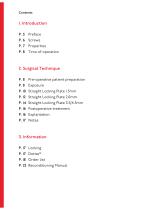
1. Introduction P. 5 Preface P. 6 Screws P. 7 Properties P. 8 Time of operation 2. Surgical Technique P. 8 Pre-operative patient preparation P. 8 Exposure P. 10 Straight Locking Plate 1.5mm P. 12 Straight Locking Plate 2.0mm P. 14 Straight Locking Plate 3.5/4.5mm P. 16 Postoperative treatment P. 16 Explantation P. 17 Notes 3. Information P. 17 Locking P. 17 Dotize® P. 18 Order list P. 22 Reconditioning Manual
Open the catalog to page 3
Preface ITS. provides various Straight Locking Plates with different plate strengths and lengths covering a wide range of indications for shaft fractures. The special feature of these implants is the free choice of screw placement. The user is able to set any desired screw in any hole either locking or non-locking screw (except long hole). The free choice of screw angulation (+/- 15°, see page 17) provides an advantage in fracture treatment, especially in the case of complex fractures.
Open the catalog to page 5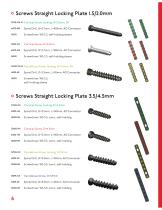
Screws Straight Locking Plate 1.5/2.0mm 37351-XX-N Cortical Screw, locking, D=3.5mm, SH Spiral Drill, D=2.7mm, L=100mm, AO Connector Screwdriver, WS 2.5, self-holding sleeve Spiral Drill, D=2.7mm, L=100mm, AO Connector Screwdriver, WS 2.5, self-holding sleeve Cancellous Screw, locking, D=4.2mm, SH Spiral Drill, D=2.5mm, L=110mm, AO Connector Screwdriver, WS 2.5, self-holding sleeve Screws Straight Locking Plate 3.5/4.5mm 37455-XX Cortical Screw, locking, D=4.5mm Spiral Drill, D=3.2mm, L=145mm, AO Connector Screwdriver, WS 3.5, conic, self-holding Spiral Drill, D=3.2mm, L=145mm, AO Connector Screwdriver,...
Open the catalog to page 6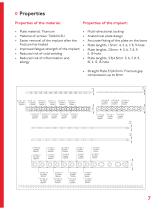
Properties Properties of the material: • Plate material: Titanium • Material of screws: TiAl6V4 ELI • Easier removal of the implant after the fracture has healed • Improved fatigue strength of the implant • Reduced risk of cold welding • Reduced risk of inflammation and allergy • Straight Plate 3.5/4.5mm: Fracture gap compression up to 8mm
Open the catalog to page 7
Time of operation • Immediately after trauma or delayed • After regression of swelling Pre-operative patient preparation • General anaesthesia, regional anaesthesia or combined can be used • Tourniquet/partial deprivation of the blood supply Exposure • Intra-operative x-ray fluoroscopy observation is required during the entire procedure • Incision to the limb subchondral bone fracture site • Transection of musculature if possible along the course of muscle fibers
Open the catalog to page 8
Surgical Technique
Open the catalog to page 9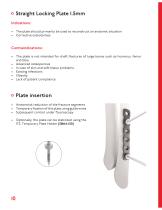
Straight Locking Plate 1.5mm Indications: • The plate should primarily be used to reconstruct an anatomic situation • Corrective osteotomies Contraindications: • The plate is not intended for shaft fractures of large bones such as humerus, femur and tibia • Advanced osteoporosis • In case of skin and soft tissue problems • Existing infections • Obesity • Lack of patient compliance Plate insertion • Anatomical reduction of the fracture segments • Temporary fixation of the plate using guide wires • Subsequent control under fluoroscopy • Optionally, the plate can be stabilized using the ITS. Temporary...
Open the catalog to page 10
Placement of the screws Use the drill guide, D=2.7/2.0mm (62202) to bore with the spiral drill, D=2.7mm, L=100mm, AO Connector (61273-100) into the plate holes closest to the fracture. Use the screwdriver, WS 2.5, self-holding sleeve (56252) to insert D=3.5mm cortical screws (32351XX) of appropriate lengths determined previously with the depth gauge, solid small fragment screws (59022). Attention: It is recommended that locking screws are not used close to the fracture. Subsequently, place either D=3.5mm cortical or locking cortical screws (32351-XX/37351-XX-N) in plate holes far to the fracture....
Open the catalog to page 11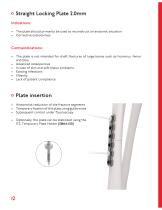
Straight Locking Plate 2.0mm Indications: • The plate should primarily be used to reconstruct an anatomic situation • Corrective osteotomies Contraindications: • The plate is not intended for shaft fractures of large bones such as humerus, femur and tibia • Advanced osteoporosis • In case of skin and soft tissue problems • Existing infections • Obesity • Lack of patient compliance Plate insertion • Anatomical reduction of the fracture segments • Temporary fixation of the plate using guide wires • Subsequent control under fluoroscopy • Optionally, the plate can be stabilized using the ITS. Temporary...
Open the catalog to page 12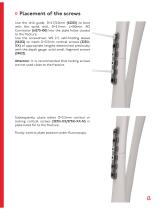
Placement of the screws Use the drill guide, D=2.7/2.0mm (62202) to bore with the spiral drill, D=2.7mm, L=100mm, AO Connector (61273-100) into the plate holes closest to the fracture. Use the screwdriver, WS 2.5, self-holding sleeve (56252) to insert D=3.5mm cortical screws (32351XX) of appropriate lengths determined previously with the depth gauge, solid small fragment screws (59022). Attention: It is recommended that locking screws are not used close to the fracture. Subsequently, place either D=3.5mm cortical or locking cortical screws (32351-XX/37351-XX-N) in plate holes far to the fracture....
Open the catalog to page 13
Straight Locking Plate 3.5/4.5mm Indications: • All diaphyseal fractures, especially when compression for fracture treatment is needed • Corrective osteotomies Advanced osteoporosis In case of skin and soft tissue problems Existing infections Obesity Lack of patient compliance Plate insertion • Anatomical reduction of the fracture parts • Temporary fixation of the plate using forceps • Subsequent control under fluoroscopy
Open the catalog to page 14All I.T.S. catalogs and technical brochures
 CTN - Cannulated Tibia Nail
28 Pages
 ufs
ufs1 Page
 DHL
DHL2 Pages
 ITS
ITS2 Pages
 SCL
SCL32 Pages
 OL - Olecranon Locking Plate
24 Pages
 PHL
PHL24 Pages
 PHLs
PHLs20 Pages
 CLS
CLS28 Pages
 ACLS
ACLS20 Pages
 CFN
CFN32 Pages
 OLS
OLS24 Pages
 SR Sacral Rods
20 Pages
 HCS
HCS24 Pages
 TOS Twist-Off Screw
20 Pages
 TLS
TLS20 Pages
 PRS-RX
32 Pages
 HLS
HLS20 Pages
 ES
ES20 Pages
 SR
SR20 Pages
 FL
FL24 Pages
 PL - Pilon Locking Plate small
12 Pages
 FLS
FLS24 Pages
 PFL
PFL20 Pages
 DTL
DTL24 Pages
 HTO
HTO24 Pages
 PTL
PTL32 Pages
 DFL
DFL32 Pages
 CAS
CAS40 Pages
 FCN
FCN20 Pages
 HOL
HOL24 Pages
 CAL
CAL20 Pages
 DUL
DUL24 Pages


Archived catalogs


- Bone plate
- Compression plate
- Metallic compression plate
- Locking compression plate
- Titanium compression plate
- Distal compression plate
- Compression bone screw
- Metallic compression bone screw
- Proximal compression plate
- Arthrodesis nail
- Forearm compression plate
- Lateral compression plate
- Medial compression plate
- Tibia compression plate
- General purpose compression bone screw
- Metallic intramedullary nail
- Humerus compression plate
- Radius compression plate
- Cannulated compression bone screw
- Arthrodesis plate