


TLS

TLS
The Tubular Locking Plates System is designed for osteosynthesis in diaphyseal and metaphyseal fractures, allowing flexible screw placement and angulation to enhance treatment for complex fractures. The system includes various screws and tools such as cortical and stabilization screws, spiral drills, and screwdrivers.
The plates are made of titanium, offering improved fatigue strength and reduced risks of cold welding and inflammation. They are anatomically shaped and available in diaphyseal and distal versions, with multiple fixation points. The system supports multi-directional locking and offers a range of plate lengths and strengths.
The system is indicated for fractures, osteotomies, and degenerative transformations, primarily in the fibula, radius, and ulna, and pediatric humeral and tibia fractures. It is contraindicated for large bone shaft fractures, advanced osteoporosis, and situations preventing tension-free skin closure.
Pre-operative preparation involves anatomical reduction and temporary fixation with guide wires. Screws are placed using a drill guide and checked under fluoroscopy. Postoperative treatment includes immediate physical therapy, with movement fixators used if necessary.
The Dotize® process enhances titanium surface properties, reducing inflammation risk and improving wear resistance. Locking mechanisms allow for screw angulation and re-setting without pre-threading.
Implants are single-use, while instruments are reusable. Cleaning involves automatic or manual procedures, with specific guidelines for disinfection and drying. The use of steam sterilization is recommended.
Manual cleaning should be avoided unless necessary, as it is less effective than automatic processes. It can support automatic reconditioning for heavily soiled instruments. Recommended equipment includes a cleaning agent with a pH of 9-11, nylon brushes, and running water.
Instruments should be fully submerged in a cleaning agent and disinfectant solution, following manufacturer instructions for concentration, temperature, and exposure time. Use agents from the VAH list, such as Sekusept® Aktiv 2% by ECOLAB. Avoid highly alkaline or acidic additives, and ensure the cleaning agent is suitable for ultrasound cleaning.
Instruments should be treated in an ultrasound bath for 5 minutes, followed by a 15-minute soak in the solution.
Rinse instruments thoroughly with tap water, ensuring no contaminants remain. Pay special attention to hard-to-reach areas. Use purified water for final rinsing and dry immediately.
If the cleaning agent lacks disinfectant properties, separate disinfection is required. Follow manufacturer instructions for disinfectant use.
Inspect each instrument for cleanliness and functionality. Use lubricants for movable parts and ensure reassembled instruments fit together easily.
Packaging should follow standard guidelines and use sterile barrier systems. Sterilization should be done using the fractionated pre-vacuum procedure, adhering to EN 285 and EN ISO 17665 standards. Recommended steam sterilization parameters are 134°C for 5 to 18 minutes.
Follow hospital guidelines for disposal. Instruments returned to I.T.S. GmbH must be cleaned, disinfected, inspected, and sterilized, with confirmation of decontamination.
The instructions are validated for reconditioning medical devices. Reconditioners must ensure the process achieves desired results through validation and routine inspections.
Patients should be informed about post-implantation behavior and the importance of reporting any negative changes or incidents.
The document includes symbols for prescription, single use, sterilization methods, and more. Contact information for I.T.S. USA is provided.
Catalog excerpts

Implants trauma Tubular Locking Plates System
Open the catalog to page 1
CAUTION: Federal Law (USA) restricts this device to sale by or on the order of a board certified physician. WARNING: If there is no sufficient bone healing, wrong or incomplete postoperative care, plate might break. All ITS plates are preformed anatomically as a matter of principle. If adjustment of the plate to the shape of the bone is required, this is possible by carefully bending gently in one direction once. Particular care is required when bending in the region of a plate hole, as deformation of the plate may lead to a failure of the locking mechanism. The plate must not be buckled or bent...
Open the catalog to page 2
1. Introduction P. 5 Preface P. 6 Screws P. 7 Properties P. 8 Pre-operative planning P. 8 Indications P. 9 Contraindications P. 9 Time of operation 2. Surgical technique P. 10 Pre-operative patient preparation P. 10 Reduction P. 11 Placement of the screws P. 12 Postoperative treatment P. 12 Explantation 3. Information P. 13 Locking P. 13 Dotize® P. 14 Order list P. 16 Reconditioning Manual P. 18 Notes
Open the catalog to page 3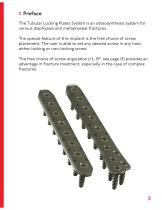
Preface The Tubular Locking Plates System is an osteosynthesis system for various diaphyseal and metaphyseal fractures. The special feature of this implant is the free choice of screw placement. The user is able to set any desired screw in any hole, either locking or non-locking screw. The free choice of screw angulation (+/- 15°, see page 13) provides an advantage in fracture treatment, especially in the case of complex fractures.
Open the catalog to page 5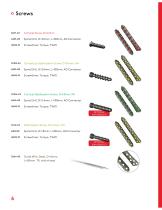
Spiral Drill, D=2.0mm, L=100mm, AO Connector Cancellous Stabilization Screw, D=3.0mm, RH Spiral Drill, D=2.0mm, L=100mm, AO Connector Cortical Stabilization Screw, D=3.0mm, RH Spiral Drill, D=2.4mm, L=100mm, AO Connector Screwdriver, Torque, T9x70 OPTIONAL (ON REQUEST) Spiral Drill, D=1.8mm, L=100mm, AO Connector Screwdriver, Torque, T9x70 OPTIONAL (ON REQUEST) Guide Wire, Steel, D=1.6mm, L=150mm, TR, with thread
Open the catalog to page 6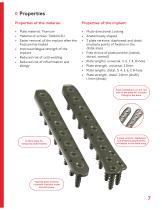
Properties Properties of the material: • Plate material: Titanium • Material of screws: TiAl6V4 ELI • Easier removal of the implant after the fracture has healed • Improved fatigue strength of the implant • Reduced risk of cold welding • Reduced risk of inflammation and allergy • Multi-directional Locking • Anatomically shaped • 2 plate versions: diaphyseal and distal (multiple points of fixation in the distal area) • Free choice of plate position (lateral, dorsal, ventral) • Plate lengths, universal: 5, 6, 7, 8, 10-hole • Plate strength, universal: 2.0mm • Plate lengths, distal: 3, 4, 5, 6,...
Open the catalog to page 7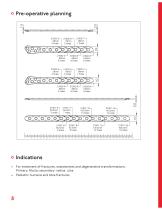
Pre-operative planning Indications • For treatment of fractures, osteotomies and degenerative transformations. Primary: fibula; secondary: radius, ulna • Pediatric humeral and tibia fractures
Open the catalog to page 8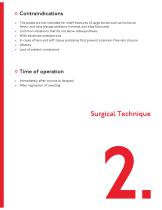
Contraindications • The plates are not intended for shaft fractures of large bones such as humerus, femur and tibia (except pediatric humeral and tibia fractures) • Common situations that do not allow osteosynthesis • With advanced osteoporosis • In cases of skin and soft tissue problems that prevent a tension-free skin closure • Obesity • Lack of patient compliance Time of operation • Immediately after trauma or delayed • After regression of swelling
Open the catalog to page 9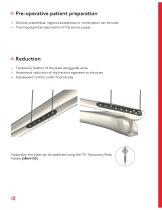
Pre-operative patient preparation • General anaesthesia, regional anaesthesia or combination can be used • Tourniquet/partial deprivation of the blood supply Reduction • Temporary fixation of the plate using guide wires • Anatomical reduction of the fracture segments to the plate • Subsequent control under fluoroscopy Optionally, the plate can be stabilized using the ITS. Temporary Plate Holder (58164-15
Open the catalog to page 10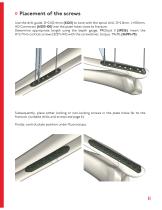
Placement of the screws Use the drill guide, D=2.0/2.4mm (62215) to bore with the spiral drill, D=2.0mm, L=100mm, AO Connector (61203-100) into the plate holes close to fracture. Determine appropriate length using the depth gauge, PROlock II (59026). Insert the D=2.7mm cortical screws (32271-XX) with the screwdriver, torque, T9x70, (56095-70). Subsequently, place either locking or non-locking screws in the plate holes far to the fracture. (suitable drills and screws see page 6). Finally, control plate position under fluoroscopy.
Open the catalog to page 11
Postoperative Information treatment • Physical therapy immediately following surgery (no immobilization required) • In case of poor bone quality or insecure fixation, movement fixator for a maximum of 6 weeks • When a locking screw connection has been used, it is necessary to be aware that the diagnosis of a non-union may be very delayed. Explantation If desired by the patient, the implant can be removed Removal should be performed at the earliest 6 months - 1 1/2 years later or after radiographic verification of the healed bone. The problem of cold welding was resolved by using a special surface...
Open the catalog to page 12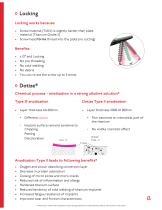
Locking Locking works because: • Screw material (TiAlV) is slightly harder than plate material (Titanium Grade 2) • Screw head forms thread into the plate (no cutting) ± 15° and Locking No pre threading No cold welding No debris You can re-set the screw up to 3 times Dotize® Chemical process - anodization in a strong alkaline solution* Type III anodization Dotize Type II anodization + Film becomes an interstitial part of the titanium - Implant surface remains sensitive to: Chipping Peeling Discoloration Type - III - No visible cosmetic effect Dotize® Type - II Ti-Oxid Anodization Type II leads...
Open the catalog to page 13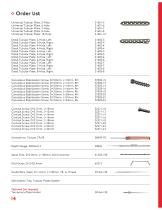
Order list Universal Tubular Plate, 5-Hole 21601-5 Universal Tubular Plate, 6-Hole 21601-6 Universal Tubular Plate, 7-Hole 21601-7 Universal Tubular Plate, 8-Hole 21601-8 Universal Tubular Plate, 10-Hole 21601-10 Distal Tubular Plate, 3-Hole, Left 21602-3 Distal Tubular Plate, 3-Hole, Right 21603-3 Distal Tubular Plate, 4-Hole, Left 21602-4 Distal Tubular Plate, 4-Hole, Right 21603-4 Distal Tubular Plate, 5-Hole, Left 21602-5 Distal Tubular Plate, 5-Hole, Right 21603-5 Distal Tubular Plate, 6-Hole, Left 21602-6 Distal Tubular Plate, 6-Hole, Right 21603-6 Distal Tubular Plate, 7-Hole, Left 21602-7...
Open the catalog to page 14All I.T.S. catalogs and technical brochures
 CTN - Cannulated Tibia Nail
28 Pages
 ufs
ufs1 Page
 DHL
DHL2 Pages
 ITS
ITS2 Pages
 SCL
SCL32 Pages
 SLS
SLS24 Pages
 OL - Olecranon Locking Plate
24 Pages
 PHL
PHL24 Pages
 PHLs
PHLs20 Pages
 CLS
CLS28 Pages
 ACLS
ACLS20 Pages
 CFN
CFN32 Pages
 OLS
OLS24 Pages
 SR Sacral Rods
20 Pages
 HCS
HCS24 Pages
 TOS Twist-Off Screw
20 Pages
 PRS-RX
32 Pages
 HLS
HLS20 Pages
 ES
ES20 Pages
 SR
SR20 Pages
 FL
FL24 Pages
 PL - Pilon Locking Plate small
12 Pages
 FLS
FLS24 Pages
 PFL
PFL20 Pages
 DTL
DTL24 Pages
 HTO
HTO24 Pages
 PTL
PTL32 Pages
 DFL
DFL32 Pages
 CAS
CAS40 Pages
 FCN
FCN20 Pages
 HOL
HOL24 Pages
 CAL
CAL20 Pages
 DUL
DUL24 Pages


Archived catalogs


- Bone plate
- Compression plate
- Metallic compression plate
- Locking compression plate
- Titanium compression plate
- Distal compression plate
- Compression bone screw
- Metallic compression bone screw
- Proximal compression plate
- Arthrodesis nail
- Forearm compression plate
- Lateral compression plate
- Medial compression plate
- Tibia compression plate
- General purpose compression bone screw
- Metallic intramedullary nail
- Humerus compression plate
- Radius compression plate
- Cannulated compression bone screw
- Arthrodesis plate