
- Catalogs
- Jiangsu Fosafe Medical Technology
- Infusion set & Transfusion Set & Extension Set

Infusion set & Transfusion Set & Extension Set

Infusion set & Transfusion Set & Extension Set
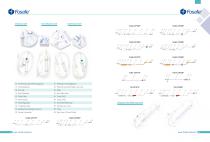
Overview of Infusion and Transfusion Set Components
This document provides a detailed list and description of components used in various medical infusion and transfusion sets. These components are essential for the safe and effective delivery of fluids and medications intravenously.
1. Component Identification
- Protective Cap of Piercing Device (①): A safety cover to maintain sterility before use.
- Piercing Device (②): Used to penetrate seals or containers for fluid access.
- Air Inlet (③): Allows air entry to maintain fluid flow.
- Drip Chamber (④): Enables visualization of fluid flow and prevents air embolism.
- Fluid Filter (⑤, ⑬): Filters impurities from the fluid to ensure safety.
- Pinch Clamp (⑥): Controls or stops fluid flow manually.
- Flow Regulator (⑦, ⑪): Adjusts the rate of fluid delivery precisely.
- Y Injection Site (⑧): Allows additional medication to be injected without disconnecting the set.
- Needle Free Filling Connector (⑨): Enables safe filling without needles, reducing contamination risk.
- Screw Connector (⑩): Provides secure attachment between components.
- Protective Cap for Male Luer Lock (⑫): Maintains sterility of connectors.
- One-Way Valve (⑭): Prevents backflow of fluids.
- Tubes (PVC - ⑮, TPE - ⑯): Flexible tubing materials used for fluid transport.
- Unvented Male Cap (⑰): Seals the system without air venting.
- Female Luer Lock (⑱): Standard connector for secure attachment.
- T-tee (⑲): Allows branching of fluid lines.
- Dual Luer 2-Piece 2-Way (⑳): Facilitates dual fluid pathways with secure connections.
2. Product Variants
The components are assembled into various product types including:
- Infusion Sets
- Transfusion Sets
- Extension Sets
- Infusion Sets with Burette
Each product is identified by specific codes such as IVAD-CP01P through IVAD-CP08P, IVET-CP01P, IVET-CP02P, and TS-CP01P, TS-CP02P, indicating different configurations and features.
3. Assembly and Configuration
The document includes numeric references indicating which components are included in each product variant, ensuring clarity in assembly and usage. For example, infusion sets may include components 1, 2, 4, 6, 7, 15, 8, 10, 12, while transfusion sets include others such as 1, 2, 3, 4, 5, 6, 7, 15, 8, 13, 10, 12.
4. Critical Information and Best Practices
- Maintaining sterility with protective caps is essential to prevent contamination.
- Use of needle-free connectors enhances safety by reducing needle-stick injuries.
- Flow regulators and clamps allow precise control of fluid administration rates.
- Filters and one-way valves ensure fluid purity and prevent backflow, enhancing patient safety.
- Correct assembly according to product codes and component lists is critical for device functionality.
Summary: This document serves as a comprehensive reference for the components and configurations of infusion and transfusion sets, emphasizing safety features, component functions, and product variants to guide healthcare professionals in proper device selection and use.
Catalog excerpts
① Protective Cap of Piercing Devie ⑪ Precision Flow Regulator ⑫ Protective Cap for Male Luer Lock ⑱ Female Luer Lock ⑨ Needle Free Filling Connector Infusion Set With Burette
Open the catalog to page 1All Jiangsu Fosafe Medical Technology catalogs and technical brochures
 Two Parts Syring
1 Page
 Safety Insulin Syringe
1 Page
 Insulin Pen Needle
1 Page
 Disposable Needle
1 Page
 Blood Collection Tube
1 Page
 Fosafe Product Catalog
18 Pages


