
- Catalogs
- Jiangsu Mole Bioscience
- E011T100B0C1

- Company
- Products
- Catalogs
- News & Trends
- Exhibitions
E011T100B0C1

E011T100B0C1
Multiple fluorescent PCR is utilized to detect EV71, CA16, and other enteroviruses simultaneously using different fluorescent probes in a single tube. This method is crucial for identifying enteroviruses that cause hand-foot-mouth disease (HFMD), with EV71 and CA16 being the most common pathogens.
Enterovirus nucleic acid testing is significant during the infant eruption period and even before symptoms like continuous fever and vomiting appear. This early detection aids in prevention and treatment, especially in severe cases with atypical rash where clinical diagnosis is challenging.
The document lists several recommended real-time PCR systems, including Applied Biosystems TM7500 and BioRad CFX96, among others, capable of detecting multiple fluorescent channels simultaneously.
Samples for testing include oropharyngeal swab, anal swab, feces, and herpes fluid.
The test kits are available in different sizes, with options for spin column and magnetic bead extraction methods.
- Simultaneous confirmation and typing with three fluorescent probes.
- Multi-channel detection technology enhances reliability by monitoring the entire nucleic acid extraction and detection process.
- High specificity with no cross-reaction with other viruses, achieving over 95% specificity.
- Fast and efficient processing, completing sample processing within half an hour.
- Simple and convenient one-step reverse transcriptase amplification method to avoid cross-contamination.
Jiangsu Mole Bioscience Co., Ltd. holds a national authorized invention patent and has received a gold medal at the China international patent and famous brand Expo. They are a leading partner in HFMD vaccine research and development.
Catalog excerpts

EV71, CA16 and Other Enteroviral Nucleic Acid Test Kit (Fluorescent Probe-Based Real-Time PCR Assay) ——Predic�on indicators for hand-foot-mouth disease (HFMD) Background Overview Enteroviruses that cause HFMD include more than 30 kinds of viruses, such as poliovirus, coxsackie virus, ECHO virus and New enterovirus. Among which EV71 and CA16 enteroviruses are the most common pathogens, and EV71 infec�on is the main cause of severe cases and deaths. Clinical significance Carry out enterovirus nucleic acid test in the infant erup�on period, and even before the erup�on showing con�nuous fever, poor mental health, vomi�ng and other symptoms to clarify whether the pa�ent has enterovirus infec�on to, so as to early preven�on, early treatment For severe cases with atypical rash, clinical diagnosis is difficult, and it is more necessary to carry out e�ological diagnosis to determine whether there is enterovirus infec�on HFMD has a fast onset rate, and the detec�on of enterovirus nucleic acid can achieve early interven�on and early blocking Testing Principle Mul�ple fluorescent PCR was used to simultaneously detect EV71, CA16 and other enteroviruses with different fluorescent probes in a single tub
Open the catalog to page 1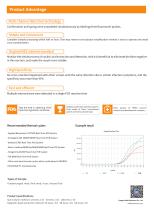
Product Advantage Multi-channel detection technology Confirmation and typing were completed simultaneously by labeling three fluorescent probes. Complete Sample processing within half an hour. One-step reverse transcriptase amplifica�on method is easy to operate and avoid cross contamina�on. Original MS2 internal standard Monitor the whole process of nucleic acid extraction and detection, which is beneficial to eliminate the false negative in the reaction, and make the result more reliable High Specificity No cross-reaction happened with other viruses with the same infection site or similar infection...
Open the catalog to page 2All Jiangsu Mole Bioscience catalogs and technical brochures
 HPV Catalogue_S02104T2096
2 Pages
 R231T050B0C0
2 Pages
 P087T00301
1 Page
 P082T00401
1 Page
 P031T100A0C0
1 Page
 M091T050B0C0
1 Page
 R401T050B0C2
1 Page
 T011T012B0C2
2 Pages
 Mole 32M
2 Pages
 Mole 96M
2 Pages
 M011T024A0C2
2 Pages
 Mole Fast96
2 Pages
 R214T020B0C0
1 Page
 T021T012B0C2
2 Pages
 B281T050B0C0
1 Page
 R219T020B0C0
1 Page
 R083T050B0C1
2 Pages
 R205T050B0C0
2 Pages
 R206T020B0C0
1 Page
 R061T016B0C1
2 Pages
 R084T020B0C0
1 Page
 R220T001B0C0
1 Page
 R213T050B0C2
2 Pages
 R208T050B0C2
2 Pages


Archived catalogs
 B052T050B0C2
2 Pages
- Solvent reagent
- Blood detection kit
- Molecular biology reagent
- Serum detection kit
- Rapid chromatographic immunoassay test
- Plasma detection kit
- Blood rapid screening test
- Cassette rapid test
- Immunoassay rapid diagnostic test
- Laboratory reagent
- Infectious disease detection kit
- Rapid serum test
- Rapid plasma test
- Rapid virus test
- Molecular detection kit
- Enzyme reagent
- Rapid whole blood test
- Whole blood detection kit
- Respiratory disease assay kit