
- Catalogs
- JN Medsys Pte. Ltd.
- Clarity plus™

Clarity plus™

Clarity plus™
The Clarity Plus™ digital PCR (dPCR) system is a new platform for absolute quantification of SARS-CoV-2, offering enhanced multiplexing and a wider dynamic range. This study evaluates a dPCR assay optimized for Clarity Plus™, demonstrating high precision, accuracy, and linearity over a broad range. The assay shows higher sensitivity than qPCR, especially at lower concentrations, making it reliable for detecting low viral loads in clinical and environmental samples.
Digital PCR (dPCR) is a third-generation PCR technology that partitions samples into numerous nanoliter sub-reactions, allowing for absolute quantification of nucleic acids without standard curves. The Clarity Plus™ system combines droplet and chip-based technologies, enhancing sensitivity and accuracy. It is applied in detecting SARS-CoV-2, necessitating reliable detection methods due to its high transmissibility and global impact.
The study used a TaqMan-based dPCR assay on the Clarity Plus™ system. Reagents were prepared per manufacturer instructions, and samples were partitioned into 40,000 partitions for analysis. The assay's linearity and limit of quantification (LOQ) were assessed using synthetic RNA, and the limit of detection (LOD) was evaluated using inactivated SARS-CoV-2 virus. Comparisons were made between dPCR and qPCR platforms to assess sensitivity.
The Clarity Plus™ system demonstrated excellent linearity and precision in quantifying SARS-CoV-2 RNA, with a dynamic range from 0.02 to 30,000 copies/μl. The system's sensitivity was superior to qPCR, particularly at low concentrations, confirming its potential for clinical and environmental applications. The study highlights the Clarity Plus™ system's robustness and reliability for SARS-CoV-2 detection and quantification.
The assay demonstrated excellent linearity across a dynamic range of 0.2 to 20,000 copies/μl. Inter and intra-assay precision showed a relative uncertainty (RU) of less than 10% for most concentrations, except for the lowest dilutions. High RU values at lower concentrations were noted, but linear regression analysis indicated good linearity with R² values of 0.915 for N1 and 0.835 for ORF1ab.
The LOQ was determined using synthetic RNA concentrations ranging from 0.125 to 1 copies/μl. Despite high RU values, the mean measured concentrations showed a strong linear correlation with expected values, with an R² of 0.98 for N1 and 0.83 for ORF1ab. The LOQ was established at 0.25 copies/μl.
The preliminary LOD for detecting N1 and ORF1ab targets was determined using serial dilutions of inactivated SARS-CoV-2 virus. The Clarity Plus™ system achieved a 100% detection rate at a dilution factor of 8 times for both targets, with an expected concentration of 0.225 copies/μl. The assay demonstrated higher sensitivity on the Clarity Plus™ dPCR system compared to the QuantStudio® 3 qPCR platform.
The RT-dPCR assay using Clarity Plus™ showed excellent performance in detecting and quantifying SARS-CoV-2 RNA, with potential applications in clinical diagnostics and environmental surveillance. The study highlights the assay's capability to detect low viral loads with high precision, making it suitable for monitoring treatment effectiveness and early warning of disease transmission.
The research did not receive specific funding from public, commercial, or not-for-profit sectors.
Tables detail the preliminary determination of the detection limit (LOD) for the N1 and ORF1ab SARS-CoV-2 RT-dPCR assays. The assays were tested using AccuPlex™ SARS-CoV-2 RNA triplicates at various expected concentrations ranging from 1.8 to 0.05625 copies/μl. The mean concentrations were calculated from three replicates.
Table compares the N1 SARS-CoV-2 assay performance on the Clarity Plus™ dPCR and QuantStudio® 3 qPCR platforms. The detection rates were 100% for Clarity Plus™ at 0.225 copies/μl and 85% at 0.1125 copies/μl, while QuantStudio® 3 showed 100% and 75% detection rates, respectively.
Table presents the performance of the ORF1ab assay on the Clarity Plus™ platform, with detection rates of 95% at 0.225 copies/μl and 50% at 0.1125 copies/μl.
Figure illustrates the experimental workflow of the Clarity Plus™ digital PCR system, highlighting the chip-in-a-tube format, partitioning, sealing, thermal cycling, and fluorescence detection.
Figures show the linearity studies for N1 and ORF1ab assays, with high correlation coefficients (R2 = 0.9983 for N1 and R2 = 0.9987 for ORF1ab). Figure demonstrates the limit of quantification for both assays, with R2 values of 0.9824 for N1 and 0.8382 for ORF1ab.
The study confirms the high sensitivity and accuracy of the Clarity Plus™ system for SARS-CoV-2 detection, with reliable detection limits and strong linearity across tested concentrations.
Catalog excerpts
medRxiv preprint doi: https://doi.org/10.1101/2021.05.30.21256718; this version posted June 1, 2021. The copyright holder for this preprint (which was not certified by peer review) is the author/funder, who has granted medRxiv a license to display the preprint in perpetuity. It is made available under a CC-BY-NC-ND 4.0 International license . Clarity Plus™ digital PCR: A novel platform for absolute quantification of SARS-CoV-2 Shawn Yi Han Tan2, Sheng Yi Milton Kwek1, Huiyu Low1, Yan Ling Joy Pang2 1JN Medsys, 217 Henderson Road #02-08, Singapore 159555, Singapore Institute of Technology, 10 Dover Dr, Singapore 138683, Singapore [email protected], [email protected], [email protected], [email protected] Abstract In recent years, the usage of digital polymerase chain reaction (dPCR) for various clinical applications has increased exponentially. Considering the growing demand for improved dPCR technology, the Clarity Plus™ dPCR system which features enhanced multiplexing capability and a wider dynamic range for nucleic acid analysis was recently launched. In this study, a dPCR assay optimized for use on Clarity PlusTM was evaluated for the absolute quantification of severe acute respiratory syndrome coronavirus 2 (SARS-CoV-2), the causative agent responsible for the global coronavirus disease 2019 (COVID-19) outbreak. The assay demonstrated good inter- and intraassay precision, accuracy, as well as excellent linearity across a range of over 6 orders of magnitude for target gene quantification. In addition, comparison of the assay on both dPCR and qPCR platforms revealed that dPCR exhibited a slightly higher sensitivity compared to its qPCR counterpart when quantifying SARS-CoV-2 at a lower concentration. Overall, the results showed that the dPCR assay is a reliable and effective approach for the absolute quantification of SARSCoV-2 and can potentially be adopted as a molecular tool for detecting low viral load in patients and wastewater surveillance of COVID-19. NOTE: This preprint reports new research that has not been certified by peer review and should not be used to guide clinical practice
Open the catalog to page 1
medRxiv preprint doi: https://doi.org/10.1101/2021.05.30.21256718; this version posted June 1, 2021. The copyright holder for this preprint (which was not certified by peer review) is the author/funder, who has granted medRxiv a license to display the preprint in perpetuity. It is made available under a CC-BY-NC-ND 4.0 International license . Keywords SARS-CoV-2 RT-dPCR assay, Absolute viral quantification, Clarity Plus™, Sample partitioning, Tube-strip digital PCR. 1. Introduction Digital Polymerase Chain Reaction (dPCR) was first introduced by Volgelstein and Kinzler in a 1999 publication in...
Open the catalog to page 2
medRxiv preprint doi: https://doi.org/10.1101/2021.05.30.21256718; this version posted June 1, 2021. The copyright holder for this preprint (which was not certified by peer review) is the author/funder, who has granted medRxiv a license to display the preprint in perpetuity. It is made available under a CC-BY-NC-ND 4.0 International license . and the Naica® System (Stilla Technologies). The second method is a chip-based dPCR technology used by BioMark™ HD (Fluidigm), QuantStudio® 3D (Thermo Fischer Scientific), and Clarity™ (JN Medsys) [2, 6]. Since the mid-2000s, a plethora of new dPCR applications...
Open the catalog to page 3
medRxiv preprint doi: https://doi.org/10.1101/2021.05.30.21256718; this version posted June 1, 2021. The copyright holder for this preprint (which was not certified by peer review) is the author/funder, who has granted medRxiv a license to display the preprint in perpetuity. It is made available under a CC-BY-NC-ND 4.0 International license . N2 sequences [12, 13]. Presently, reverse transcription-quantitative polymerase chain reaction (RT-qPCR) is the gold standard method for the diagnosis of COVID-19 worldwide [14]. Various RT-qPCR assays have been developed worldwide which detect SARS-CoV-2...
Open the catalog to page 4
medRxiv preprint doi: https://doi.org/10.1101/2021.05.30.21256718; this version posted June 1, 2021. The copyright holder for this preprint (which was not certified by peer review) is the author/funder, who has granted medRxiv a license to display the preprint in perpetuity. It is made available under a CC-BY-NC-ND 4.0 International license . Using the Clarity™ auto loader, the mix was delivered onto the chip where it was sub-divided into 40,000 partitions and subsequently sealed with Clarity™ Seal Enhancer with addition of 245μl Clarity™ Sealing fluid (Fig 1). All sealed chips underwent another...
Open the catalog to page 5
medRxiv preprint doi: https://doi.org/10.1101/2021.05.30.21256718; this version posted June 1, 2021. The copyright holder for this preprint (which was not certified by peer review) is the author/funder, who has granted medRxiv a license to display the preprint in perpetuity. It is made available under a CC-BY-NC-ND 4.0 International license . 2.3 SARS-CoV-2 linearity study and limit of quantification (LOQ) The Linearity and LOQ of SARS-CoV-2 RT-dPCR assay were obtained by quantifying a single copy of N1 and ORF1ab gene obtained from a series of serial dilutions with a range of expected target...
Open the catalog to page 6
medRxiv preprint doi: https://doi.org/10.1101/2021.05.30.21256718; this version posted June 1, 2021. The copyright holder for this preprint (which was not certified by peer review) is the author/funder, who has granted medRxiv a license to display the preprint in perpetuity. It is made available under a CC-BY-NC-ND 4.0 International license . QuantStudio® 3 qPCR system is unable to read the Quasar670 fluorescence, only ORF1ab digital PCR data is provided. The extracted RNA stock was diluted 8 and 16 times to achieve an expected concentration of 0.225 and 0.1125 copies/μl respectively. Reagent...
Open the catalog to page 7
medRxiv preprint doi: https://doi.org/10.1101/2021.05.30.21256718; this version posted June 1, 2021. The copyright holder for this preprint (which was not certified by peer review) is the author/funder, who has granted medRxiv a license to display the preprint in perpetuity. It is made available under a CC-BY-NC-ND 4.0 International license . 3. Results and Discussion 3.1 Absolute quantification of SARS-CoV-2 target using Clarity Plus™ system The linearity and the limit of quantification (LOQ) for the Clarity PlusTM SARS-CoV-2 RT-dPCR assay were first determined using N1 and ORF1ab Synthetic...
Open the catalog to page 8All JN Medsys Pte. Ltd. catalogs and technical brochures
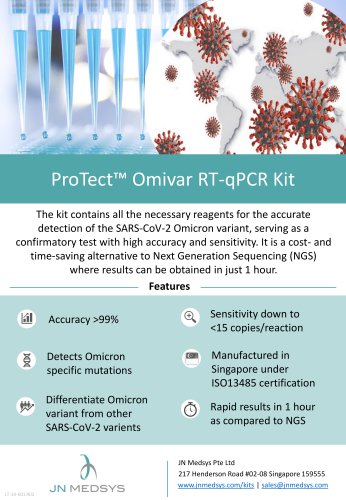 ProTect™ Omivar RT-qPCR Kit
2 Pages
 Exponent Thermal Cycler
2 Pages
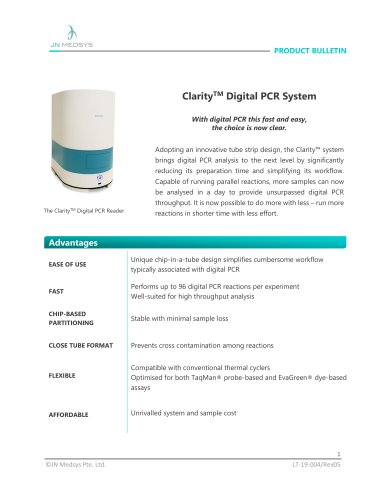 ClarityTM Digital PCR System
3 Pages
 Clarity™
7 Pages


- Detection kit
- Molecular detection kit
- Respiratory disease assay kit
- Sample tube
- Laboratory test tube
- COVID-19 assay kit
- PCR system
- Nasopharyngeal detection kit
- V-bottom test tube
- Compact PCR machine
- 96-well PCR machine
- Gradient PCR machine
- Autosampler
- RT-qPCR assay kit
- Molecular biology test tube
- Portable PCR analyzer
- PCR test tube
- Fast PCR PCR machine
- Digital thermal cycler
- High-performance PCR machine