
- Catalogs
- JN Medsys Pte. Ltd.
- Clarity™

Clarity™

Clarity™
The Clarity™ digital PCR system is a cutting-edge platform designed for precise nucleic acid quantification, offering a streamlined workflow compared to traditional digital PCR methods. It employs a chip-in-a-tube technology for enhanced precision and accuracy without requiring a standard curve.
The system was tested for quantifying the single-copy human RNase P gene, demonstrating high precision and accuracy with excellent linearity over a broad range. It is compatible with various commercial master mixes, both probe- and dye-based, providing application flexibility.
Compared to the QX100™ droplet dPCR system, Clarity™ showed similar copy number concentrations, indicating reliability and robustness. It combines the benefits of droplet- and chip-based systems, offering stable partitions and a simplified workflow.
The Clarity™ system uses a chip-in-a-tube format for simultaneous loading and partitioning of eight reaction mixes. Partitions are sealed and thermally cycled, with fluorescent signals detected post-amplification to calculate copy number concentration using Poisson statistics.
The study quantified the RNase P gene from serial dilutions of human genomic DNA, assessing compatibility with different master mixes. Performance was compared with the QX100™ system using ERM-AD623 reference materials.
The system provided accurate and precise quantification across various concentrations, maintaining consistent DNA copy measurements. Results were comparable to the QX100™ system, confirming efficacy in absolute nucleic acid quantification.
The Clarity™ digital PCR system is a reliable and flexible platform for genetic analysis, offering a simplified workflow and high compatibility with commercial master mixes. Its chip-in-a-tube technology enhances precision and accuracy, making it valuable for biomedical research.
Tested with eight serial dilutions of human genomic DNA, the system showed high accuracy with concentrations closely matching expected values, and a relative standard deviation of ≤10% for most samples. Linear regression analysis indicated excellent linearity with an R² value above 0.999.
Clarity™ is compatible with various commercial qPCR master mixes, achieving DNA copy measurements within 5% of expected concentrations and relative standard deviations below 5%.
Compared with BioMark™ HD and QX100™ systems using ERM-AD623 standards, Clarity™ measurements were within 10% of certified concentrations, while QX100™ measurements were lower by 14-30%. Both systems showed strong linear correlation with BioMark™ measurements.
The project was supported by Singapore Polytechnic and the Singapore Totalisator Board.
No conflict of interest was declared, and references to previous studies and methodologies related to digital PCR are included.
Catalog excerpts

Anal Bioanal Chem DOI 10.1007/s00216-016-0131-7 RESEARCH PAPER Clarity™ digital PCR system: a novel platform for absolute quantification of nucleic acids Huiyu Low 1 & Shun-Jie Chan 2 & Guo-Hao Soo 1 & Belinda Ling 1 & Eng-Lee Tan 2,3 Received: 27 September 2016 / Revised: 17 November 2016 / Accepted: 2 December 2016 # Springer-Verlag Berlin Heidelberg 2016 Abstract In recent years, digital polymerase chain reaction (dPCR) has gained recognition in biomedical research as it provides a platform for precise and accurate quantification of nucleic acids without the need for a standard curve. However, this technology has not yet been widely adopted as compared to real-time quantitative PCR due to its more cumbersome workflow arising from the need to sub-divide a PCR sample into a large number of smaller partitions prior to thermal cycling to achieve zero or at least one copy of the target RNA/ DNA per partition. A recently launched platform, the Clarity™ system from JN Medsys, simplifies dPCR workflow through the use of a novel chip-in-a-tube technology for sample partitioning. In this study, the performance of Clarity™ was evaluated through quantification of the single-copy human RNase P gene. The system demonstrated high precision and accuracy and also excellent linearity across a range of over 4 orders of magnitude for the absolute quantification of the target gene. Moreover, consistent DNA copy measurements were also attained using a panel of different probeand dye-based master mixes, demonstrating the system’s compatibility with commercial master mixes. The Clarity™ was Electronic supplementary material The online version of this article (doi:10.1007/s00216-016-0131-7) contains supplementary material, which is available to authorized users. * Eng-Lee Tan [email protected] 1 JN Medsys, 217 Henderson Road #02-08, Singapore 159555, Singapore Centre for Biomedical and Life Sciences, Singapore Polytechnic, 500 Dover Road, Singapore 139651, Singapore Department of Paediatrics, University Children’s Medical Institute, National University Hospital, 1E Kent Ridge Road, Singapore 119228, Singapore then compared to the QX100™ droplet dPCR system from Bio-Rad using a set of DNA reference materials, and the copy number concentrations derived from both systems were found to be closely associated. Collectively, the results showed that Clarity™ is a reliable, robust and flexible platform for nextgeneration genetic analysis. Keywords Tube-strip digital PCR . Absolute DNA quantification . Sample partitioning . Clarity Introduction Digital polymerase chain reaction (dPCR) is the thirdgeneration PCR technology that enables absolute quantification of target nucleic acid without using external standards. It works by dividing a PCR mixture into thousands of independent nanolitre partitions, such that each individual reaction contains zero or at least one target of interest [1]. By analysing the proportion of partitions that are positive or negative for PCR products, an absolute DNA copy number is then determined based on the Poisson statistics. Apart from obviating the use of a DNA standard, dPCR has additional advantages over real-time quantitative PCR (qPCR) such as improved precision and accuracy, lower susceptibility to PCR inhibitors and increased sensitivity for detecting rare targets amidst a high background of non-target DNA [1]. Due to its advantages, dPCR has successfully been applied to a wide array of preclinical research studies such as rare mutation detection, copy number variation studies and low-level pathogen quantification [2–6]. Commercial dPCR platforms mainly employ two different methods of sample partitioning. The QX100™/QX200™ (Bio-Rad Laboratories) and RainDrop ® (RainDance™ Technologies) systems partiti
Open the catalog to page 1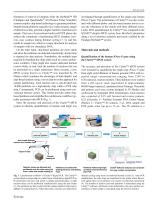
formation of water-in-oil droplets while the BioMark™ HD (Fluidigm) and QuantStudio® 3D (Thermo Fisher Scientific) systems employ chip-based technology to generate partitions. Droplet-based platforms typically have wider dynamic ranges of detection as they generate a higher number of partitions per sample. Their use of conventional multi-well PCR plates also reduces the complexity of performing dPCR. Droplets, however, may coalesce during thermal cycling [7, 8], and this results in sample loss which is a major drawback for analysis of samples with low abundance DNA. On the other hand, chip-based...
Open the catalog to page 2
Absolute nucleic acid quantification using Clarity™ dPCR Table 1 Oligonucleotides used for BCR-ABL b3a2 amplification BCR-ABL b3a2 forward BCR-ABL b3a2 reverse BCR-ABL b3a2 probe proprietary formulation optimized for robust performance on Clarity™ high-density chips. Using the Clarity™ auto loader, the resultant mix was then delivered onto the chip where it was sub-divided into 10,000 partitions. The partitions were then sealed with the Clarity™ Sealing Enhancer and 230 μL Clarity™ Sealing Fluid, followed by thermal cycling using the following parameters: initial cycle of 95 °C for 10 min and...
Open the catalog to page 3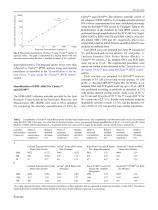
Measured Concentraion (copies/ L) 10 100 1000 Expected Concentration (copies/ L) Fig. 2 Measured concentrations of RNase P using Clarity™ against its expected values. The graph is represented in a log-log format with each data point representing the mean ± standard deviation of five replicates spectrophotometry). The prepared master mixes were then subjected to Clarity™ dPCR analysis using experimental procedures as described in the BQuantification of the human RNase P gene using the Clarity™ dPCR system^ section. Quantification of ERM-AD623 by Clarity™ and QX100™ The ERM-AD623 reference materials...
Open the catalog to page 4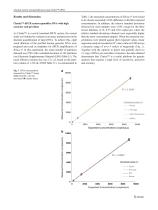
Absolute nucleic acid quantification using Clarity™ dPCR Results and discussion Clarity™ dPCR system quantifies DNA with high accuracy and precision As Clarity™ is a newly launched dPCR system, the current study was initiated to evaluate its accuracy and precision in the absolute quantification of target DNA. To achieve this, eight serial dilutions of the purified human genomic DNA were prepared and used as templates for dPCR amplification of RNase P. In this experiment, the mean number of partitions detected was 9782 with a standard deviation of 142 partitions (see Electronic Supplementary Material...
Open the catalog to page 5All JN Medsys Pte. Ltd. catalogs and technical brochures
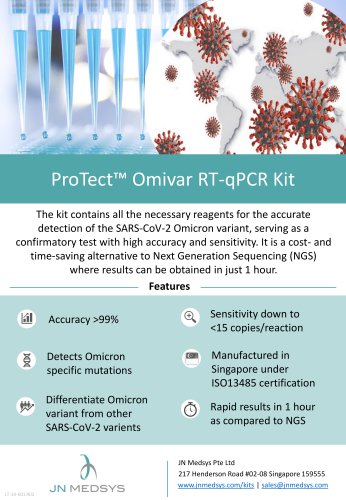 ProTect™ Omivar RT-qPCR Kit
2 Pages
 Exponent Thermal Cycler
2 Pages
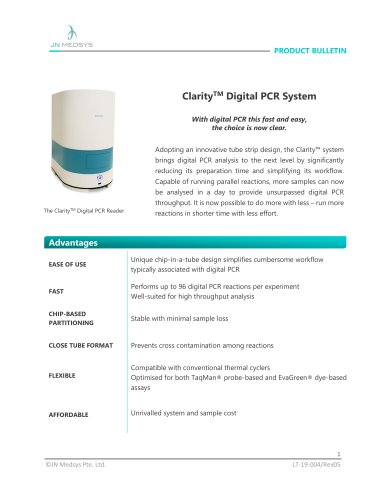 ClarityTM Digital PCR System
3 Pages
 Clarity plus™
23 Pages


- Detection kit
- Molecular detection kit
- Respiratory disease assay kit
- Sample tube
- Laboratory test tube
- COVID-19 assay kit
- PCR system
- Nasopharyngeal detection kit
- V-bottom test tube
- Compact PCR machine
- 96-well PCR machine
- Gradient PCR machine
- Autosampler
- RT-qPCR assay kit
- Molecular biology test tube
- Portable PCR analyzer
- PCR test tube
- Fast PCR PCR machine
- Digital thermal cycler
- High-performance PCR machine