- Catalogs
- Johnson Matthey
- INTERCAT FCC additives and catalyst handling technologies


INTERCAT FCC additives and catalyst handling technologies
INTERCAT FCC additives and catalyst handling technologies
Johnson Matthey (JM) offers FCC additives and systems to improve refinery performance, product quality, and environmental compliance. Their INTERCAT™ range focuses on optimizing FCC unit yields and minimizing emissions, with both Performance and Environmental Additives available.
Propylene, Butylene, and Octane Improvement: JM's ZSM-5 based additives, such as PROPYL MAX™ and SUPER Z™, enhance olefin production without increasing coke or lighter gases. ZMX™ additives improve gasoline octane and LPG yields, while ISOCAT™ boosts gasoline octane without increasing LPG yields.
Bottoms Upgrading: BCA-105™ selectively cracks heavy feedstock components, reducing heavy fuel oil production and adapting to crude changes.
Catalyst Enhancement: CAT-AID™ protects against metal contaminants, reducing hydrogen yield and delta coke, and acts as a SOx capturing agent.
SOx Reduction: INTERCAT SUPER SOXGETTER™ and LO-SOX PB™ reduce SOx emissions by over 95% without affecting yields.
NOx Reduction: INTERCAT NONOX™ technology converts NOx precursors to N₂, effective in various regenerator conditions.
Sulphur Reduction in Gasoline: INTERCAT LGS™ additives reduce gasoline sulphur content by up to 40% without yield loss.
CO Oxidation: Platinum and non-platinum CO promoters optimize regenerator operation and reduce NOx emissions.
JM's R&D facility in Savannah, GA, is dedicated to developing innovative FCC technologies. Investment in R&D is crucial for maintaining industry leadership and providing comprehensive customer support.
INTERCAT addition systems, used globally since the 1980s, offer precise additive control, enhancing FCC operation stability and efficiency. They allow for flexible responses to market changes and are recommended by major licensors.
The system includes a storage vessel for additives or catalysts, associated piping, equipment for loading, and a control system that manages the supply of catalysts to the FCC unit. The INTERCAT Management System (IMS) provides precise control over catalyst flow from the hopper.
The IMS is a digital controller that manages and tracks catalyst or additive loading into the regenerator. It interfaces with the plant's distributed control system (DCS) via MODBUS or 4-20 mA signals, providing graphical displays of current and historical data.
The hopper is equipped with three load cells for precise monitoring and control of additions. The catalysts flow through the Everlasting Valve, a patented control valve, into the feed line.
During refilling, carrier air is vented to the atmosphere, and a sintered metal filter (SMF) prevents powder escape. The SMF is a self-cleaning system that can be retrofitted to existing systems to eliminate dust emissions.
JM's AIM TECHNOLOGY™ automates inventory management, tracking onsite inventory and scheduling deliveries. It ensures compliance with government testing protocols and provides secure access to inventory updates.
Johnson Matthey offers technical service with experienced staff, supporting additive selection, system design, installation, and testing. They maintain relationships with refinery personnel to optimize FCC additive usage and provide economic justification for additive performance.
For further information, contact your local sales representative or visit the Johnson Matthey website.
Catalog excerpts

INTERCAT FCC additives and catalyst handling technologies
Open the catalog to page 1
Information contained in this publication or as otherwise supplied to Users is believed to be accurate and correct at time of going to press, and is given in good faith, but it is for the User to satisfy itself of the suitability of the Product for its own particular purpose. Johnson Matthey plc (JM) gives no warranty as the fitness of the Product for any particular purpose and any implied warranty or condition (statutory or otherwise) is excluded except to the extent that exclusion is prevented by law. JM accepts no liability for loss or damage (other than that arising from death or personal...
Open the catalog to page 2
Introduction Most refiners now find it essential to use catalytic additives to supplement the host FCC catalyst in order to achieve the desired unit performance, product quality, and environmental emissions targets that must be met. Johnson Matthey (JM) is the foremost supplier of FCC additives and addition systems, specializing in the development, manufacture, sale, and technical support of both additives and addition systems for the refining industry. Our INTERCAT™ range of FCC additives and addition systems allow refiners to make the most of the synergies that exist in the FCC unit so that...
Open the catalog to page 3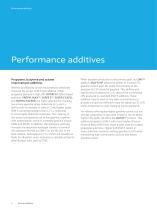
Performance additives Performance additives Propylene, butylene and octane improvement additives Refinery profitability can be maximised by selectively choosing the proper ZSM-5 type additive. When propylene demand is high, JM’s INTERCAT ZSM‑5 based additives, PROPYL MAX™, SUPER Z™, SUPER Z EXCEL, and SUPER Z EXCEED, are highly selective for cracking low octane gasoline range molecules to C₃ and C₄ olefins with no increase in coke or C₂ and lighter gases. ZSM-5 isomerises straight chain C₄–C₁₀ molecules to more highly branched molecules. The cracking of low octane components out of the gasoline,...
Open the catalog to page 4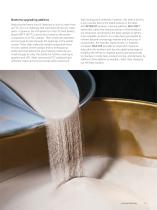
Bottoms upgrading additive Reducing the heavy fuel oil (bottoms or slurry) make from an FCC unit is a challenge that has faced refiners for many years. In general, the components in the FCC feed boiling above 800°F (427°C) cannot be cracked by the zeolite component of an FCC catalyst. Their molecular diameters are too large to pass through the openings in the zeolite crystal. These high molecular weight compounds must first be cracked on the catalyst matrix (mesoporous acidic alumina) before the pre-cracking molecules are small enough to enter the zeolite for further cracking to gasoline and...
Open the catalog to page 5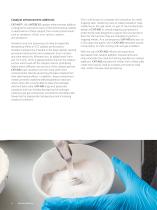
Catalyst enhancement additives CAT-AID™, JM’s INTERCAT catalyst enhancement additive, is designed to overcome many of the shortcomings related to deactivation of base catalyst from metal contaminants such as vanadium, nickel, iron, calcium, sodium, and potassium. Vanadium and iron poisoning can have an especially devastating effect on FCC catalyst performance. Vanadium attacks the Y-zeolite in the base catalyst causing permanent destruction and consequent loss in activity and coke selectivity. Whereas iron, at added levels from just +0.3 wt%, forms a glassy/nodular shell on the catalyst surface...
Open the catalog to page 6
Environmental additives Environmental additives SOX reduction additives Government agencies worldwide are adopting ever more stringent legislation regulating the levels of sulphur oxide (SOx) emissions from oil refineries. While FCC feedstock desulphurization and flue gas scrubbing are both proven methods for FCC flue gas SOx emission control, many refiners find that the use of an in-situ SOx reduction additive is the most cost effective means of meeting these regulatory requirements. SOx reduction additives are added directly to the FCC catalyst inventory where they adsorb sulphur oxides in...
Open the catalog to page 7
NOx reduction additives As concern grows over atmospheric pollution, government agencies worldwide have become focused on regulating the level of nitrogen oxide (NOx) emissions from oil refineries. NOx emissions from an FCC are extremely unit specific and can vary with changes in feed and other process parameters. Potential sources of NOx include nitrogen compounds from coke in the feed and nitrogen from air in CO boilers. Most of the nitrogen present in FCC feeds ends up in the coke being burned in the regenerator. When this is combusted the nitrogen forms N₂, NOx and other nitrogen species...
Open the catalog to page 8
Sulphur reduction in gasoline additives A refiner’s ability to reduce the sulphur content of FCC gasoline may be limited by the molecular species that are present in the FCC unit. Numerous sulphur containing species including mercaptans, sulphides, disulphides, thiophenes, and benzothiophenes are present in the gasoline. Their concentration varies depending upon the original crude source, the boiling ranges of feedstocks, and their historical treatment. Combustion promoters are required to ensure smooth regenerator operation, control of afterburning and reduction of CO emissions. Afterburning...
Open the catalog to page 9
Platinum based promoters Non-platinum based promoters Platinum based combustion promoters, COP™-250, 375, 550, and COP-850, containing various levels of platinum provide a range of additives with varying activity. For units requiring higher levels of promotion the higher activity grades are recommended. For refiners requiring very little promotion it is usually more effective to add a greater amount of a lower activity additive for optimal control of afterburning. An undesired side effect of platinum based CO promoters is that they may increase the formation of NOx in some FCC regenerators. For...
Open the catalog to page 10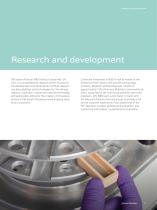
Research and development JM’s state-of-the-art R&D facility in Savannah, GA, USA, is a comprehensive research center focused on the development and advancement of fluid catalytic cracking additives and technologies for the refining industry. Expertise in advanced materials technology and applications allows for the creation of innovative products that benefit the planet while bringing value to our customers. Continued investment in R&D is vital to remain at the forefront of the industry and provide cutting edge products. Research and Development consists of approximately 13% of Johnson Matthey’s...
Open the catalog to page 11All Johnson Matthey catalogs and technical brochures
 Oleochemicals
12 Pages
 Edible oils catalysts
12 Pages
 Ammonia
24 Pages
 Purification solutions
12 Pages
 Fuel cells
8 Pages