
- Catalogs
- JULABO GmbH
- Optimal temperature control of reactors


Optimal temperature control of reactors

Optimal temperature control of reactors
Temperature Control of Reactors
Effective temperature control in pharmaceutical and chemical settings is crucial for managing reactions. Systems must be dynamic and chosen based on specific conditions to ensure efficiency.
Process Stability
Stability is influenced by reactor materials, design, and mixing efficiency. Compliance with the Pressure Equipment Directive 97/23/EG and Delta-T limits is essential. Key components include heat exchangers, pumps, and control electronics, which must handle ambient temperature variations.
Investment Protection
Temperature control systems are major investments. Factors like pump pressure, temperature range, and system size impact ROI. Systems should be compact, durable, and supported by maintenance and manufacturer services.
Operational Safety
Safety is a joint responsibility. Systems should be user-friendly with clear interfaces and access controls to prevent unauthorized changes.
Checklists
Checklists are provided for evaluating process stability, investment security, and operational safety, detailing criteria for temperature control solutions.
Overview
The document outlines features for optimizing temperature-control systems, emphasizing user safety, efficiency, and investment protection. It stresses remote control, experiment reproducibility, and safety.
Specifications
Modern systems should support remote operation and precise experiment reproducibility, with intuitive interfaces to reduce errors.
Procedures
Users need training for complex systems, which should be easy to install, operate, and maintain. Considerations include noise, transportability, and ease of filling with heat-transfer liquids.
Standards and Recommendations
Systems should have extensive data exchange interfaces, support a wide temperature range, and use a single heat-transfer liquid. Minimal noise is recommended for ergonomic benefits.
Checklists
Checklists cover process stability, investment protection, and safety, focusing on cooling/heating capacity, pressure management, maintenance, and user interface features.
Key Data from Tables
Checklists evaluate pressure control, temperature range, pump features, and user interface capabilities, highlighting preventative maintenance, user training, and system integration.
Catalog excerpts
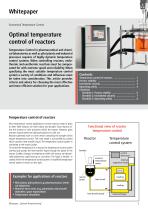
Economical Temperature Control Optimal temperature control of reactors Temperature Control in pharmaceutical and chemical laboratories as well as pilot plants and industrial processes requires of highly dynamic temperature control systems. When controlling reactors, endothermic and exothermic reactions must be compensated for with extreme speed and reliability. When specifying the most suitable temperature control system a variety of conditions and influences must be taken into consideration. This article provides criteria and advice for choosing the most effective and most efficient solution for your applications. Most temperature control applications involve reactors made of glass or steel. Steel reactors are more robust and durable. Glass reactors allow the chemist to view processes within the reactor. However, glass reactors require extenisve safety precautions for safe use. Reactors generally have an inner vessel containing the samples which require temperature control. The inner vessel is surrounded by a jacket which contains heat-transfer liquid. The temperature control system is connected to the reactor jacket. To control the temperature of a reactor, the temperature control system continuously pumps the heat-transfer liquid through the jacket of the reactor. Sudden changes in temperature within the reactor are dynamically balanced by rapid heat-up or cool-down. The liquid is heated or cooled within the temperature control system. A simplified temperature control system is shown on the right. Functional view of reactor temperature control Temperature control system control electronics Examples for applications of reactors • Mini plants, pilot plants (e.g. pharmaceutical, chemical industries) • Material stress tests (e.g. automotive and aircraft industries, space exploration) • Temperature simulation reactor jacket loop circuit heat transfer liquid heat exchanger Whitepaper „Optimale Temperierlosung
Open the catalog to page 1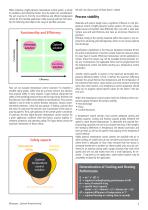
When choosing a highly dynamic temperature control system, a variety of conditions and influential factors must be taken into consideration. The aim must be to find the most effective and efficent temperature control for the intended application while assuring optimum functionality. The following chart depicts the range of possible outcomes. We will now discuss each of these factor in detail. Process stability Materials and reactor design have a significant influence on the temperature control of highly dynamic reactor systems. Of course, a glass walled vessel will transfer heat differently than...
Open the catalog to page 2
The temperature control system‘s integrated pump must be powerful enough to achieve the required flow rates at constant pressure. The pump should provide the required pressure quickly and with maximum control to avoid exceeding the pressure limit values mentioned before. Regulation of pump capacity should be made in steps or by presetting a limit value. Pressure specifications and operating conditions of the reactor must always be considered. Advanced temperature control systems feature pumps that automatically and dynamically balance changes of the viscosity of the heat transfer liquid to ensure...
Open the catalog to page 3
properly evaluate the size of a temperature-control system, you must look beyond just the footprint. It is absolutely essential to consider how much space will be needed for connections and adequate airflow. A space-optimized temperature control system will have as many connections and ventilation openings on the front and rear sides as possible. Units designed in this way will save you valuable space by allowing you to place additional laboratory devices directly next to the temperature-control system. Poorly designed units will require you to reserve additional space that must be kept unoccupied...
Open the catalog to page 4
It is common practice in laboratories to conduct a series of experiments under identical temperature conditions. Even failed experiments usually must be repeated precisely under the same control parameters. The temperature-control system should contain functions that enable precise reproducibility in these situations. These functions simultaneously lower the expense of generating documentation for an experiment. Although temperature-control systems are increasingly equipped with intuitive operating functions, it is still advisable to inquire about user training from the manufacturer of the system....
Open the catalog to page 5
User-related aspects ■ Calculate the required cooling/heating capacity ^ Tip: Ask the manufacturer to calculate the correct cooling/heating capacity! ■ Compare the required working temperatures with the working temperature range of the temperature-control solution ^ Tip: Ask the manufacturer for assistance! ■ Observe the pressure values and operating conditions of the reactor ■ Ensure thorough mixing in the reactor Whitepaper „Optimale Temperierlosung
Open the catalog to page 6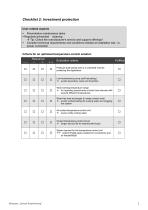
User-related aspects ■ Preventative maintenance tasks ■ Regularly-scheduled cleaning ^ Tip: Check the manufacturer's service and support offerings! ■ Consider technical requirements and conditions needed at installation site, i.e. power connection Whitepaper „Optimale Temperierlosung
Open the catalog to page 7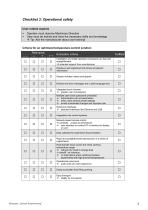
User-related aspects ■ Operator must observe Machinery Directive ■ User must be trained and have the necessary skills and knowledge ^ Tip: Ask the manufacturer about user training! Whitepaper „Optimale Temperierlosung
Open the catalog to page 8All JULABO GmbH catalogs and technical brochures
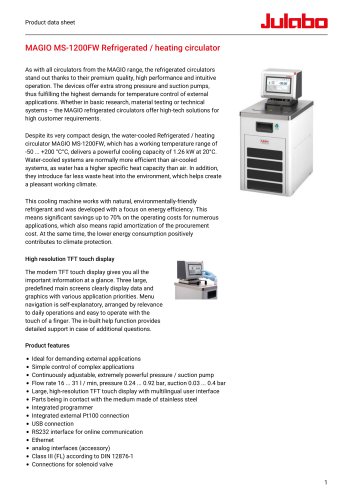 MAGIO MS-1200FW
4 Pages
 PURA 22 Brochure en
12 Pages
 PURA 30 Brochure en
12 Pages
 PURA 14 Brochure en
12 Pages
 CORIO Brochure English
50 Pages
 JULABO Brochure EN
178 Pages
 MAGIO MS-600F
8 Pages
 F-gas Regulation
4 Pages
 The Thermal Bath Fluids
32 Pages
 CORIO CD-600F Refrigerated
5 Pages
 PRESTO W56 Flyer
2 Pages
 DYNEO Brochure english
34 Pages
 TopTech | HighTech Circulators
64 Pages
 Wireless TEMP
24 Pages
 Booster Pump
2 Pages
 PRODUCT PORTFOLIO
28 Pages
 PURA Water Baths
12 Pages
 JULABO Shaking Water Bath
12 Pages
 JULABO Products
28 Pages
 JULABO PRESTO W55
2 Pages
 JULABO Booster Pump
2 Pages
 F34-MA
2 Pages
 CORIO CD-1000F
4 Pages
 F1000 Recirculating Cooler
2 Pages
 Julabo SemiChiller
3 Pages
 WirelessTEMP - Solution Finder
24 Pages
 JULABO Water Baths
8 Pages
 ED-13A
2 Pages
 F12-ED
2 Pages


Archived catalogs
 DYNEO Brochure english
18 Pages
 PURA
PURA16 Pages
 JULABO PURA Water Baths
16 Pages
 JULABO Productportfolio
28 Pages


- Laboratory bath
- Benchtop laboratory bath
- Benchtop water bath
- Heating laboratory bath
- Digital thermoregulator
- Cooling thermostat
- Laboratory chiller
- Heating water bath
- Digital controller
- Laboratory thermostat
- Circulating thermostat
- Heating thermostat
- Pressure control system
- Thermostatic laboratory bath
- Circulating laboratory cooler
- Thermostatic water bath
- Refrigerated laboratory bath
- Stainless steel water bath
- Circulating laboratory bath
- Temperature control system