DepleteX® Rare Transcript Boost Kit
DepleteX® Rare Transcript Boost Kit
The DepleteX® Rare Transcript Boost Kit is designed for post-library depletion of Illumina NGS libraries. It enhances the detection of less abundant transcripts by removing highly expressed transcripts using CRISPR Cas9 endonuclease and guide RNA. This process targets abundant protein-coding transcripts, which make up about 70% of sequencing reads.
- Total Assay Time: ~18 hours (including 16 hours overnight incubation)
- Hands-on Time: ~1 hour
- Samples Per Kit: 24 samples
- Sample Type: RNA-Seq Poly(A)-Selected DNA Library from Human Fibroblast or Whole Blood
- DNA Library Input: 10 ng
- Average DNA Library Size: ≥ 420 bp
- Method: CRISPR-Cas9 mediated depletion
The protocol involves a 16-hour incubation for effective depletion, recommended to start at the end of the workday. The workflow includes:
- Step A: Depletion of Highly Expressed RNA (Hands-on time: ~30 min, Total time: ~17 hours)
- Step B: PCR Amplification (Hands-on time: ~30 min, Total time: ~1 hour)
The kit contains materials for 24 RNA-Seq libraries, stored at -20°C and -80°C. Key components include Cas9, RNase Inhibitor, Guide RNA, and PCR Mix.
Includes plastic consumables, reagents like AMPure XP Beads, and equipment such as pipettes, vortex mixer, microcentrifuge, and PCR thermal cycler.
Ensure proper calibration of pipettes, use DNase- and RNase-free consumables, and follow RNA-safe procedures. Handle reagents like Cas9 and RNase Inhibitor with care, maintaining them on ice and minimizing freeze-thaw cycles.
The kit is optimized for RNA-Seq libraries from human fibroblast or whole blood, focusing on poly(A)-selected libraries to minimize ribosomal RNA presence. Libraries should be ≥ 420 bp in size.
Step A: Depletion of Highly Expressed RNA
Involves RNP Complex Formation and CRISPR Digestion, followed by a 16-hour incubation. Bead Size Selection is performed to purify the depleted library.
Step B: PCR Amplification
Includes PCR amplification and bead cleanup to prepare the library for sequencing.
For support, contact Jumpcode Genomics at [email protected] or call 1.619.900.1701.
This document is a user manual for the DepleteX® Rare Transcript Boost Kit v1.1, intended for research use only. It provides detailed instructions for DNA library preparation and PCR amplification, followed by bead cleanup and recommendations for sequencing preparation.
- Step A: DNA Library Preparation - Involves washing beads with ethanol, resuspending in nuclease-free water, and eluting DNA. The process includes incubation and magnetic stand steps to ensure purity and concentration of the DNA.
- Step B: PCR Amplification - Requires combining reagents in a PCR tube and running a thermal cycler program. The number of cycles is adjusted based on DNA input, with a typical yield of 100-300 ng.
- Step B2: Bead Cleanup - Involves adding AMPure XP beads, washing with ethanol, and resuspending in Tris Buffer. The final product is a depleted DNA library ready for sequencing.
It is recommended to assess library yield using a dsDNA-specific fluorescence-based method and to check library size using an Agilent Bioanalyzer 2100. If DNA fragments are smaller than 420 bp, a gel-based size selection is advised before sequencing.
The product is not intended for therapeutic or diagnostic use in humans or animals. Users may need additional intellectual property rights for certain applications.
The document lists several registered trademarks, including AMPure XP®, BIOANALYZER®, ILLUMINA®, NEBNext®, DepleteX™, and Qubit®.
Catalog excerpts

DepleteX® Rare Transcript Boost Kit KIT1020 For post-library depletion of Illumina NGS libraries Contact Us If you have any questions, contact Technical Support at [email protected] Find us at our website: jumpcodegenomics.com Call us at 1.619.900.1701 DepleteX Rare Transcript Boost Kit v1.1 | April, 2024 © Copyright 2024, Jumpcode Genomics, Inc.; all rights reserved
Open the catalog to page 1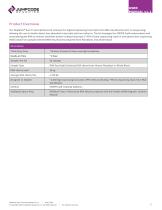
The DepleteX® Rare Transcript Boost Kit removes the highest expressing transcripts from RNA-Seq libraries prior to sequencing, allowing the user to better detect less abundant transcripts and rare isoforms. The kit leverages the CRISPR Cas9 endonuclease and associated guide RNA to remove abundant protein-coding transcripts (~70% of total sequencing reads in next-generation sequencing (NGS) data) from poly(A)-selected RNA-Seq libraries prepared from fibroblasts and whole blood. DepleteX® Rare Transcript Boost Kit v1.1 | April, 2024 © Copyright 2024, Jumpcode Genomics, Inc.; all rights reserved...
Open the catalog to page 2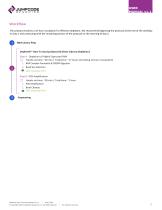
Workflow The protocol involves a 16-hour incubation for effective depletion. We recommend beginning the protocol at the end of the workday on Day 1 and continuing with the remaining portion of the protocol on the morning of Day 2. DepleteX™ Rare Transcript Boost Kit (Post-Library Depletion) Step A: Depletion of Highly Expressed RNA Hands-on time: ~30 min | Total time: ~17 hours (including 16-hour incubation) 1. RNP Complex Formation & CRISPR Digestion 2. Bead Size Selection Safe Stopping Point Step B: PCR Amplification Hands-on time: ~30 min | Total time: ~1 hour 1. PCR Amplification 2. Bead...
Open the catalog to page 3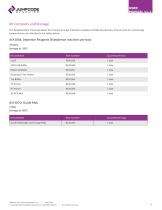
The DepleteX Rare Transcript Boost Kit contains enough material to deplete 24 RNA-Seq libraries. The kit contents and storage temperatures are indicated in the tables below. DepleteX® Rare Transcript Boost Kit v1.1 | April, 2024 © Copyright 2024, Jumpcode Genomics, Inc.; all rights reserved |
Open the catalog to page 4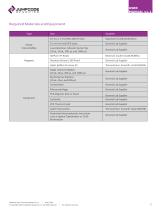
Required Materials and Equipment Type DepleteX® Rare Transcript Boost Kit v1.1 | April, 2024 © Copyright 2024, Jumpcode Genomics, Inc.; all rights reserved |
Open the catalog to page 5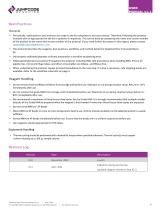
USERMANUAL v1.1Best PracticesGeneral • Periodically, optimizations and revisions are made to the kit components and user manual. Therefore, following the protocol included with or appropriate for the kit in question is important. This can be done by comparing the name and version number of the product to the name and version number of the protocol. If you need further assistance in this regard, please contact [email protected] • This protocol describes the reagents, best practices, workflow, and method details for DepleteX Rare Transcript Boost kit. • Use properly calibrated pipettes...
Open the catalog to page 6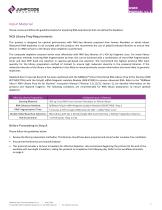
Please review and follow the guidelines below for preparing RNA-Seq libraries that are optimal for depletion: This product is designed for optimal performance with RNA-Seq libraries prepared from human fibroblast or whole blood. Ribosomal RNA depletion is not included with this product. We recommend the use of poly(A)-selected libraries to ensure that little or no rRNA remains in the library when depletion is performed. The Jumpcode depletion protocol works most effectively with RNA-Seq libraries of > 420 bp fragment sizes. For many library preparation methods involving RNA fragmentation by heat,...
Open the catalog to page 7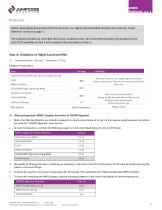
Before attempting this protocol for the first time, it is highly recommended that the user read the "Input Material" section on page 7. The protocol includes an overnight (16 hours) incubation step. We recommend starting the protocol at the end of the workday on Day 1 and complete the procedure on Day 2. Reagent Preparation DepleteX® Rare Transcript Boost Kit v1.1 | April, 2024 © Copyright 2024, Jumpcode Genomics, Inc.; all rights reserved | For research use only.
Open the catalog to page 8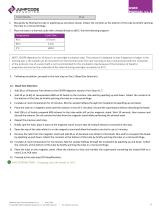
Total Volume 6. Mix gently by flicking the tube or pipetting up and down slowly. Collect the contents at the bottom of the tube by briefly spinning the tube in a microcentrifuge. 7. Place the tube in a thermal cycler with a heated lid set to >80°C. Run the following program: NOTE: CRISPR digestion for 16-hours is an overnight incubation step. The protocol is designed so that if digestion is begun in the evening day 1, the sample can be removed from the thermal cycler the next morning on day 2 and proceed with the remainder of the protocol. Use of a water bath is not recommended for this incubation...
Open the catalog to page 9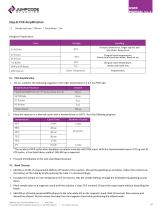
USERMANUAL v1.1 Step B: PCR Amplification Reagent Preparation *The number of PCR cycles after depletion correlates inversely with DNA input. With the recommended input of 10 ng and 10 PCR cycles, a final total library yield of 100-300 ng is expected. 3. Proceed immediately to the next step (Bead Cleanup). 1. Add 60 pi (0.6X) of resuspended AMPure XP beads to the reaction. Mix well by pipetting up and down. Collect the contents at the bottom of the tube by briefly spinning the tube in a microcentrifuge. 2. Incubate the sample at room temperature for 10 minutes. Mix the sample halfway through the...
Open the catalog to page 10
USER MANUAL v1.1 5. Repeat the previous wash step. 6. Briefly spin the tube, place it back on the magnetic stand. Ensure that all residual ethanol is removed at this step. 7. Open the cap of the tube while it is on the magnetic stand and allow the beads to air dry for up to 5 minutes. 8. Remove the tube from the magnetic stand and add 30 μL of Tris Buffer to the beads. Mix well to resuspend the beads by pipetting up and down. Collect the contents at the bottom of the tube by briefly spinning the tube in a microcentrifuge. 9. Incubate the sample at room temperature for 10 minutes. Mix the sample...
Open the catalog to page 11All Jumpcode catalogs and technical brochures
 CRISPRclean®
3 Pages
 DepleteX® Mito DNA Depletion Kit
11 Pages