
- Catalogs
- Kartell S.p.A.
- catalogue 2017

- Products
- Catalogs
- News & Trends
- Exhibitions
catalogue 2017

catalogue 2017
Kartell, established in 1949, is a leading European company known for its innovative use of plastic materials in designer furniture and accessories. Over the past 60 years, Kartell has integrated technological advancements with cultural and aesthetic values, becoming a leader in industrial design both in Italy and globally.
In the late 1950s, Kartell's technological progress led to the creation of the Labware Division, which provides technical laboratory products. This division uses materials like polypropylene, polystyrene, and polyethylene, offering plastic as a lightweight, durable, and cost-effective alternative to glass.
Kartell prioritizes quality, earning ISO 9001 certification in 1996, with updates planned to UNI EN ISO 9001:2015 in 2017. These certifications demonstrate Kartell's commitment to high-quality management systems.
Kartell focuses on recyclability and sustainability. Despite using plastic, Kartell products are designed for easy recycling, with components identifiable according to DIN 6120 standards. In 2011, Kartell achieved ISO 14001:2004 certification for its environmental management system, with plans to update to UNI EN ISO 14001:2015 in 2017.
Kartell's dedication to quality, innovation, and environmental responsibility positions it as a key player in the design industry, committed to producing high-quality, safe, and environmentally friendly products.
The document provides detailed specifications and descriptions of various laboratory equipment and components, including connectors, hoses, and scoops. It includes technical data, material specifications, and usage recommendations for each item.
The document lists multiple items with their respective nominal outer diameters (O.D.), valley/crest O.D., and bore measurements in millimeters, crucial for selecting the appropriate size and type of component for laboratory applications.
Various types of connectors are described, including three-way, four-way, straight, and tapered connectors, used for joining hoses of different materials like glass, rubber, and plastic. The document highlights the importance of matching inlet and outlet diameters for effective use.
Two types of flow indicators are mentioned: ball and paddle wheel, measuring liquid flow rates and unsuitable for corrosive fluids or high temperatures. The ball indicator is used for flows from 50 ml/min to 140 ml/min, while the paddle wheel is suitable for flows up to 95 ml/sec.
The document details various types of hoses, including those made from PVC, silicone, PTFE, and natural rubber, each with specific temperature ranges, chemical resistance, and compliance with standards like PhEur and FDA. The hoses are suitable for medical, industrial, and laboratory use.
The document emphasizes the non-toxic, autoclavable nature of materials like PVC and HDPE, providing information on chemical resistance, highlighting the suitability of materials for different acids, bases, and solvents.
Recommendations include avoiding the use of certain components with corrosive fluids or at temperatures exceeding specified limits. The document advises on the proper selection of connectors and hoses based on diameter and material compatibility.
The tables provide precise measurements for each component, including dimensions, capacities, and packaging details, essential for ensuring compatibility and functionality in laboratory setups.
The document describes a tissue grinder composed of a borosilicate glass mortar and a PTFE pestle, with a clearance of 0.15 to 0.25 mm. The pestle has a diameter of 6.5 mm, ideal for tough materials like tumor tissues, and can withstand temperatures up to 120°C, operated by water or air pressure between 1 and 2.5 Kg/cm².
The tissue grinder should be used with glass homogenizers for sample crushing, suitable for environments where electric motors are not advisable due to safety concerns.
Avoid excessive heat generation during use to prevent binding of the tissue. The equipment is stable with a molded base and can be used on a bench or clamped to a stand.
The document lists various labware items such as autoclavable funnels, stirring paddles, and trays, made from materials like PP, HDPE, and PVC, offering excellent chemical resistance and durability.
The tables provide detailed specifications for various labware items, including dimensions, capacities, and materials.
Ensure compatibility of the pestle and mortar by ordering the correct sizes. The equipment's non-electric operation makes it suitable for specific safety-sensitive environments. The labware's chemical resistance and autoclavability are highlighted as key features for laboratory use.
The document describes a plastic container with 1kg of cooling liquid, compatible with products 3705 and 3706, with specified dimensions and capacities.
Made from polycarbonate, the safety box is fully autoclavable and designed for secure transport of medical items requiring an airtight seal, featuring a transparent design for leak inspection, a silicone safety seal, and four safety locks.
Two types of adhesive tapes are described for indicating sterilization, complying with ISO 11140/2005 standards.
The document details various types of bottles, including graduated wide neck, square, and narrow neck bottles, suitable for food contact, conforming to EC regulations 1935/2004 and 10/2011.
The document provides detailed specifications for various types of bottles and containers, including their capacities, dimensions, and materials.
The document describes the operation of adjustable volume dispenser bottles, using a graduated PMP measuring cup that slides along a tube to vary the dispensed volume.
The containers are designed for easy storage and stability, with ergonomic handles for easy pouring, suitable for foodstuff and complying with various transportation regulations for hazardous liquids.
Graduated bottles with ergonomic design and screw caps, high-impact PS emergency eye wash stations, heavy-walled carboy bottles with O-ring seals, and industrial tanks designed for space optimization.
The document lists accessories like spigots and bottle carriers, designed for easy stacking and transportation of multiple bottles.
This document provides detailed specifications and recommendations for storing and protecting microscope slides, highlighting the importance of using numbered cavities and dust covers to prevent contamination.
Slide mailers offer robust protection for slides during transportation, with individual compartments to prevent damage.
These boxes are designed for easy handling and storage of slides, with numbered slots and removable lids.
The document details various staining jars and racks, designed for efficient staining processes, with features like removable lids and the ability to hold multiple slides simultaneously.
General-purpose containers with screw caps are described, suitable for storing various samples, including mercury.
These jars, made from HDPE, are suitable for storing powders, solids, and hygroscopic substances.
The document mentions other accessories like colorimetric trays and microscope covers, designed to protect equipment from dust and facilitate specific assays.
The document describes various laboratory equipment, including funnel holders, clamps, supports, and pipette accessories.
The document outlines the assembly and usage of the equipment, designed to be easily assembled and disassembled for cleaning or accommodating different shapes.
The spatulas are made according to DIN 12890 standards, ensuring excellent chemical resistance and suitability for food contact.
Funnel holders cannot be used with funnels below 75 mm diameter, and the pipette holder should not be exposed to ultraviolet light.
Ensure proper assembly of equipment to prevent contamination and maintain safety standards.
The document provides detailed specifications and descriptions of various laboratory equipment, primarily focusing on test tube racks and related accessories.
- Test Tube Racks: Available in two-tier designs, capable of holding 20 tubes in pre-numbered cavities.
- Base Plates: Designed to hold two test tube racks, useful for colorimetric analysis and standard sample storage.
- Material and Design: Made from materials like PP and PMMA, these racks are lightweight, robust, and resistant to high temperatures.
- Autoclaving: Most products are autoclavable at +121°C for 20 minutes.
- Versatility: The racks can be used dry, in water baths, or in freezers without deforming.
- Stackability: Racks are stackable even when loaded.
- Use the color-coded racks for easy identification and error-proof sample management.
- Ensure proper autoclaving procedures to maintain sterility.
- Safety Box: Made of polycarbonate, designed for secure transport of tubes and containers.
- Ice Buckets and Trays: Designed for use with dry ice and cooling mixtures.
1. Autoclavable Products: The document describes various hospital wares that are sterilizable in an autoclave.
1. Usage in Medical Settings: The products are primarily used in hospitals for tasks such as urine collection and storage of surgical instruments.
1. Temperature and Chemical Resistance: PTFE products can withstand temperatures from -200°C to +300°C.
1. Dimensions and Capacities: The document provides detailed measurements for various products.
1. Transparent wash bottles and volumetric flasks made of PFA and fluorinated resin, offering high chemical and thermal resistance.
1. Cuvettes are compatible with most spectrophotometers and photometers.
1. Volumetric flasks are individually calibrated according to DIN EN ISO 1042, class “A”.
1. Use cuvettes with 4 optical faces for spectrofluorimetry techniques.
1. Cuvettes are available in various capacities and optical path lengths.
1. Ensure proper calibration and compatibility with equipment for accurate results.
1. Reproducible tare weight with batch variation normally less than 5%.
1. Made of PP with volumes ranging from 0.05 ml to 50 ml.
1. Made from crystal clear PS, one-piece construction up to 25 ml to avoid leakage.
1. Adjustable volume repetitive dosing devices made of high-quality materials.
1. Ideal for dosing organic polar and non-polar solvents.
The document provides detailed specifications and descriptions of various liquid handling devices, including dosing devices and digital burettes.
The document lists several models of dosing devices, such as Dosipet and Dosilab, with varying capacities and precision levels.
These are designed for use with various acids and peroxides.
This series offers adjustable volume dispensers with precise volume adjustment via an analogue slider.
This device is ideal for precise titrations, featuring a large LCD for volume display.
The document lists various accessories, including amber bottles, suction and discharge tubes, and adapters.
The devices are designed for safety and ease of use, with features like autoclavability and high chemical resistance.
Technotrate is a digital burette designed for precise titrations both in laboratories and in the field.
The burette includes a 180° rotating dispensing spout to prevent accidental spills.
- Automatic shut-off after 3 minutes
- Operating temperature: +10°C to +40°C
- Storage temperature: up to +60°C
- Rechargeable battery with indicator
- Bubble-free distribution
The PLURIPET line consists of eight single-channel micropipettes with capacities from 0.2 µl to 10,000 µl.
- Comfortable grip and easy volume selection
- Large display for easy reading
- Adjustable tip ejector
- Robust PVDF body, autoclavable at +121°C
- UV resistant materials
- Compliant with EN IS 8655
The FIXOPET line includes eleven single-channel micropipettes with fixed volumes ranging from 5 µl to 1,000 µl.
- Comfortable grip and non-straining tip ejection
- Removable ejector for narrow test tubes
- Integrated recalibration system
- Robust PVDF body, autoclavable at +121°C
- UV resistant materials
- Compliant with EN IS 8655
Includes stands for micropipettes and spare parts such as cones, PTFE seals, O-rings, and nuts.
The document provides detailed information on various types of micropipettes, including their specifications, technical features, and applications.
These micropipettes are designed for use in ELISA dosages, molecular biology, and DNA amplifications.
This line caters to the demand for fixed volume micropipettes, offering volumes from 5 µl to 1,000 µl.
Comprising eight models, these micropipettes are suitable for molecular biology, microbiology, and analytical chemistry applications.
The document includes detailed tables listing the models, capacities, accuracy, repeatability, and compatibility with Kartell tips for each type of micropipette.
The document provides detailed information on various liquid handling devices, including micropipettes, pipette fillers, and magnetic stirrers.
These are designed for dispensing large volumes of aqueous, dense, and viscous fluids.
This innovative line includes ten fixed-volume air displacement mini-micropipettes.
Developed for aspirating liquids from glass or plastic pipettes.
This device is used for filling and dispensing liquids in pipettes up to 100 ml.
This device features a hot plate made of aluminum alloy with an anti-acid coating for uniform heat distribution.
The document provides detailed technical specifications and features of various models of magnetic stirrers with heating plates.
- Model TK22: Features a bi-polar mains switch with a green indicator lamp.
- Model TK23: Similar to TK22 but with a stirring capacity of up to 20 liters.
- Model TK6 and TK15: These models can stir multiple containers simultaneously.
- Model TKO: A traditional magnetic stirrer without heating.
- All models are designed to provide uniform heat distribution and high magnetic attraction strength without vibrations.
- They are equipped with electronic speed controls and temperature regulation systems.
The document describes a test tube mixer/shaker model TK3S, which allows for variable mixing through vibration frequency adjustment.
An accessory holder for 25 microcentrifuge tubes of 1.5 ml is available.
The document provides detailed technical specifications, including power requirements, motor type, frequency range, dimensions, and weight.
The document highlights the compliance of the materials used with various international standards.
A comprehensive table lists the chemical resistance of various plastics to different chemical groups.
Catalog excerpts

KartellU\BWARE Kartell, da oltre 60 anni leader nel design industriale Kartell, more than 60 years as leader in industrial design Kartell, depuis plus de 60 ans leader dans le design industriel
Open the catalog to page 2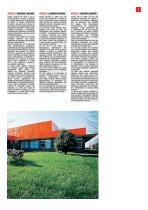
3 KARTELL DIVISIONE LABWARE KARTELL LABWARE DIVISION KARTELL DIVISION LABWARE Kartell, fondata nel 1949, è tra le prime aziende in Europa a utilizzare le materie plastiche per la produzione di mobili di design, complementi d’arredo e accessori per la casa. La linea guida che ha caratterizzato questi sessant'anni di attività è l’idea di unire l’aspetto tecnologico e industriale, necessario per rispondere a specifiche esigenze economiche e sociali, a quello culturale ed estetico. In questo senso Kartell è una delle principali interpreti del design industriale nel panorama delle aziende italiane...
Open the catalog to page 4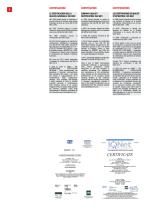
LE CERTIFICAZIONI DELLA QUALITÀ AZIENDALE: ISO 9001 COMPANY QUALITY CERTIFICATION: ISO 9001 LES CERTIFICATIONS DE QUALITÉ D’ENTREPRISE: ISO 9001 Nel 1996 Kartell decide di certificare il proprio Sistema di Gestione della Qualità Aziendale secondo le norme UNI EN ISO 9001:1994. In 1996, Kartell decided to certify its Corporate Quality Management System in compliance with UNI EN ISO 9001:1994 standards. En 1996, Kartell a décidé de faire certifier son Système de Gestion de la Qualité d’Entreprise conformément aux normes UNI EN ISO 9001 : 1994. Nel 2005 l’Azienda adegua il proprio Sistema di estione...
Open the catalog to page 5
RICICLABILITA Riciclabilita, sostenibilita, eco-compatibilita - in una parola rispetto per l'ambiente -sono temi molto sentiti dalla comunita mondiale. E forse puo sembrare un controsenso parlare di ambiente per produzioni che hanno nei materiali plastici il loro comune denominatore. Tuttavia, contrariamente alla percezione comune, le produzioni di Kartell sono perfettamente riciclabili: per semplificare il processo di riciclaggio, infatti, i vari componenti dei prodotti Kartell sono facilmente separabili tra loro e riconducibili ad elementi monomaterici; le parti in plastica di ogni prodotto...
Open the catalog to page 6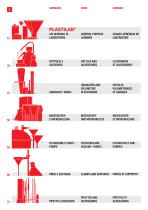
GENERAL PURPOSE LABWARE USAGES GÉNÉRAUX DE LABORATOIRE GRADUATED AND VOLUMETRIC PLASTICWARE ARTICLES VOLUMÉTRIQUES ET GRADUÉS FILTRAZIONE E VUOTO POMPE FILTRATION AND VACUUM - PUMPS FILTRATION ET VIDE POMPES
Open the catalog to page 7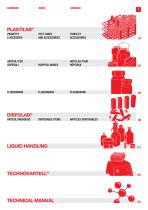
TEST TUBES AND ACCESSORIES HOSPITAL WARES ARTICLES POUR HÔPITAUX DISPOSABLE ITEMS ARTICLES DISPOSABLES PLASTILAB® PROVETTE E ACCESSORI DISPOLAB® ARTICOLI MONOUSO LIQUID HANDLING TECHNICAL MANUAL
Open the catalog to page 8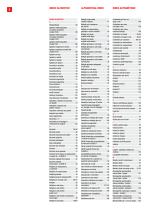
INDICE ALFABETICO ALPHABETICAL INDEX INDEX ALPHABETIQUE Agitatore elettromagnetico con piatto riscaldante modello TK22 146 Agitatore elettromagnetico con piatto riscaldante modello TK23 147 Agitatore elettromagnetico modello TKO 148 Agitatore magnetico a turbina 27 Agitatore magnetico modello tk6 modello TK15 148 Ancorette magnetiche, forma cilindrica 91 Anse sterili per inoculazione 125 Aspiratore e dosatore di sicurezza per pipette 77 Aspiratore e dosatore per pipette “vadosa” 77 Aspiratore universale per pipette 76 Bacchette per il dosaggio e l'estrazione del...
Open the catalog to page 9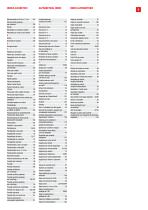
INDICE ALFABETICO ALPHABETICAL INDEX INDEX ALPHABETIQUE Monopalla con valvola e tubetto 25 Monopalla per vuoto a due valvole 25 Pappagallo uomo con tappo 87 Piastre di petri monouso 126 Pinze per giunti conici 71 Pistoni, fondo striato 27 Pompa manual per vuoto mityvac 66 Pompa per vuoto a getto d'acqua 65 Pompe per liquidi viscosi 67 Pompetta di gomma a tre valvole con adattatore 76 Pompetta doppia con retina 25 Portacampione per Centrifichem®, Technicon®, Beckman® 104 Portacampione per Technicon®, Beckman®, Konelab® 104 Presa di protezione per le mani...
Open the catalog to page 10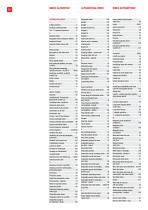
25 Slides staining trough 59 Adjustable volume dispenser bottles 43 Analytical funnels 67 Aspirator bottles, heavy duty 45 Base plate for test tube racks 81 Bench pipette holder 72/77 Blue graduated beakers, low form -CLASS B 50 Blue graduated measuring cylinders tall form - CLASS B 48/49 Bucket with spout 31 Centrifichem®, Technicon®, Beckman® sample cup 104 Centrifuge tubes, cylindrical 80 Clamps for glass joints 71 Cobas mira® multi-cuvettes 101 Colorimetric 8 cell tray 61 Conical 1 and 2 hole stoppers 23 Conical centrifuge tubes 80 Conical centrifuge...
Open the catalog to page 11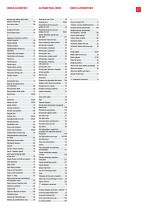
INDICE ALFABETICO ALPHABETICAL INDEX INDEX ALPHABETIQUE Narrow neck bottles with white tamper-evident cap 37 P Package of 5 drawers, with lid -without supports 56 Pipette filler with adapter 76 Pipette filler with plunger 77 Pipette stand, vertical 75 Pipette tray for drawer 76 Policemen stirring rods 29 Rods for clot detachment and extraction 125 Round bottom flask 98 Round bottom flask holder 72 Sampling bottle for urine 86/87 Sedimentation imhoff cone 54 Semitransparent empty boxes for refills 119 Separating funnel holder 70 Short spout dropping bottle...
Open the catalog to page 12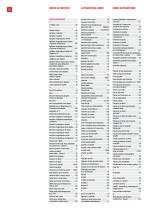
INDICE ALFABETICO ALPHABETICAL INDEX INDEX ALPHABETIQUE INDEX ALPHABETIQUE # 4 Petites roues 56 Agitateur magnetique a turbine 27 Agitateur magnetique avec plaque chauffante modele tk22 146 Agitateur magnetique avec plaque chauffante modele tk23 147 Agitateur magnetique modele tk6 -modele tk15 148 Agitateur magnetique modele tko 148 Agitateurs pour ballons 90 Agitateur-vibreur pour tubes a essais modele tk3s (avec frequence de vibration reglable) 149 Ampoule a decanter, graduee 53 Aspire-doseur pour pipettes 77 Aspire-doseur pour pipettes “vadosa” 77 Aspire-pipettes...
Open the catalog to page 13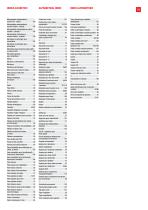
INDICE ALFABETICO ALPHABETICAL INDEX INDEX ALPHABETIQUE Micropipettes autoclavables a volume fixe - labofix 139 Micropipettes autoclavables a volume variable - pluripet 136 Micropipettes autoclavables a volume variable - pluripet ii 140 Micropipettes multicanaux a volume variable - multipet 138 Microtubes a centrifuger pour echantillons 102 Microtubes a centrifuger pour echantillons 102 Microtubes avec bouchons cobas-bio® et cobas mira® 102 Microtubes gradues pour echantillons 102 Mono-poire avec valve et tuyaux 25 Mono-poire pur vide avec deux valves 25 Petite cuvette...
Open the catalog to page 14All Kartell S.p.A. catalogs and technical brochures


Archived catalogs
 catalog
170 Pages

- Laboratory test tube
- Sample container
- Pipette tip
- Laboratory rack
- Polypropylene test tube
- Laboratory tube rack
- V-bottom test tube
- Digital thermoregulator
- Laboratory bottle
- Laboratory thermostat
- Storage sample container
- Sample container with cap
- Transport sample container
- Polypropylene sample container
- Mechanical micropipette
- Bedpan