- Catalogs
- Kilde Medic
- CelliantCalgary_RJTA_final_publication

CelliantCalgary_RJTA_final_publication
CelliantCalgary_RJTA_final_publication
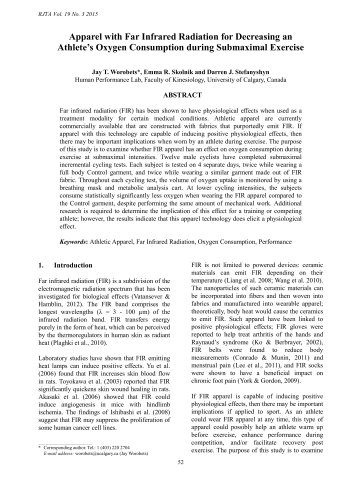
Introduction: FIR is known for its biological effects, such as enhancing skin blood flow and aiding wound healing. It is emitted by ceramic materials in fabrics, potentially benefiting athletes by improving performance and recovery.
Methods: Twelve male cyclists participated in four sessions, wearing either FIR or control garments. Oxygen consumption was measured during incremental cycling tests to assess the impact of FIR apparel at submaximal intensities.
Results: The study found a significant reduction in oxygen consumption at lower intensities (<2 mmol/L and 2-4 mmol/L blood lactate levels) when wearing FIR apparel, with reductions of 1.1% and 0.9% respectively. No significant difference was observed at higher intensities (4-6 mmol/L).
Discussion: FIR apparel affects oxygen consumption at lower exercise intensities, though its benefits at competitive endurance levels are unclear. Further research is needed to understand the mechanisms, possibly involving increased blood circulation.
Conclusion: FIR apparel can reduce oxygen consumption during exercise at lower intensities. Additional studies are necessary to evaluate its impact on performance at higher intensities.
Study Overview: The document highlights that FIR apparel reduces oxygen consumption by approximately 1.0% at lower intensities, with diminishing effects at higher intensities, indicating the need for further research for endurance athletes.
Acknowledgements: The study was supported by Hologenix LLC, which did not influence the study design or results.
References: The document includes references to studies on FIR's effects on endothelial nitric oxide synthase, angiogenesis, and skin microcirculation, among other topics.
Catalog excerpts
Apparel with Far Infrared Radiation for Decreasing an Athlete’s Oxygen Consumption during Submaximal Exercise Jay T. Worobets*, Emma R. Skolnik and Darren J. Stefanyshyn Human Performance Lab, Faculty of Kinesiology, University of Calgary, Canada ABSTRACT Far infrared radiation (FIR) has been shown to have physiological effects when used as a treatment modality for certain medical conditions. Athletic apparel are currently commercially available that are constructed with fabrics that purportedly emit FIR. If apparel with this technology are capable of inducing positive physiological effects, then there may be important implications when worn by an athlete during exercise. The purpose of this study is to examine whether FIR apparel has an effect on oxygen consumption during exercise at submaximal intensities. Twelve male cyclists have completed submaximal incremental cycling tests. Each subject is tested on 4 separate days, twice while wearing a full body Control garment, and twice while wearing a similar garment made out of FIR fabric. Throughout each cycling test, the volume of oxygen uptake is monitored by using a breathing mask and metabolic analysis cart. At lower cycling intensities, the subjects consume statistically significantly less oxygen when wearing the FIR apparel compared to the Control garment, despite performing the same amount of mechanical work. Additional research is required to determine the implication of this effect for a training or competing athlete; however, the results indicate that this apparel technology does elicit a physiological effect. Keywords: Athletic Apparel, Far Infrared Radiation, Oxygen Consumption, Performance FIR is not limited to powered devices: ceramic materials can emit FIR depending on their temperature (Liang et al. 2008; Wang et al. 2010). The nanoparticles of such ceramic materials can be incorporated into fibers and then woven into fabrics and manufactured into wearable apparel; theoretically, body heat would cause the ceramics to emit FIR. Such apparel have been linked to positive physiological effects; FIR gloves were reported to help treat arthritis of the hands and Raynaud’s syndrome (Ko & Berbrayer, 2002), FIR belts were found to reduce body measurements (Conrado & Munin, 2011) and menstrual pain (Lee et al., 2011), and FIR socks were shown to have a beneficial impact on chronic foot pain (York & Gordon, 2009). Far infrared radiation (FIR) is a subdivision of the electromagnetic radiation spectrum that has been investigated for biological effects (Vatansever & Hamblin, 2012). The FIR band comprises the longest wavelengths (λ = 3 - 100 µm) of the infrared radiation band. FIR transfers energy purely in the form of heat, which can be perceived by the thermoregulators in human skin as radiant heat (Plaghki et al., 2010). Laboratory studies have shown that FIR emitting heat lamps can induce positive effects. Yu et al. (2006) found that FIR increases skin blood flow in rats. Toyokawa et al. (2003) reported that FIR significantly quickens skin wound healing in rats. Akasaki et al. (2006) showed that FIR could induce angiogenesis in mice with hindlimb ischemia. The findings of Ishibashi et al. (2008) suggest that FIR may suppress the proliferation of some human cancer cell lines. If FIR apparel is capable of inducing positive physiological effects, then there may be important implications if applied to sport. As an athlete could wear FIR apparel at any time, this type of apparel could possibly help an athlete warm up before exercise, enhance performance during competition, and/or facilitate recovery post exercise. The purpose of this study is to examine * Corresponding author. Tel.: 1 (403) 220 2704 E-mail address: [email protected] (Jay Worobets)
Open the catalog to page 1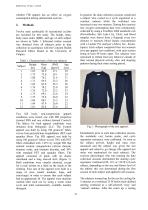
whether FIR apparel has an effect on oxygen consumption during submaximal exercise. Twelve male aerobically fit recreational cyclists are recruited for this study. The height, mass, body mass index (BMI), and age of each subject are shown in Table 1. Informed written consent was obtained from all subjects prior to data collection in accordance with the Conjoint Health Research Ethics Board at the University of Calgary. Table 1. Characteristics of the test subjects Two full body, non-compression apparel conditions were tested; one with FIR properties (termed FIR) and one without (termed Control)....
Open the catalog to page 2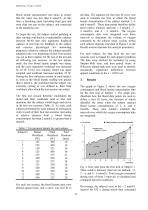
blood lactate measurement was taken to ensure that the value was less than 2 mmol/L. At this time, a breathing mask (including head gear and nose clip) was put on the subject, and connected to the metabolic cart. To begin the test, the subject started pedaling at their starting workload at a maintainable cadence between 80-90 rpm (the ergometer displayed cadence in real time for feedback to the subject and exercise physiologist for monitoring purposes); whatever cadence the subject naturally adopted at the very beginning of their first session was set as their cadence for the rest of the test...
Open the catalog to page 3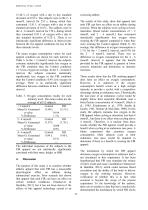
15.40 L of oxygen with a day to day standard deviation of 0.32 L. The subjects were in the 2 - 4 mmol/L interval for 255 s, during which they consumed 11.81 L of oxygen with a day to day standard deviation of 0.25 L. The subjects were in the 4 - 6 mmol/L interval for 158 s, during which they consumed 8.92 L of oxygen with a day to day standard deviation of 0.20 L. There is no statistically significant difference in interval time between the two apparel conditions for any of the three intensity levels. The mean oxygen consumption values for each apparel condition are shown for each interval in...
Open the catalog to page 4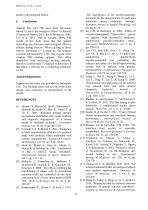
positive physiological effects. Apparel that emit FIR have been previously shown to elicit physiological effects in humans (Conrado & Munin, 2011; Ko & Berbrayer, 2002; Lee et al. 2011; York & Gordon, 2009). The results of this study show that this apparel technology can also have a physiological effect on athletes during exercise. When cycling at lower relative intensities (< 4 mmol/L), the subjects consume approximately 1.0% less oxygen when wearing FIR emitting apparel. This effect diminishes with increasing cycling intensity; therefore, further study is required to determine if this effect...
Open the catalog to page 5All Kilde Medic catalogs and technical brochures
 Kilde_testreport
8 Pages
 InHouse_TCPO2_Overview
22 Pages
 FDA_Polsinelli_2017_06_14
2 Pages
 celliant principals of operation
13 Pages
 Celliant
24 Pages
 Celliant Published Studies
213 Pages
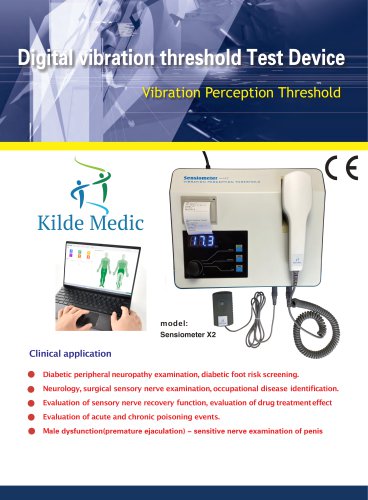 Kilde Medic Biothesiometer
2 Pages
 ReflexWear
8 Pages