

SuperCable ® Grip and Plate System
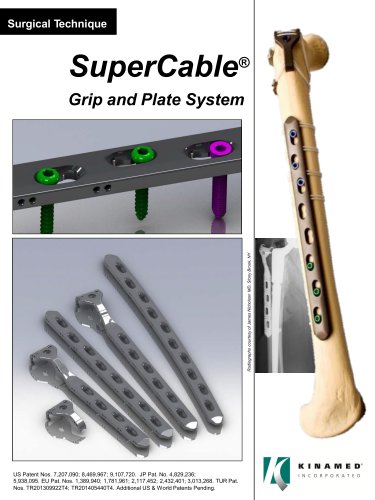
SuperCable ® Grip and Plate System
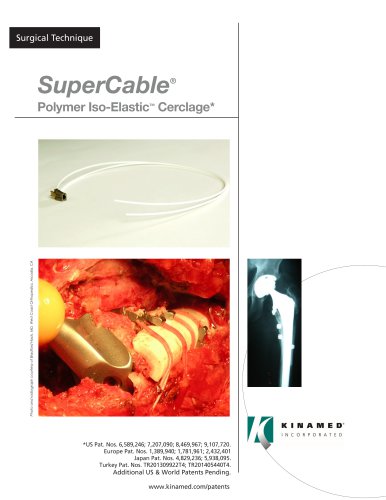
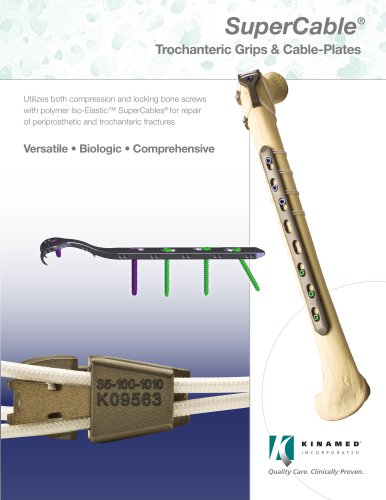
The Kinamed SuperCable® Trochanteric Grip and Cable-Plate System is designed for use with the SuperCable Iso-Elastic polymer cerclage cable. It features integrated holes for cable passage, allowing secure fixation of the plate to bone. The system supports both locking and compression screws, offering flexibility in managing complex fractures. Available in various lengths and configurations, it aims to improve anatomic fixation.
The system is indicated for use in conjunction with cerclage in trochanteric grips or bone plates, particularly for reattachment of the greater trochanter following osteotomy or fracture, and fixation of long bone fractures. Specific indications include trochanteric osteotomy, extended trochanteric osteotomy, trochanteric fracture, and periprosthetic long bone fractures.
Trochanteric Grips: Designed with integrated holes for SuperCable polymer cerclage cables, these grips minimize cable stress and provide stability with proximal and distal tines. They allow for secure fixation using locking or standard bone screws and are constructed from titanium.
Cable-Plates: These also feature integrated holes for cerclage cables and allow for compression, locked, or combination plating. They are made from titanium and offer various screw fixation options.
Compression Plating: Provides fracture stabilization with interfragmentary compression, suitable for healthy bone and simple fractures.
Locked Plating: Creates a fixed angle construct that acts as an "internal fixator," preserving periosteal blood supply and suitable for comminuted fractures and osteoporotic bone.
Combination Plating: Utilizes both compression and locked plating techniques for different fracture levels, offering enhanced stability.
The SuperCable grips are designed for lateral fixation of the trochanter, avoiding the need for complex contouring and minimizing soft-tissue impingement. The design allows for sharp proximal tines and a proximal locking screw hole for additional fixation.
Trochanteric Grip Fixation: The technique involves selecting the appropriate grip, feeding cables through the grip, positioning the grip using a threaded drill guide, and securing the cable with tension. The procedure emphasizes careful handling to avoid damage to neurovascular structures and proper alignment for effective tensioning.
Ensure firm grip fixation with cables or clamps before drilling and placing screws. Position the cable clasp to maximize conformity with the bone surface and consider locking screw placement when medial bone is absent.
This document provides a detailed surgical technique for trochanteric grip fixation and cable-plate fixation, including the use of bone screws and cables for securing fractures. It outlines the steps for proper tensioning, trimming, and securing of cables, as well as the optional use of screws for additional fixation.
- Cable Tensioning: Cables should be tensioned sequentially to compensate for movement in the fracture construct. Retensioning is possible before trimming the cable ends.
- Screw Fixation (Optional): Bone screws can be used in addition to cables. The most proximal hole accepts a locking or standard compression screw. Proper drilling and placement are crucial to avoid damaging cables.
- Plate Selection: Choose a cable-plate based on fracture type. For comminuted fractures, a longer plate is recommended.
- Cable Feeding: Cables should be fed through the plate before positioning, ensuring the locking clasp is accessible for tensioning.
- Cable Tensioning: Apply tension and lock the cable clasp. Check all cables for optimal tension before trimming.
- Screw Fixation (Optional): Locking screws can be used with cables for additional fixation. Ensure the plate is secured before drilling.
- Locking Screws: Insert manually to avoid cross-threading. Locking screws create a fixed-angle construct and should be used after securing the plate with cables or compression screws.
- Compression Screws: Use for dynamic compression. Pre-drill using appropriate drill guides and ensure screws are slightly longer than the depth gauge reading.
The document lists the instruments required for the procedure, including cable passers, tensioners, drivers, and drill guides.
A list of references is provided for further reading on related surgical techniques and outcomes.
All instruments are supplied non-sterile and must be cleaned and sterilized before use. Sterilization is achieved through autoclaving, following FDA, ISO, and ANSI/AAMI standards. Instruments must be thoroughly cleaned and inspected for dryness before autoclaving.
Instruments must be free of packaging material and biocontaminants prior to sterilization. Cleaning, maintenance, and mechanical inspection should be performed by authorized personnel. Refer to the SuperCable IFU document B00154 for detailed cleaning instructions.
Implants must be handled with care to avoid bending, notching, or scratching, which can reduce strength and fatigue resistance. Implants and instruments should be protected from corrosive environments. Only system-specific instruments should be used to ensure correct implantation.
The recommended sterilization method is steam autoclave with specific cycle types and temperatures. For example, a pre-vacuum cycle at 132°C or 270°F for 4 minutes with a 45-minute dry time.
The document lists various components and their part numbers, including trochanteric grips, cable passers, drill guides, and bone screws, all made of titanium.
Kinamed, Inc. provides contact details including phone numbers, fax, and website for further inquiries.
Catalog excerpts
Surgical Technique Radiographs courtesy of James Nicholson MD, Stony Brook, NY Grip and Plate System US Patent Nos. 7,207,090; 8,469,967; 9,107,720. JP Pat. No. 4,829,236; 5,938,095. EU Pat. Nos. 1,389,940; 1,781,961; 2,117,452; 2,432,401; 3,013,268. TUR Pat. Nos. TR201309922T4; TR201405440T4. Additional US & World Patents Pending.
Open the catalog to page 1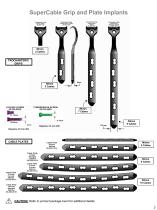
Trochanteric Gre 6 Hole Plat* Straight. 245mm 5-200 1 TROCHANTERIC GRIPS CABLE PLATES Refer to product package insert for additional details. 2
Open the catalog to page 2
The Kinamed SuperCable® Trochanteric Grip and Cable-Plate System is designed specifically for use with the SuperCable Iso-Elastic™ polymer cerclage cable3637. Holes integrated in the grips and plates allow passage of the SuperCable for secure fixation of the plate to bone. Screw fixation may be achieved using locking screws*, compression screws, or a combination of both. The unique figure-of-eight design of the screw fixation holes allows locking or compression screws to be used on either side, giving the surgeon greater flexibility in the management of complex fractures. Trochanteric grips and...
Open the catalog to page 3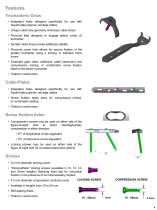
• Integrated holes designed specifically for use with SuperCable polymer cerclage cables • Unique cable hole geometry minimizes cable stress • Proximal tines designed to engage lateral cortex of trochanter • Smaller distal tines provide additional stability • Proximal screw hole allows for secure fixation of the greater trochanter using a locking or standard bone screw • Extended grips allow additional cable placement and compression, locking, or combination screw fixation distal to the lesser trochanter • Titanium construction • Integrated holes designed specifically for use with SuperCable...
Open the catalog to page 4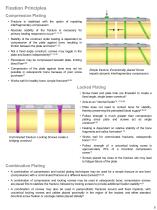
Fixation PrinciplesCompression Plating • Fracture is stabilized with the option of imparting interfragmentary compression • Absolute stability of the fracture is necessary for primary healing response to occur4,7,17,37 • Stability of the construct under loading is dependent on compression of the plate against bone resulting in friction between the plate and bone4,7,25 • Not a fixed angle construct; screws may toggle in the plate and loosen independently4,7,14,32 • Periosteum may be compressed beneath plate, limiting blood flow4,26 • Compression of the plate against bone may not be possible in...
Open the catalog to page 5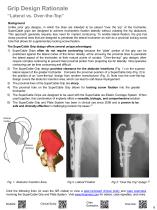
Grip Design Rationale “Lateral vs. Over-the-Top” Background Unlike prior grip designs, in which the tines are intended to be placed "over the top” of the trochanter, SuperCable grips are designed to achieve trochanteric fixation laterally without violating the hip abductors. This approach generally requires less need for implant contouring. To enable lateral fixation, the grip has sharp proximal tines that are designed to penetrate the lateral trochanter as well as a proximal locking screw hole that allows for supplementary locking screw fixation. The SuperCable Grip design offers several unique...
Open the catalog to page 6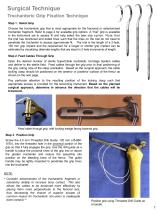
Surgical Technique Trochanteric Grip Fixation Technique Step 1. Select Grip Choose the trochanteric grip that is most appropriate for the fractured or osteotomized trochanter fragment. Refer to page 2 for available grip options. A “trial” grip is available in the instrument set to assess fit and help select the best size option. Note that the trial has shortened and dulled tines such that the tines on the trial do not need to penetrate the trochanter to assess approximate fit. The trial is the length of a 2-hole, 135 mm grip implant and the requirement for a longer or shorter grip implant can...
Open the catalog to page 7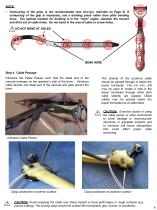
Contouring of the grips is not recommended (see d e s i g n rationale on Page 6). If contouring of the grip is necessary, use a bending press rather than plate bending irons. The optimal location for bending is in the “neck” region, between the second and third set of cable holes. Do not bend in the area of cable or screw holes. DO NOT BEND AT HOLES BEND HERE Step 4. Cable Passage Introduce the Cable Passer such that the distal end of the cannula emerges on the operator’s side of the bone. Introduce cable strands into distal end of the cannula and pass around the bone. The strands of the proximal...
Open the catalog to page 8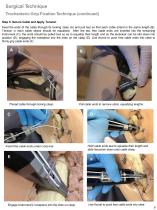
Surgical Technique Trochanteric Grip Fixation Technique (continued) Step 5. Secure Cable and Apply Tension Feed the ends of the cable through its locking clasp (A) and pull taut so that each cable strand is the same length (B). Tension in each cable strand should be equalized. After the two free cable ends are inserted into the tensioning instrument (C), the ends should be pulled taut so as to equalize their length and so the tensioner can be slid down into position (D), engaging the nosepiece into the slots on the clasp (E). Use thumb to push free cable ends into cleat to firmly grip cable ends...
Open the catalog to page 9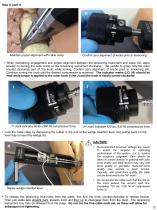
Maintain proper alignment with cable clasp. Confirm zero alignment of knobs prior to tensioning. • While maintaining engagement and proper alignment between the tensioning instrument and clasp (G), apply tension by turning the outer knob on the tensioning instrument clockwise. Be careful to grasp only the outer knurled (textured) part of the knob while turning. Confirm zero alignment of knobs prior to tensioning (H). Continue turning the knob until the desired compression is achieved. The indicator marks (LO, HI) should be read while torque is applied to the outer knob (I and J) and the knob...
Open the catalog to page 10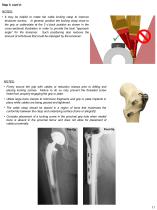
• It may be helpful to rotate the cable locking clasp to improve tensioner access. In general, position the locking clasp close to the grip or cable-plate at the 2 o’clock position as shown in the cross-sectional illustration in order to provide the best “approach angle” for the tensioner. Such positioning also reduces the amount of soft-tissue that could be impinged by the tensioner. • Firmly secure the grip with cables or reduction clamps prior to drilling and placing locking screws. Failure to do so may prevent the threaded screw head from properly engaging the grip or plate. • Utilize large...
Open the catalog to page 11All Kinamed catalogs and technical brochures
 OsteoRepair
2 Pages
 MD3T™ Technique Overview
21 Pages
 MD3T
2 Pages
 VacuJet ®
2 Pages
 CarboJet XF ®
2 Pages
 SuperCable
4 Pages
 SuperCable Brochure
4 Pages
 SuperCable Flyer
1 Page
 KineMatch® PFR
4 Pages



- Compression plate
- Metallic compression plate
- Locking compression plate
- Titanium compression plate
- Proximal compression plate
- Surgical navigation system
- Optical surgical navigation system
- Cranial fixation system
- Non-absorbable cranial fixation system
- Pulsed lavage system
- Bone cerclage wiring
- Orthopedic surgery pulsed lavage system
- Orthopedic surgery navigation system
- Multifilament polymer bone cerclage
- Sternal closure bone cerclage wiring
- Patello-femoral prosthesis