


- Company
- Products
- Catalogs
- News & Trends
- Exhibitions
PEGASO CATALOGUE
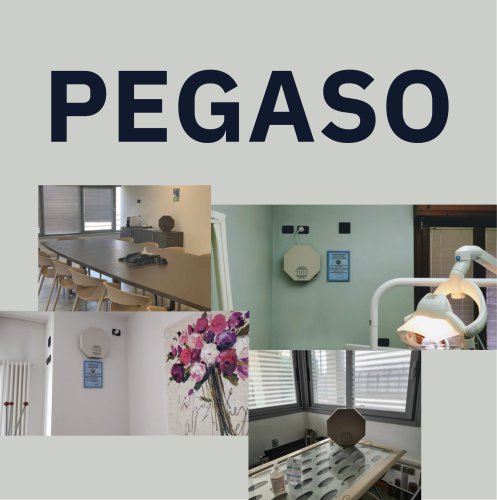
PEGASO CATALOGUE
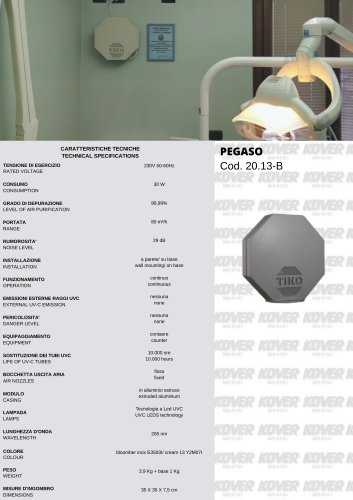
The PEGASO is a forced closed-cycle air disinfection device that utilizes patented and certified UV-C LED technology to achieve a 99% air disinfection rate, specifically targeting Mycobacterium Tuberculosis. It is designed for use in both domestic and working environments, providing continuous protection without the risk of UV exposure to people.
Specifications
- Air disinfection rate: 99% for Mycobacterium Tuberculosis
- Coverage: Up to 80 m³/h
- Operating voltage: 230V 50/60 Hz
- Power consumption: 30W
- Noise level: 29dB
- Wavelength: 265 nm
- Structure: Steel
- Dimensions and weight: 35x35x7.5 cm, 3.9 kg + 1 kg base
Operation and Features
The device operates on a forced closed-cycle ventilation system, drawing air through an inlet nozzle, exposing it to UV-C LEDs for germicidal action, and expelling it through an outlet grille. The UV-C LEDs emit radiation at 265 nm, which is optimal for DNA absorption, effectively reducing microbiological contamination.
Testing and Results
Tests conducted at SAVI LABORATORI demonstrated a 98.44% reduction in Staphylococcus Aureus ATCC25923 after 1 hour of operation. The device was tested in a sealed chamber of 1 m³, using passive sampling methods to measure microbiological reduction.
Certifications and Standards
- ISO 18593: Horizontal methods for sampling techniques
- ISO 4833: Enumeration of microorganisms
Advantages
UV-C LEDs offer a compact, durable, and eco-friendly solution for air disinfection, without generating ozone or ionizing frequencies. The technology is effective against a wide range of microorganisms, preventing resistance development.
Contact Information
KOVER SRL, Strada Ronchetti 6/d, 46027 San Benedetto Po (Mn)
Tel: 0376 620562
Email: [email protected]
Catalog excerpts
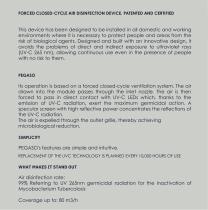
FORCED CLOSED-CYCLE AIR DISINFECTION DEVICE. PATENTED AND CERTIFIED This device has been designed to be installed in all domestic and working environments where it is necessary to protect people and areas from the risk of biological agents. Designed and built with an innovative design, it avoids the problems of direct and indirect exposure to ultraviolet rays (UV-C 265 nm), allowing continuous use even in the presence of people with no risk to them. PEGASO Its operation is based on a forced closed-cycle ventilation system. The air drawn into the module passes through the inlet nozzle. The air...
Open the catalog to page 2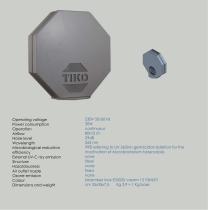
Operating voltage Power consumption Operation Airflow Noise level Wavelength Microbiological reduction efficiency External UV-C ray emission Structure Hazardousness Air outlet nozzle Ozone emission Colour Dimensions and weight 230V 50/60 Hz 30W continuous 80m3 /h 29dB 265 nm 99% referring to UV 265nm germicidal radiation for the inactivation of Mycobacterium tubercolosis none Steel none fixed none bloomber inox E3503I/ cream 13 Y2M07I cm 35x35x7,5 Kg 3,9 + 1 Kg base
Open the catalog to page 3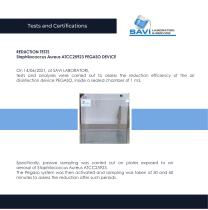
REDUCTION TESTS Staphilococcus Aureus ATCC25923 PEGASO DEVICE On 14/06/2021, at SAVI LABORATORI, tests and analyses were carried out to assess the reduction efficiency of the air disinfection device PEGASO, inside a sealed chamber of 1 m3. Specifically, passive sampling was carried out on plates exposed to an aerosol of Staphilococcus Aureus ATCC25923. The Pegaso system was then activated and sampling was taken at 30 and 60 minutes to assess the reduction after such periods.
Open the catalog to page 4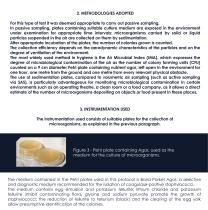
2. METHODOLOGIES ADOPTED For this type of test it was deemed appropriate to carry out passive sampling. In passive sampling, plates containing suitable culture medium are exposed in the environment under examination for appropriate time intervals: microorganisms carried by solid or liquid particles suspended in the air are collected on them by sedimentation. After appropriate incubation of the plates, the number of colonies grown is counted. The collection efficiency depends on the aerodynamic characteristics of the particles and on the degree of ventilation of the environment. The most widely...
Open the catalog to page 5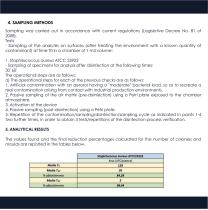
Sampling was carried out in accordance with current regulations (Legislative Decree No. 81 of 2008). - Sampling of the analytes on surfaces (after treating the environment with a known quantity of contaminant) at time T0 in a chamber of 1 m3 volume: 1. Staphilococcus aureus ATCC 25923 - Sampling of specimens for analysis after disinfection at the following times: The operational steps are as follows: a) The operational steps for each of the previous checks are as follows: 1. Artificial contamination with an aerosol having a "moderate" bacterial load, so as to recreate a real contamination arising...
Open the catalog to page 6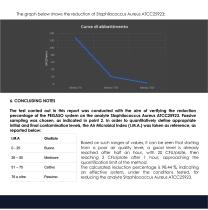
The graph below shows the reduction of Staphilococcus Aureus ATCC25923: The test carried out in this report was conducted with the aim of verifying the reduction percentage of the PEGASO system on the analyte Staphilococcus Aureus ATCC25923. Passive sampling was chosen, as indicated in point 2. In order to quantitatively define appropriate initial and final contamination levels, the Air Microbial Index (I.M.A.) was taken as reference, as reported below: Based on such ranges of values, it can be seen that starting from a poor air quality level, a good level is already reached after half an hour,...
Open the catalog to page 7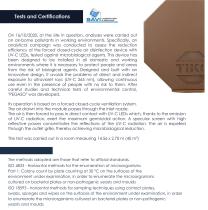
Tests and Certifications On 16/10/2020, at the site in question, analyses were carried out on air-borne pollutants in working environments. Specifically, an analytical campaign was conducted to assess the reduction efficiency of the forced closed-cycle air disinfection device with UV-C LEDs, tested against microbiological agents. This device has been designed to be installed in all domestic and working environments where it is necessary to protect people and areas from the risk of biological agents. Designed and built with an innovative design, it avoids the problems of direct and indirect exposure...
Open the catalog to page 8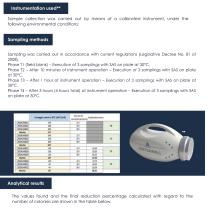
Instrumentation used** Sample collection was carried out by means of a calibrated instrument, under the following environmental conditions: Sampling methods Sampling was carried out in accordance with current regulations (Legislative Decree No. 81 of 2008). Phase T1 (field blank) – Execution of 3 samplings with SAS on plate at 30°C. Phase T2 – After 10 minutes of instrument operation – Execution of 3 samplings with SAS on plate at 30°C. Phase T3 – After 1 hour of instrument operation – Execution of 3 samplings with SAS on plate at 30°C. Phase T4 – After 3 hours (4 hours total) of instrument operation...
Open the catalog to page 9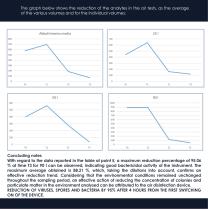
The graph below shows the reduction of the analytes in the air tests, as the average of the various volumes and for the individual volumes: Concluding notes With regard to the data reported in the table at point 5, a maximum reduction percentage of 95.06 % at time T3 for 90 l can be observed, indicating good bactericidal activity of the instrument. The maximum average obtained is 88.21 %, which, taking the dilutions into account, confirms an effective reduction trend. Considering that the environmental conditions remained unchanged throughout the sampling period, an effective action of reducing...
Open the catalog to page 10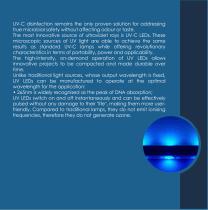
UV-C disinfection remains the only proven solution for addressing true microbial safety without affecting odour or taste. The most innovative source of ultraviolet rays is UV-C LEDs. These microscopic sources of UV light are able to achieve the same results as standard UV-C lamps while offering revolutionary characteristics in terms of portability, power and applicability. The high-intensity, on-demand operation of UV LEDs allows innovative projects to be compacted and made durable over time. Unlike traditional light sources, whose output wavelength is fixed, UV LEDs can be manufactured to operate...
Open the catalog to page 11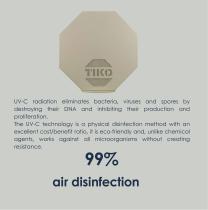
UV-C radiation eliminates bacteria, viruses and spores by destroying their DNA and inhibiting their production and proliferation. The UV-C technology is a physical disinfection method with an excellent cost/benefit ratio, it is eco-friendly and, unlike chemical agents, works against all microorganisms without creating resistance.
Open the catalog to page 13All KOVER SRL catalogs and technical brochures
 PEGASO 20.13-B
1 Page
 DEPLIANT KOVER SRL
2 Pages
 ANION GERM UV C G 11100
1 Page
 UV STERIL DUCT CI
1 Page
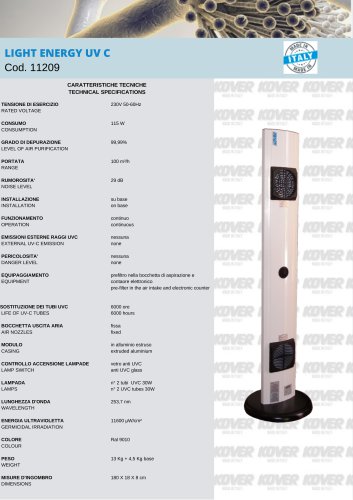 LIGHT ENERGY UV C 11209
1 Page
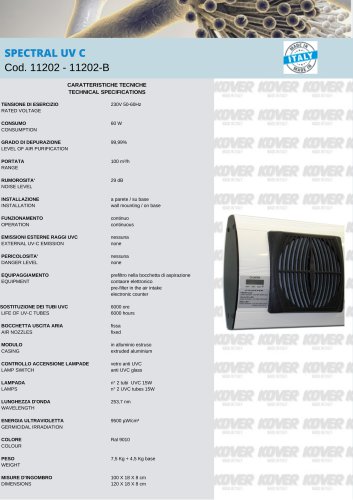 SPECTRAL UV C 11202
1 Page
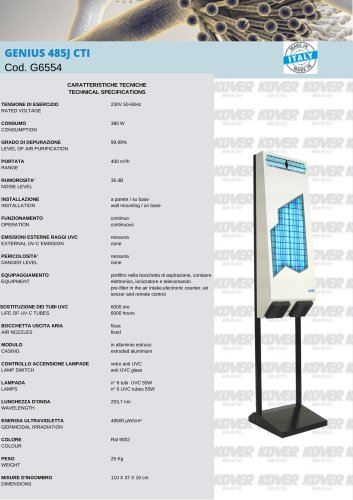 GENIUS 485J CTI
1 Page
 KOVER CATALOGUE
25 Pages
 Genius 485j cti
6 Pages
 UV STERIL DUCT
6 Pages
 UV STERIL AIR SYSTEM
6 Pages
- Germicidal air sterilizer
- UV air recirculator
- Mobile disinfection system
- Air purifier with microbial elimination
- Compact air sterilizer
- Home use air sanitizer
- Electric disinfection system
- UVC air sterilizer
- UVC disinfection system
- Laboratory disinfection system
- Disinfection system with germicidal lamp
- Benchtop disinfection system
- Air purification system
- Remote-controlled disinfection system
- Environmental disinfection system
- Wall-mounted disinfection system
- UVC air purification system