


IMPLADENT STI-Bio-C

IMPLADENT STI-Bio-C
The document discusses the STI-Bio-C implant, a bioactive titanium dental implant with a unique alkali-treated surface designed to accelerate bone-implant contact formation. This enhances secondary stability and reduces healing time, allowing for early and immediate loading.
Bioactive Surface Characteristics
The bioactive surface of the STI-Bio-C implant is hydrophilic, nano-structured, and osseoconductive. It increases the density of hydroxyl groups, enhancing ion interaction with blood plasma and promoting rapid bone formation. The surface treatment results in a macro-, micro-, and nano-porous structure, significantly increasing the surface area compared to smooth implants.
Cellular Response
Studies show that the bioactive surface improves cell attachment and differentiation. It attracts and binds cells more effectively than other surfaces, leading to higher production of osteopontin, a key protein in bone matrix formation.
Clinical Documentation
The STI-Bio-C implant has been clinically documented since its market introduction in 1999. Studies demonstrate its effectiveness in reducing healing time and supporting immediate loading protocols. Clinical trials report high success rates and stability, even with reduced healing periods.
Conclusion
The STI-Bio-C implant's bioactive surface offers a reliable and predictable treatment option, enhancing implant stability and reducing healing time, making it suitable for advanced dental procedures.
Catalog excerpts

IMPLADENT STI-Bio-C BIOACTIVE TITANIUM since 1999 • HYDROPHILIC • NANO STRUCTURED • OSSEOCONDUCTIVE The unique alkali-treated bioactive surface of the STI-Bio-C implant accelerates the process of boneimplant contact formation, providing the implant with increasing secondary stability at the earliest stages of healing. This phenomenon helps to reduce the healing time and enables early and immediate loading to become a predictable and safe treatment protoc
Open the catalog to page 1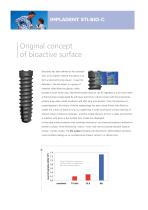
IMPLADENT STI-BIO-C Bioactivity has been defined as the characteristics of an implant material that allows it to form a bond with living tissues1. It was first detected in the late sixties: in a group of materials called bioactive glasses, which bonded to bone within days. Machined-smooth titanium can be regarded as a bio-inert material that becomes encapsulated by soft tissue and forms a direct contact with bone (osseointe-gration) only under certain conditions and after long time periods2. Since the discovery of osseointegration, the history of dental implantology has been closely linked with...
Open the catalog to page 2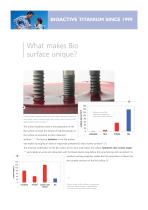
BIOACTIVE TITANIUM SINCE 1999 What makes Bio surface unique? Contact of three implant surfaces with blood (left: sand-blasted large grit Surface area of Bio surface in comparison with other tested surfaces. acid etched, center: anodized, right: Bio; arrows mark the level of the highest blood implant contact) 4,5,14 The surface treatment used in the preparation of the Bio surface increases the density of hydroxyl groups on the surface as compared to other measured surfaces . The level of hydration of the Bio surface was higher by roughly an order of magnitude compared to that of other surfaces5,14...
Open the catalog to page 3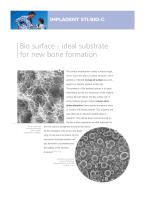
IMPLADENT STI-BIO-C Bio surface - ideal substrate for new bone formation 5 The surface modification creates a macro-rough, micro- and nano-porous surface structure, which exhibits a 138-fold increase of surface area compared to a smooth implant surface (4). The presence of the hydroxyl groups is of great importance for the ion interaction of the implant surface (5) with blood. The Bio surface rich in active hydroxyl groups induces calcium phos phate adsorption (bone apatite formation) when in contact with blood plasma6. This property was also observed on fluoride treated titanium implants7. The...
Open the catalog to page 4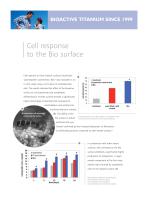
BIOACTIVE TITANIUM SINCE 1999 Cell response to the Bio surface Cell response to three implant surfaces ('machined', 'sand-blasted+acid-etched', 'Bio') 8 was evaluated in an in vitro study using a cell culture of osteoblast-like cells. The results indicated the effect of the bioactive surface on cell attachment and osteoblastic differentiation. The Bio surface showed a significantly higher percentage of attached cells compared to sand-blasted+acid-etched and 7 machined titanium surfaces An osteoblastic cell spreading Cell attachment to the Bio surface in comparison with machined and sand-blasted+acid...
Open the catalog to page 5
IMPLADENT STI-BIO-C Bioactive surface clinically documented STI-Bio-C represents a dental implant of a new bioactive generation. It entered the that the functional immediate loading of market in 1999 and since then its clinical the fixed bridge carried by STI-Bio implants success has been systematically document- in the mandible represented a predictable ed. The accelerated bone-implant contact treatment option. formation helps to reduce the healing time and enables a predictable and safe application of advanced treatment protocols, such Early loading (4 weeks) of dental implants as early and...
Open the catalog to page 6
BIOACTIVE TITANIUM SINCE 1999 Bioactive surface clinically documented Reduced healing time of Impladent implants with bioactive surface11. Šimůnek A. (Assoc. Professor M.D., Ph.D., Stomatology Clinic Hradec Králové, Charles University Prague, Czech Republic). The purpose of the study was to evaluate the success rate of STI-Bio implants for which the standard healing time was reduced by half (6 weeks in the mandible, 12 weeks in the maxilla). During the monitored period (March 2002 to December 2003), a total of 1092 implants with Bio Implant stability after insertion and during loading (mean values...
Open the catalog to page 7
IMPLADENT STI-BIO-C 1. Hench L.L., Splinter R.J., Allen W.C., Greenlee T.K. Bonding mechanism at the interface of ceramic prosthetic materials., J. Biomed. Mater. Res. Symp. 2,117, 1971 • 2. Strnad Z, Strnad J, Povýšil C, K.Urban. Effect of Plasma Sprayed Hydroxyapatite Coating on Osteoconductivity of cp Titanium Implants. J of Oral and Maxillofacial Implants, 2000, 15, 483-490 • 3. Suketa et.al. Photocatalytic reaction on Tiunite surfaces, Clin. Oral. Impl. Res. 15, 4, 2004 • 4. Šimůnek A., Kopecká D., Strnad J., Alkali treatment - new concept of titanium implant surface modification, Clin....
Open the catalog to page 8All LASAK catalogs and technical brochures
 Product catalog 2020
52 Pages
 EXTEND DRIVER
2 Pages
 Quick start – Prosthetics
5 Pages
 BioniQ product catalog 2014/2015
28 Pages
 Bone regeneration material
4 Pages
 LASAK – Capability brochure
4 Pages
 Product catalog 2014 /2015
30 Pages
 PORESORB ® -TC P
8 Pages


- Implant abutment
- Titanium implant abutment
- Straight implant abutment
- Titanium dental implant
- Internal implant abutment
- Conical dental implant
- Angled implant abutment
- Straight dental implant
- Bone substitute
- Screw implant abutment
- Internal dental implant
- Dental implant analog
- Straight dental implant analog
- Hexagonal dental implant
- Healing abutment
- Dental screwdriver
- Internal hexagon dental implant
- Orthopedic surgery bone substitute
- Titanium healing abutment