

- Company
- Products
- Catalogs
- News & Trends
- Exhibitions
LAUDA Heat transfer liquids

LAUDA Heat transfer liquids
LAUDA constant temperature equipment is engineered for precise temperature control, utilizing specific heat transfer liquids suitable for temperatures ranging from −95 to 350 °C. The selection of appropriate liquids, such as water, water-glycol mixtures, polyethylene glycol, mineral, and silicone oils, is crucial for efficient heat transfer. Safety and technical data sheets are accessible on the LAUDA website.
The document details the compatibility of various heat transfer liquids with LAUDA product lines, stressing the importance of avoiding contaminated or mixed liquids, even within the same chemical class.
LAUDA's 'Therm' and 'Kryo' product lines cater to temperatures above and below 0 °C, respectively. Each product is specified by its chemical composition, temperature range, and material compatibility.
- Aqua 90: Water-based for open systems, 5 to 90 °C, no corrosion inhibitors.
- Therm 160: Polyalkylene glycol-based, 60 to 160 °C, water-soluble, incompatible with polycarbonate.
- Therm 180: Polydimethylsiloxane-based, 0 to 180 °C, inert and eco-friendly.
- Therm 250: Polymethylphenylsiloxane-based, 50 to 250 °C, for high temperatures.
- Ultra 301: White mineral oil, 40 to 230 °C in open systems, up to 300 °C in closed systems, for surface-sensitive applications.
Proper use of heat transfer liquids involves adhering to safety precautions and hazard statements. Following the operating manual for each product line ensures optimal performance and safety.
- Ultra 301: Temperature range: 40 - 230 °C (open), 40 - 300 °C (closed); white mineral oil; flash point: 245 °C.
- Ultra 350: Temperature range: 30 - 350 °C (closed); dibenzyltoluene; flash point: > 212 °C.
- Kryo 10: Temperature range: -10 - 90 °C; water, propylene glycol; blue, no known incompatibility.
- Kryo 20: Temperature range: -20 - 170 °C; polydimethylsiloxane; incompatible with silicone.
- Kryo 30: Temperature range: -30 - 90 °C; water, ethylene glycol; light yellow, no known incompatibility.
- Kryo 51: Temperature range: -50 - 120 °C; polydimethylphenylsiloxane; incompatible with silicone.
- Kryo 60: Temperature range: -60 - 60 °C; polydimethylsiloxane; incompatible with silicone.
- Kryo 65: Temperature range: -65 - 140 °C; aliphatic hydrocarbons; incompatible with EPDM.
- Kryo 70: Temperature range: -70 - 220 °C; polydimethylsiloxane; incompatible with silicone elastomers.
- Kryo 95: For temperatures below -50°C; polydimethylsiloxane; low viscosity, noncorrosive.
- Refrifluid 1 & 5: Antifreeze protection; water, ethylene glycol; suitable for Ultracool units.
- Algicide Aquastab: Prevents algae in bath thermostats; soluble in water.
- Decalcifier: Citric acid-based for lime scale removal.
- Refrifluid B: Corrosion inhibitor; transparent pink, water-soluble.
- Avoid using silicone tubing with silicone oils.
- Adhere to safety precautions and hazard statements.
- Safety and product data sheets are available at www.lauda.de.
Catalog excerpts
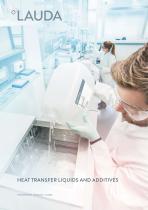
HEAT TRANSFER LiQUiDS AND ADDiTiVES "FAHRENHEIT. "CELSIUS. "LAUDA.
Open the catalog to page 1
LAUDA constant temperature equipment consists of highly precise machines that are optimally designed for temperature control. This includes precise control when approaching the setpoint, maintaining a constant value, and command of change when dynamically moving between setpoints. This precision can only be achieved in conjunction with a heat transfer liquid that harmonizes perfectly with the equipment and is also approved for the required temperature range. The selection of the correct heat transfer liquid is also crucial for the efficiency of the heat transfer. In this respect, the working...
Open the catalog to page 2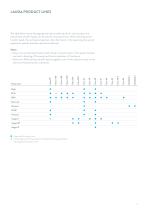
Lauda product lines The table below shows the appropriate heat transfer liquids for each product line. Not all heat transfer liquids can be used for all product lines. When selecting a heat transfer liquid, the working temperature, the information in the operating manual and application specific features need to be observed. Product line Notes • Never use contaminated heat transfer liquids. Contamination of the pump chamber can lead to blocking of the pump and thus to shutdown of the device. • Never mix different heat transfer liquids together, even if the substance class or the chemical characterization...
Open the catalog to page 3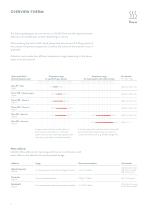
The following table gives an overview to our LAUDA Heat transfer liquids and water additives with available part numbers depending on volume. When ordering the heat transfer liquid, please take into account the filling volume of the constant temperature equipment, as well as the volume of the external circuit, if applicable. Attention: some media have different temperature ranges depending on the device (open or closed systems). Heat transfer fluid / Chemical substance class Part Number Temperature range for open/half-open systems -100 °C -50 °C 0 °C 100 °C 200 °C 300 °C Temperature range for...
Open the catalog to page 4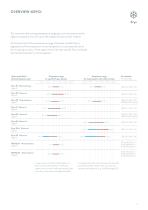
Kryo The recommended working temperature range gives you the lowest and the highest temperature for the use of the respective heat transfer medium. At the lower limit of the temperature range of the heat transfer fluid, a degradation of the temperature control properties is to be expected due to the increasing viscosity. At the upper limit of the heat transfer fluid, increased thermal decomposition is to be expected. Heat transfer fluid / Chemical substance class Temperature range for open/half-open systems Part Number In open systems the heat transfer liquid is in direct contact with ambient...
Open the catalog to page 5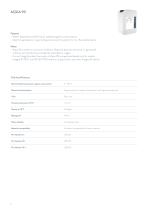
Features • Water-based heat transfer liquid, stabilized against contamination • Ideal for applications in open temperature control systems for non-flammable liquids • Aqua 90 contains no corrosion inhibitors. Materials based on aluminum or galvanized surfaces can therefore be corroded by atmospheric oxygen. • For our Integral product line, water or Aqua 90 are approved liquids only for models Integral IN 130 T and IN 230 T(W), there is no approval for any other Integral IN device. Technical Features Recommended temperature range for open systems Chemical characterisation Aqueous solution of organic,...
Open the catalog to page 6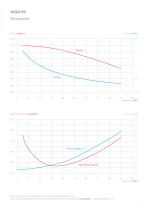
Volume change % Specific heat capacity cp [kJ/kg K] Please pay attention to the safety precautions and hazard statements before use. The concerning safety data sheet and the product data sheet can be downloaded under www.lauda.de or requested directly from us.
Open the catalog to page 7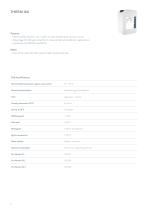
Features • Heat transfer liquid for use in baths or open temperature control circuits • Advantage of cold water solubility in measurement and calibration applications • Conforms with REACH and RoHs Notes • Cannot be used with bath vessels made of polycarbonate. Technical Features Recommended temperature range for open systems Chemical characterisation Polyalkylene glycol and additives Light green - colorless Solidifying point Flash point Boiling point Ignition temperature Water solubility Soluble in cold water Material incompatibility Non-ferrous metals, Polycarbonate
Open the catalog to page 8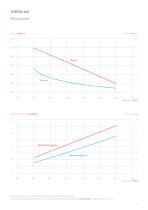
Physical properties Density p [kg/m3] Specific heat capacity cp [kJ/kg K] Please pay attention to the safety precautions and hazard statements before use. The concerning safety data sheet and the product data sheet can be downloaded under www.lauda.de or requested directly from us.
Open the catalog to page 9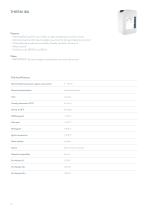
Features • Heat transfer liquid for use in baths or open temperature control circuits • Colorless heat transfer liquid, enables visual control during temperature control • Chemically inert and environmentally friendly synthetic silicone oil • Conforms with REACH and RoHs • IMPORTANT: silicone tubing is not allowed to use with silicone oils. Technical Features Recommended temperature range for open systems Chemical characterisation Solidifying point Flash point Boiling point Ignition temperature Water solubility Petrol, Acetone, Alcohols Material incompatibility
Open the catalog to page 10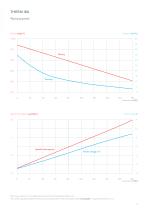
Physical properties Volume change % Specific heat capacity cp [kJ/kg K] Please pay attention to the safety precautions and hazard statements before use. The concerning safety data sheet and the product data sheet can be downloaded under www.lauda.de or requested directly from us.
Open the catalog to page 11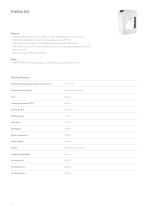
Features • Heat transfer liquid for use in baths or open temperature control circuits • Thermally stabilized, for use at temperatures above 200 °C • Chemically inert and environmentally friendly synthetic silicone oil • Colorless heat transfer liquid, enables visual control during temperature control • Conforms with REACH and RoHs • IMPORTANT: silicone tubing is not allowed to use with silicone oils. Technical Features Recommended temperature range for open systems Chemical characterisation Solidifying point Flash point Boiling point Ignition temperature Water solubility Petrol, Acetone, Alcohols...
Open the catalog to page 12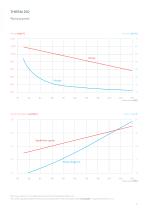
Physical properties Density p [kg/m3] Please pay attention to the safety precautions and hazard statements before use. The concerning safety data sheet and the product data sheet can be downloaded under www.lauda.de or requested directly from us.
Open the catalog to page 13All LAUDA catalogs and technical brochures
 LAUDA Command App
6 Pages
 LAUDA Universa
44 Pages
 LAUDA Ultratemp
8 Pages
 STILLS
8 Pages
 Mobifreeze
12 Pages
- LAUDA laboratory freezer
- LAUDA 1-door freezer
- LAUDA electric freezer
- LAUDA stainless steel freezer
- LAUDA laboratory bath
- Benchtop laboratory bath
- Mobile freezer
- Benchtop water bath
- LAUDA chest freezer
- Hospital freezer
- Vaccine freezer
- LAUDA heating laboratory bath
- LAUDA freezer with natural refrigerant
- LAUDA freezer with direct cooling
- LAUDA digital thermostat
- Medical freezer
- LAUDA cooling thermostat
- LAUDA laboratory chiller
- LAUDA heating water bath
- LAUDA laboratory thermostat