
- Catalogs
- LDR Medical
- ROI-A:Patient EDUCATION

ROI-A:Patient EDUCATION

ROI-A:Patient EDUCATION
The lower back, or lumbar spine, is composed of bones, spinal cord, nerves, muscles, ligaments, and blood vessels. It supports the upper body and absorbs movement forces, with discs between vertebrae providing cushioning and allowing movement.
This condition involves a damaged disc causing pain, characterized by reduced disc cushioning, tears in the disc's outer ring, and potential nerve irritation. It can lead to complications such as disc herniation and spinal canal stenosis.
The ROI-A Cage is designed to replace worn-out discs, facilitating bone fusion, restoring disc height, and relieving nerve pressure. Made from medical-grade plastic, it can be used with or without metal plates and is filled with bone graft during surgery to promote fusion.
Suitable for adults with proven disc degeneration causing pain, who have tried other treatments for six months. It can replace one or two adjacent discs from L2 to S1.
Surgery is not recommended for patients with infections, metal allergies, severe osteopenia, pregnancy, previous fusion at the same level, or inability to follow post-surgery instructions.
Possible issues include cage breakage, non-fusion, nerve damage, infection, blood clots, heart attack, and the need for additional surgeries.
Patients should follow doctor's instructions, arrange post-surgery support, and avoid eating or drinking the night before surgery.
Recovery involves gradual resumption of activities, wearing a brace, and following a physical therapy plan. Regular doctor visits are necessary to monitor healing and fusion progress.
The incision is typically 3-5 inches long, made in the belly. The location varies slightly between anterior lumbar and oblique cages.
Unlike other methods requiring additional implants, the ROI-A Cage uses strong plates to secure the cage without needing a second incision.
Definitions of medical terms such as annulus fibrosis, anterior lumbar, bone graft, and others are provided for clarity.
Catalog excerpts

ROI-A ANTERIOR LUMBAR and oblique CAGEs ® Patient Education ROI-A Anterior Lumbar ROI-A Oblique
Open the catalog to page 1
his patient information brochure will describe: • How the lower back works. • What happens when a disc wears out. • How to help your back pain and connected problems. Your doctor may have said that surgery using the ROI-A® Anterior Lumbar or Oblique Cage could help lessen your pain and discomfort. This brochure will help answer some of the most common questions before and after surgery. This information should not take the place of talking with a doctor. Please go to your doctor with questions about how you are feeling. Talk to a doctor about the best way to help your back problem. • The ROI-A...
Open the catalog to page 2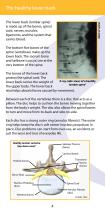
The healthy lower back The bottom five bones of the spine (vertebrae) make up the lower back. The sacrum bone and tailbone (coccyx) are at the very bottom of the spine. The lower back (lumbar spine) is made up of the bones, spinal cord, nerves, muscles, ligaments, and the system that carries blood. Vertebra Disc Vertebra The bones of the lower back protect the spinal cord. The X-ray (side-view) of a healthy lower back carries the weight of lumbar spine1 the upper body. The lower back also helps absorb forces caused by movement. Between each of the vertebrae there is a disc that acts as a pillow....
Open the catalog to page 4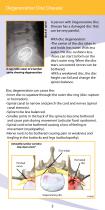
Degenerative Disc Disease X-ray (side-view) of a lumbar spine showing degeneration A person with Degenerative Disc Disease has a damaged disc that can be very painful. With disc degeneration: •The center of the disc takes in and holds less water. With less water, the disc cushions less. •Tears can start to form on the disc’s outer ring. When the disc tears, uncovered nerves can be bothered. •With a weakened disc, the disc height can fall and change the spine’s balance. Disc degeneration can cause the: • Inner disc to squeeze through the outer disc ring (disc rupture or herniation). • Spinal canal...
Open the catalog to page 5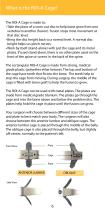
What is the ROI-A Cage? The ROI-A Cage is made to: • Take the place of a worn out disc to help bone grow from one vertebra to another (fusion). Fusion stops most movement at that disc level. • Bring the disc height back to a normal level. A normal disc height helps un-pinch nerves. • Work by itself (stand-alone) with just the cage and its metal plates. If used stand-alone, there is no other plate used on the front of the spine or screws in the back of the spine. The rectangular ROI-A Cage is made from strong, medical grade plastic (polyether ether ketone). The top and bottom of the cage have...
Open the catalog to page 6
Who can receive an ROI-A Cage? The ROI-A Anterior Lumbar and Oblique Cages: • Are for adults; the bones must be fully grown. • Take the place of a degenerated disc that is causing pain. Degeneration needs to be proven by patient history and the study of X-ray or MRI images. • Take the place of one or two damaged discs in the lower back from levels L2 to S1 (Sacrum). • Can be used to fuse one disc or two discs that are next to each other. • Are for people who are still having pain. The patient should have tried six months of other medical treatments before having surgery. Do I need surgery? Have...
Open the catalog to page 7
Who should not have surgery with a cage in the lower back? If you have any of the following, you should not have surgery with the ROI-A: • A fever or a serious, long-term, full-body, or one-area infection. • Metal allergies or a past reaction to what the cage and plate are made from: PEEK Optima®, tantalum, or titanium. • Bone with a lower amount of minerals (severe osteopenia). • Pregnancy. • A past fusion at the same level(s) of the lower back that need to be operated on again. • Unable to follow directions after surgery, including changing your activity level. • Anything that would end the...
Open the catalog to page 8
What are the problems the ROI-A Cage surgery can cause? You should talk to your doctor about having surgery with the ROI-A. As with any surgery, there are things that can go wrong when getting an ROI-A. This list does not cover everything that can go wrong with a surgery, but problems could include: • A cage break. • A loose cage or a cage that starts moving (fusion may not occur). • The loss of movement (paralysis) or nerve health getting worse. • The growth of unhealthy soft tissue (lesion) or new pain because of the surgery. • Damage to blood vessels, nerves (such as loss of sexual function...
Open the catalog to page 9
Preparing for my ROI-A surgery Follow your doctor’s directions when getting ready for your surgery. Here is a to-do list for before surgery. Your doctor’s directions may be different: • Check that the medicine(s) you are taking will still be OK to take after having surgery on your lower back. • Take time before going to the hospital to arrange your life for after surgery: -Move anything you use a lot to an easy to reach spot. -Arrange to have family or friends around to help you. • You will likely be told not to eat or drink the night before the surgery. • Ask your doctor to tell you what to...
Open the catalog to page 10
What can I expect after surgery? Ask your doctor to describe how you will feel and what you will need to do after surgery. Replacing your disc(s) with the ROI-A is a major surgery. Getting better will take time. How fast you get better depends on your age, your general health, and the reason for the surgery. You may get better faster if you follow your doctor’s directions and exercise with the help of a physical therapist. Here is a list of ways to take care of yourself after a lower back fusion surgery. Your doctor’s directions may be different: • Sit, stand, and walk the night after surgery....
Open the catalog to page 11
What will my surgery cut (incision) look like? The incision will likely be three to five inches long. The doctor will usually make a cut in the belly in the up-and-down direction. The cut for the: • ROI-A Anterior Lumbar Cage will be near the middle of the belly, just to the side of the belly button. • ROI-A Oblique Cage will be made off-center, normally more to the left of the patient’s belly button. When can I start driving and moving normally? Get direction from your doctor on when it is OK to return to your normal life movements. In most cases, a lower back surgery on only one or two discs...
Open the catalog to page 12All LDR Medical catalogs and technical brochures
 C-PLATE
2 Pages
 ROI-A
ROI-A3 Pages
 MC+
MC+2 Pages
 ROI - C
2 Pages
 SpineTune ® TL
2 Pages
 ROI
ROI6 Pages
 Easyspine®
41 Pages
 Anterior Cervical Plate
15 Pages
 MC+®
MC+®8 Pages
 ROI-C®
18 Pages
 Mobi-C® Plug & Fit
14 Pages

- Bone plate
- Interbody fusion cage
- Bone substitute
- PEEK interbody fusion cage
- Lumbar interbody fusion cage
- Anterior interbody fusion cage
- Arthrodesis plate
- Orthopedic surgery bone substitute
- Spinal stabilization system
- Posterior spinal osteosynthesis unit
- Metallic arthrodesis plate
- Adult spinal osteosynthesis unit
- Cervical interbody fusion cage
- Locking arthrodesis plate
- Synthetic bone substitute
- Posterior interbody fusion cage
- Transforaminal interbody fusion cage
- Rigid bone substitute
- Thoraco-lumbar osteosynthesis unit
- Cervical vertebra arthrodesis plate