


Mygo_stander

Mygo_stander
The Mygo Stander by Leckey is designed for children aged 4 to 14 years to support standing therapy. It combines clinical benefits with ease of use, enhancing participation and interaction in daily life.
Benefits of Standing
- Bone Density: Increases bone density and reduces fracture risk in non-ambulatory children.
- Muscle Stretching: Improves muscle extensibility and range of movement, preventing contractures.
- Respiration and Voice Control: Enhances breathing efficiency and voice control.
- Circulation: Improves blood circulation and reduces orthostatic hypotension.
- Social Interaction: Facilitates eye-to-eye interaction, boosting confidence and social skills.
- Wellbeing: Enhances sleep, alertness, and overall wellbeing.
- Digestion: Supports digestion and bowel function.
- Hip Joint Formation: Aids in early hip joint development.
- Skin Integrity: Relieves pressure, improving skin health.
Mygo Stander Features
- Configurations: Three-in-one design (Supine, Prone, Upright) with adjustable angles.
- Sizes: Available in two sizes for ages 4-10 and 8-14.
- Colours: Offered in blue, pink, orange, and infection control options.
- Clinical Advantages: Accommodates contractures, reduces patella load, and enhances upper limb function.
Technical Specifications
- Dimensions: Adjustable to fit various heights and weights.
- Adjustments: Tool-free adjustments for user convenience.
- Accessories: Includes pads, straps, and trays for customization.
Service and Support
- Leckey provides free product training, setup, assessment, and repair within a two-year warranty.
- Products comply with 93/42/EEC guidelines and EN12182 standards.
Overview: Leckey is committed to supporting individuals with disabilities, enabling participation in everyday activities through clinically effective and family-friendly products that ensure postural support day and night.
Product Development Approach: Leckey's product design is highly clinical, involving research and collaboration with universities, therapists, users, and families to meet clinical and social needs.
Target Audience: Products cater to individuals from childhood to adulthood, providing 24-hour postural care for activities like sleeping, sitting, standing, walking, moving, bathing, and toileting.
Collaboration and Feedback: Leckey collaborates with healthcare professionals, individuals, and carers to develop reliable, durable, and high-performance products recognized worldwide for quality and effectiveness.
Contact Information: Leckey is located at 19 Ballinderry Road, Lisburn, BT28 2SA, Northern Ireland, UK. Contact via phone at 028 9260 0750, fax at 028 9260 0799, or email at [email protected]. More information is available at www.leckey.com.
Catalog excerpts
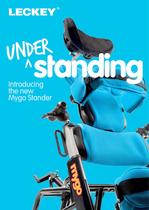
Introducing the new Mygo Stander
Open the catalog to page 1
Stronger together. We work with individuals, therapists and carers to design products with both a clinical and an emotional focus. Using the latest research and clinical understanding, we create practical solutions which are easily integrated into family life, because for us, life is about going, enjoying, participating and doing.
Open the catalog to page 2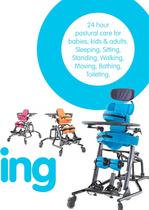
24 hour postural care for babies, kids & adults. Sleeping, Sitting, Standing, Walking, Moving, Bathing, Toileting.
Open the catalog to page 3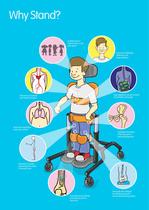
Why Stand? Enables kids to interact eye-to-eye with peers Improves wellbeing, alertness and sleep patterns Aids digestion, bowel function and bladder drainage Enhances circulation and blood pressure Improves respiration and voice control Facilitates formation of the hip joint in early development Stretches muscles, preventing the onset of contractures Increases bone density and reduces risk of fractures Improves skin integrity by relieving pressure encountered during sitting
Open the catalog to page 4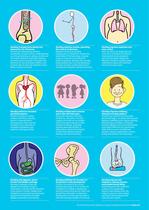
Standing increases bone density and reduces the risk of fractures. Normal bone development needs a combination of good nutrition, weight bearing, e.g. through standing or walking, and the use of muscles. Research shows that standing improves the bone density of the pelvis and leg bones of non-ambulatory children, such as those with CP, Muscular Dystrophy, Spina Bifida or spinal cord injury. Standing stretches muscles, preventing the onset of contractures. Research shows that standing programmes, if maintained, improve the extensibility of the hamstrings, increase range of movement and reduce...
Open the catalog to page 5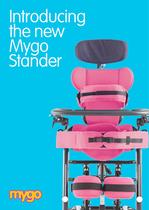
Introducing the new Mygo Stander
Open the catalog to page 7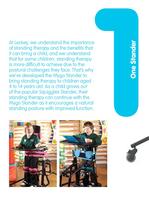
At Leckey, we understand the importance of standing therapy and the benefits that it can bring a child, and we understand that for some children, standing therapy is more difficult to achieve due to the postural challenges they face. That’s why we’ve developed the Mygo Stander to bring standing therapy to children aged 4 to 14 years old. As a child grows out of the popular Squiggles Stander, their standing therapy can continue with the Mygo Stander as it encourages a natural standing posture with improved function.
Open the catalog to page 8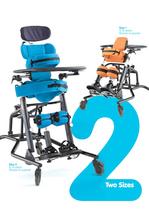
Size 1 4-10 years (Shown in prone) Size 2 8-14 years (Shown in supine)
Open the catalog to page 9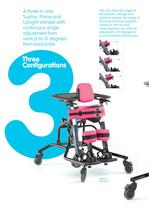
A three-in-one Supine, Prone and Upright stander with continuous angle adjustment from vertical to 10 degrees from horizontal. Not only does the angle of the stander change from prone to supine, the angle of the knee and foot supports relative to the hip and chest supports can also be adjusted by 20 degrees to accommodate contractures. Three Configurations Prone in pink fabric
Open the catalog to page 10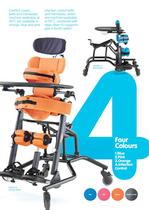
Comfort covers, belts and harnesses, machine washable at 40°C are available in orange, blue and pink. Infection control belts and harnesses, which are machine washable at 90°C, combined with wipe clean PU supports give a fourth option. Upright in blue fabric Supine in orange fabric Blue Infection Control
Open the catalog to page 11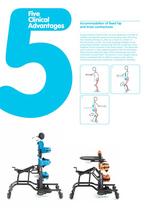
Five Clinical Advantages Accommodation of fixed hip and knee contractures During extensive clinical trials, we have observed a number of children with kyphotic postures and posterior pelvic tilt during their standing therapy (1), often as a result of a stretch on the hamstring muscles. The novel swinging footplate on the Leckey Mygo Stander mechanically links the movement of the footplate to the movement of the knee support. This allows the user to stand in a fully supported position with hip and knees flexed thereby taking the strain off the hamstrings and other contracted muscles (2&3). The...
Open the catalog to page 12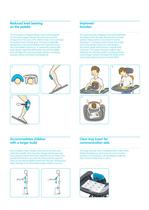
Reduced load bearing on the patella Improved function The innovative V-shaped design of the knee supports on the Leckey Mygo Stander ensures a proximal fit irrespective of the size of the child’s knees and maximises the surface area of loading (4). This load is optimally distributed on the proximal tibia and is directed away from the patella in prone (5). In supine the unique splitstrap design (optional) self locates around the patella and self aligns for any knee angle, thereby equalising pressure above and below the patella (6). The ergonomically designed chest pad replicates the shape of the...
Open the catalog to page 13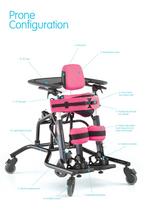
Prone Configuration 1. Chest pad 2. Breathable covers 12. PU tray 3. Prone Pelvic De-rotation belt 11. PU hip pad 4. Flexible hip laterals (not visible) 5. Height adjustable knee supports and basic knee straps 9. Tool free adjustments 7. Adjustable footplates 8. Lockable castors
Open the catalog to page 14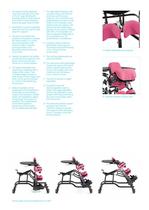
1. The ergonomically designed chest pad replicates the shape of the rib cage allowing the shoulder girdle to freely protract and retract in prone standing, improving upper body function. 2. Breathable, machine washable, colourful covers fit over the wipe clean PU supports. 3. The pelvic de-rotation belt enables the therapist to position the client’s pelvis in a central and neutral position with minimum effort. A gluteal prompt provides a proprioceptive sense of security to the client. 4. Flexible hip laterals (not visible) provide proximal support to the pelvis and ensure the user remains in...
Open the catalog to page 15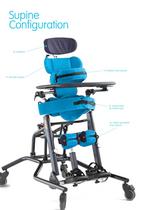
Supine Configuration 18. Headrest 14. Flexible chest laterals 17. Shoulder support 15. Supine pelvic de-rotation belt 16. Height adjustable knee suports
Open the catalog to page 16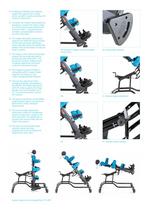
14. Wraparound flexible chest laterals support the upper body in either prone, upright or supine standing with minimum obstruction. 15. The pelvic de-rotation belt enables the therapist to position the client’s pelvis in a central and neutral position with minimum effort. A gluteal prompt provides a proprioceptive sense of security to the client. 16. The height adjustable supine knee supports are attached using a buckle mechanism and have split straps which self align above and below the patella. Basic knee straps can also be used in supine. 20. Knee angle indicator 21. Manual angle adjustment...
Open the catalog to page 17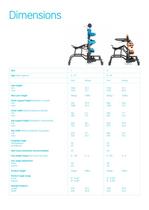
Size Age (Years Approx) Chest support height (footplate to armpit) min max Chest width (distance between laterals) min max Hip support height (footplate to mid buttocks) min max Hip width (distance between hip guides) min max Footplate angle Plantarflexion Dorsiflexion Max knee contracture accommodated Tray height range (from top of hip pad) Tray angle adjustment Prone Supine Product weight Product angle range Prone Supine Stander footprint Length Width
Open the catalog to page 18All Leckey catalogs and technical brochures
 GottaGo
4 Pages
 MyWay+
6 Pages
 Mygo Seat
4 Pages
 Corner Sitter
4 Pages
 Squiggles Seating System
9 Pages
 catalogue
29 Pages
 Kit
Kit28 Pages
 Comfee
20 Pages
 Mygo Max
2 Pages
 Everyday Activity Seat
11 Pages
 Freestander
12 Pages
 Springfield Table
4 Pages
 Mygo_Brochure
17 Pages
 Squiggles Seat
16 Pages
 Contoured Advance Seat
12 Pages
 Easy Seat
12 Pages
 Squiggles Saddle Seat
2 Pages
 Pal_brochure
8 Pages
 Squiggles__Stander
16 Pages
 Horizon-Stander
16 Pages
 Pronestander
12 Pages


Archived catalogs
 Everyday ACTIVITY SEAT Old
11 Pages
- Wheelchair
- Outdoor wheelchair
- Indoor wheelchair
- Wheelchair with legrest
- Manual wheelchair
- Positioning pillow
- Chair with armrests
- Shower chair
- Height-adjustable wheelchair
- Wheelchair cushion
- Shower chair with backrest
- Reclining wheelchair
- Wheelchair with headrest
- Head positioning pad
- Passive wheelchair
- Stander on casters
- Pediatric wheelchair
- Healthcare facility bench
- Adult cushion
- VirtualExpo Group
- Our Partners
- Recruitment
- Testimonials