


- Company
- Products
- Catalogs
- News & Trends
- Exhibitions
HCS A

HCS A
The document introduces the Leica HCS A, a high content screening automation system designed to enhance confocal imaging capabilities. It highlights the system's flexibility, ease of use, and powerful hardware for high-resolution imaging.
HCS enables researchers to transition from descriptive to quantitative fluorescence imaging, simplifying research and efficiently revealing cellular relationships. Leica Microsystems provides tools to convert confocal microscopes into high content imaging devices.
The Leica HCS A integrates with LAS AF MATRIX M3 software for automated sample screening, providing statistically relevant results and enhancing laboratory capacity by reducing routine microscopy and improving workflow.
The system offers high-resolution imaging, time-saving automation, and open architecture for platform-independent results. It supports various experiment designs with autofocus and drift compensation, providing maximum imaging flexibility.
Leica HCS A features smart user interfaces and workflow-oriented wizards for easy adjustment and quick experiment start. Predefined scanning templates streamline processes, and the system provides continuous user feedback.
The LAS AF MATRIX Mosaic and Multiwell features support complex experiments, linking metadata with images for comprehensive analysis. The system allows flexible scanning conditions and adjustable templates for various applications.
The system includes autofocus routines, z-drift compensation, and tracking algorithms to maintain optimal imaging conditions. Data is stored for immediate analysis, enabling fast feedback and modification of scanning parameters.
The LAS AF MATRIX Developer Suite supports complex assay designs, automating processes like mitosis identification. The system's open architecture allows for platform-independent information exchange and comprehensive result data sets.
The document discusses advanced imaging solutions by Leica Microsystems, focusing on high content screening (HCS) and automated image analysis. It highlights the capabilities of the DEFINIENS Cellenger® software and Leica's imaging platforms, emphasizing integration, flexibility, and efficiency in scientific research.
Leica's tools, including DEFINIENS Cellenger®, offer solutions for identifying, counting, and measuring target cells in 2D and 3D. The software supports various analysis methods to enhance throughput and achieve high content screening results. Data conversion issues are minimized with Leica's export format, compatible with modern software platforms.
Leica HCS A thrives in network environments, facilitating data sharing and collaboration across laboratories. The system uses standard LAN protocols for efficient data exchange, enhancing research productivity.
Leica HCS A integrates seamlessly with laboratory environments, overcoming format barriers and supporting existing software solutions. Computer Aided Microscopy (CAM) allows for remote control and automation of imaging systems, enabling real-time image analysis and decision-making.
The system is designed for easy integration into IT structures, with remote system tests and technical support available to ensure uptime and reproducibility. RemoteCare© provides secure remote diagnostics to minimize downtime.
Leica offers three main platforms for high-resolution imaging: TCS SP5, TCS SPE, and TCS LSI. Each platform is tailored for specific applications, providing flexibility and high spectral efficiency for various imaging needs.
Leica Microsystems operates globally across four divisions: Life Science, Industry, Biosystems, and Medical. Each division focuses on providing innovative imaging solutions tailored to specific scientific and industrial needs.
Leica Microsystems combines high-resolution imaging with advanced automation and integration capabilities, offering powerful tools for scientific research and high content screening. The company's commitment to innovation and collaboration ensures that users remain at the forefront of scientific discovery.
Catalog excerpts

Leica HCS A Amplify the Power of Imaging High Content Screening Automation
Open the catalog to page 1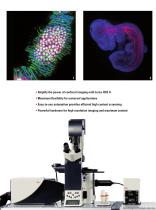
• Amplify the power of confocal imaging with Leica HCS A • Maximum flexibility for universal applications • Easy-to-use automation provides efficient high content screening • Powerful hardware for high resolution imaging and maximum content 2 Leica Design by Christophe
Open the catalog to page 2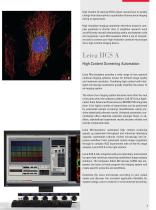
High Content Screening (HCS) allows researchers to quickly change from descriptive to quantitative fluorescence imaging during an experiment. High resolution imaging automation therefore answers complex questions in shorter time. It simplifies research work and efficiently reveals relationships within and between cells and organisms. Leica Microsystems offers a set of innovative tools to convert your high resolution confocal microscope into a high content imaging device. Leica HCS A High Content Screening Automation Leica Microsystems provides a wide range of true spectral confocal imaging systems,...
Open the catalog to page 3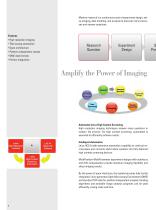
Features • High resolution imaging • Time saving automation • Open architecture • Platform independent results • OME data formats • Perfect integration Modern research is a continuous cycle of experiment design, setup imaging, data handling, and analysis to discover live's processes and answer questions. Power of Imaging Result Content Analysis Data Processing Sample Preparation Automated Leica High Content Screening High resolution imaging techniques answer many questions in modern life science. For high content screening, automation is essential to efficiently achieve results. Intelligent Automation...
Open the catalog to page 4
Sample eparation Leica High Content Screening Automation Data Management Content Analysis Research Result a Rat brain slice, small neuron network layer 5. Interneurons (Alexa 594, red) and Pyramidal Cell Oregon (Bapta 1, calcium sensitive, green). Courtesy of Dr. Thomas Nevian, Institute of Physiology, University of Bern, Switzerland. b Danio rerio – Zebrafish – Nuclear and Acetylated α-Tubulin staining of 6 days flh:eGFP Zebrafish larvae Nuclei (Hoechst, blue), acetylated tubulin (red) and neurons (GFP, green). Courtesy of ICI Imaging Centre IGBMC, Illkirch, France. Choose the adequate automation...
Open the catalog to page 5
Many companies offer dedicated imaging routines for dedicated assays only. Leica Microsystems provides standard solutions for routine experiments plus maximum flexibility to freely adapt imaging. Features • Smart user interfaces • Workflow oriented wizards • Predefined templates • Easy adjustment • Quick start Easy-to-use AutomationWe Keep It Simple! Wizards guide the user through an experiment in a streamlined way. Design follows function - benefit from clear user interfaces, ensuring fast training and the highest productivity. Predefined Scanning Templates Place the specimen carrier on the...
Open the catalog to page 6
Mouse diaphragm muscle stained against neuro-filament 150. Mosaic: xyz: 5 x 5 x 101 images Green: Alexa Fluor 488-secondary antibody and acetylcholine receptors (Red: Alexa Fluor 647-alpha-bungarotoxin). Courtesy of Dr. R. Rudolf, Cellular Signaling in Skeletal Muscle, Karlsruhe Institute of Technology, Germany.
Open the catalog to page 7
Automated High Content Screening Simplifies Da LAS AF software simplifies routines. Leica Microsystems’ goal is to make daily work as easy as possible so researchers can concentrate on the results, not on the imaging process. We Keep it Simple! LAS AF MATRIX Mosaic Fine details as well as an overview are important when evaluating experimental results. Today, simple routine tasks, such as stitching of individual images are challenging. Leica HCS A provides entirely new designed mosaic algorithms for excellent results at the push of a button. Leica LAS AF MATRIX Mosaic generates large high content...
Open the catalog to page 8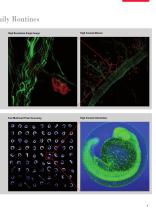
Daily Routines High Resolution Single Image High Content Mosaic Fast Multiwell Plate Screening High Content Information
Open the catalog to page 9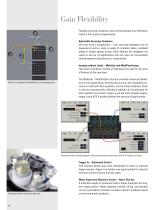
Gain Flexibility Flexible scanning conditions, even on the smallest scan field level, match a full variety of experiments. Adjustable Scanning Templates No need to be a programmer – new scanning templates can be designed at micron scale to easily fit chamber slides, multiwell plates or simple spotter arrays. Once defined, the templates are ready to use for all applications and can even be conveniently shared between laboratories or communities. Imaging without Limits – MultiJob and MultiPositioning Feel free to combine a variety of individual scan jobs for any area of interest of the specimen. Make...
Open the catalog to page 10
Autofocus Routines Five autofocus algorithms are available, optimized for different setups. The suitable routine is selected from a pull-down menu. After the initial scan, the software automatically creates a focus map with true sample topology. This map is used for fast, accurate z-positioning during the scan. According to the size and planarity of the samples, the optimal number and positions of the autofocus points can be freely defined. Z-Drift Compensation Live specimens can grow in long-time measurements, changing the z-position of interest. Microscope conditions can change due to temperature...
Open the catalog to page 11
Automated High Content Screening for Quant Detect Rare Events On-the-Fly! LAS AF MATRIX Developer Suite Highly complex assay designs are now possible with LAS AF MATRIX Developer Suite. The Mitocheck project (1), conducted at the EMBL in Heidelberg, is an excellent example of comprehensive and flexible automation: The self-acting process automates mitosis identification. High Content Screening with Fast Pre-Scan Pre-Scan – Object Identification At first, a fast, low resolution pre-scan of sample plates is routinely performed to identify the events of interest (1). After each scan, OME-image data...
Open the catalog to page 12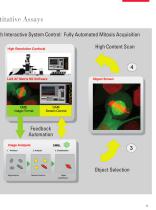
h Interactive System Control: Fully Automated Mitosis Acquisition High Content Scan Feedback Automation Image Analysis embl ijjjjjjjl 1. Pro-Scan 2. Analysis 3. Classification Segmentation Feature Extractor Object Object Selection
Open the catalog to page 13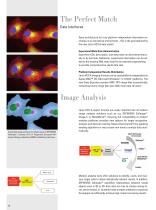
The Perfect MatchData Interfaces Open architecture for truly platform independent information exchange in an interactive environment - this is the goal attained by the new Leica HCS A data model. Experiment Meta Data Administration Experiment IDs, description, and meta data can be entered manually or by barcode. Additional experiment information can be added to the existing XML meta data file by external programming to provide comprehensive result data sets. Platform Independent Results Distribution Leica HCS A imaging formats can be used platform independent on Apple MAC™ OS, Microsoft Windows®...
Open the catalog to page 14All Leica Microsystems catalogs and technical brochures
 M620 F20
8 Pages
 M844 F40/F20
16 Pages
 EnFocus
12 Pages
 M822 F40 / F20
12 Pages
 M320 for ENT
12 Pages
 ARveo 8
16 Pages
 M320 Dental Brochure
12 Pages
 Emspira 3
4 Pages
 EM RAPID
8 Pages
 EM ICE
12 Pages
 EM TXP
10 Pages
 EM RES102
12 Pages
 EM TIC 3X
16 Pages
 TL4000 BFDF
16 Pages
 F12 I floor stand
6 Pages
 XL Stand
4 Pages
 TL3000 Ergo & TL5000 Ergo
4 Pages
 KL300 LED
8 Pages
 LED1000
16 Pages
 LED3000 BLI
20 Pages
 LED5000 NVI
20 Pages
 LED3000 NVI
20 Pages
 LED3000 DI
20 Pages
 LED5000 HDI
20 Pages
 LED5000 CXI
20 Pages
 LED2500
8 Pages
 LED5000 MCI
20 Pages
 LED3000 MCI
20 Pages
 LED5000 SLI
20 Pages
 LED3000 SLI
20 Pages
 LED2000
8 Pages
 LED5000 RL
20 Pages
 LED3000 RL
20 Pages
 MZ10 F
4 Pages
 M165 FC
16 Pages
 M205 FCA, M205 FA
16 Pages
 M125 C, M165 C, M205 C, M205 A
12 Pages
 A60 F, A60 S
16 Pages
 M50, M60, M80
12 Pages
 DVM6
DVM616 Pages
 TCS SPE
20 Pages
 DFC450 C
6 Pages
 DFC295
6 Pages
 MC170 HD
6 Pages
 DFC3000 G
6 Pages
 DMC4500
4 Pages
 ICC50 W, ICC50 E
6 Pages
 DFC7000 T, DFC7000 GT
4 Pages
 DFC9000
2 Pages
 IC90 E
6 Pages
 DMC6200
8 Pages
 DMC5400
8 Pages
 SFL7000
4 Pages
 EL6000
4 Pages
 SFL100
4 Pages
 SFL4000
4 Pages
 DMi8 S Platform
2 Pages
 THUNDER Imager Live Cell
2 Pages
 DMi8 M / C / A
12 Pages
 DM IL LED
12 Pages
 DMi1
DMi16 Pages
 DM3 XL
7 Pages
 FS M
FS M4 Pages
 FS C
FS C4 Pages
 FS CB
FS CB4 Pages
 DM3000, DM3000 LED
16 Pages

Archived catalogs
 DM750 M
12 Pages
 DM750
DM75012 Pages
 DM500
DM50012 Pages
 DM300
DM3008 Pages
 DM12000 M
8 Pages
 DM8000 M
8 Pages
 DM1750 M
12 Pages
 DM4 M, DM6 M
12 Pages
 DM4 P, DM2700 P, DM750 P
12 Pages
 DM2000, DM2000 LED
16 Pages
 DM1000
16 Pages
 DCM8
DCM816 Pages
 DM1000 LED
16 Pages
 DM2500
16 Pages
 DM4 B & DM6 B
16 Pages
 DM6 M LIBS
2 Pages
 S9 Series
12 Pages
 Z6 APO
16 Pages
 Z16 APO
16 Pages
 Leica M530 OHX for ENT
4 Pages
 M220 F12
8 Pages
 Leica Application Suite X
4 Pages
 Proveo 8
16 Pages
 M525 F20
12 Pages
 EnVisu Leica Handheld OCT
8 Pages
 EM TRIM2
8 Pages
 EM UC7
16 Pages
 EM KMR3
8 Pages
 FLEXACAM C1
4 Pages
 Exalta
2 Pages
 PROvido
8 Pages
 Leica M530 OHX
16 Pages
 Leica TCS SP8 STED 3X
24 Pages
 Leica TCS SP8 Objective
24 Pages
 Leica AOBS
16 Pages
 Leica DMC2900
6 Pages
 Leica DMshare
2 Pages
 Leica_DMshare_ICC50-Flyer_en
2 Pages
 Leica_DMshare_EC3-Flyer_en
2 Pages
 Leica_SL801-Flyer
2 Pages
 Leica_SCN400-Flyer_Clinical
2 Pages
 DM2700 M
12 Pages
 Leica_SR_GSD-Brochure
10 Pages
 Leica_AF6000-Brochure
16 Pages
 Leica motCorr-Flyer_EN
4 Pages
 Leica TCS SP8-Flyer
2 Pages
 Leica TCS SP8-Brochure
40 Pages
 Leica TCS SP8 X-Flyer
2 Pages
 Leica TCS SP8 STED-Flyer
2 Pages
 Leica TCS SP8 HyD-Flyer
2 Pages


- Leica analysis software
- Leica optical microscope
- Leica laboratory microscope
- Leica benchtop microscope
- Leica sample preparation system
- Leica visualization software
- Leica automatic sample preparation system
- Control software
- Reporting software
- Windows software
- CMOS camera
- Leica laboratory software
- Laboratory sample preparation system
- Camera with USB port
- Leica LED microscope
- Benchtop sample preparation system
- Automated software
- Leica LED light source
- Acquisition software