
- Catalogs
- Leica Microsystems
- Leica_AF6000-Brochure


- Company
- Products
- Catalogs
- News & Trends
- Exhibitions
Leica_AF6000-Brochure

Leica_AF6000-Brochure
The Leica AF6000 is a modular widefield system designed for advanced live cell research, offering innovations in fluorescence microscopy to visualize developmental and molecular processes in cells. It is customizable to meet various live cell imaging requirements, providing speed, reliability, and high image quality.
- Ease of Use: Intuitive setup with full-screen live image display and minimal training requirements.
- Flexibility and Modularity: Configurable for different microscope types with a wide choice of hardware components.
- Upgradability: Systems can be upgraded on-site to meet evolving research needs.
- Integration: Synchronization between hardware and software ensures precise timing and reliability.
The Leica AF6000 supports a variety of applications including high-speed time-lapse experiments, developmental biology, live cell studies, intracellular transport, and protein interactions. It is suitable for imaging centers and multi-user facilities.
The system uses the LAS AF software platform, shared with Leica confocal systems, and includes modules for multi-channel acquisition, time-lapse, 3D visualization, and more. High-speed control modules allow real-time control of hardware components.
- Time-Lapse Applications: Offers stability and reproducibility for long-term experiments with features like Adaptive Focus Control.
- Multi Positioning and Stitching: Allows observation of multiple locations and creation of large overview images.
- Calcium and FRET SE Modules: Provide instant feedback with online graphs and ratio images, crucial for experiments requiring immediate adjustments.
The Leica AF6000 system is designed to adapt to the dynamic needs of modern research, offering unparalleled automation and control. It supports a wide range of applications and provides tools for high-resolution imaging and analysis.
The Live Data Mode module allows users to define acquisition jobs and macros, facilitating complex experiments with features like loops, pauses, and trigger channels. The High Content Screening (HCS A) package offers flexibility for defining scanning templates and automating high content screening. It supports feedback loops from external analysis software and allows image export during experiments.
The Leica SR GSD system provides super-resolution imaging with a resolution down to 20 nm, using ground state depletion technology. It is suitable for studying cellular structures and molecular sociology. The TIRF microscopy technique enhances signal-to-noise ratio by exciting fluorophores only at shallow depths, ideal for studying cellular membranes.
LAS AF offers a user-friendly interface for experiment setup and control, minimizing user interaction through automation. It integrates various modules for processing and visualization, ensuring reproducibility and efficiency in imaging facilities.
The Leica AF6000 Core Module provides comprehensive imaging and documentation capabilities, including single image capture, multi-color image creation, and time-lapse experiments. It supports annotations, image quantification, and easy setup of experiments.
Leica Microsystems offers a range of hardware components optimized for live cell imaging, including high-speed cameras, adaptive focus control, and climate chambers. These components ensure stability and high-quality results in live cell studies.
Leica Microsystems emphasizes innovation and collaboration with users to advance scientific research. Their systems and software provide powerful tools for visualization, measurement, and analysis in life sciences, supported by a global network of customer services.
The document introduces the new LAS AF 3D visualization tool, which utilizes GPU-based processing for handling 3D datasets. It offers innovative manipulation options and a movie maker feature for creating 4D animated sequences.
- Smooth Motion: Enables smooth and fast motion of 3D volumes.
- Real-Time Visualization: Includes a time slider for real-time 4D visualization.
- Interactive Manipulation: Allows users to apply a spin to 3D volumes using a mouse.
- Shadow Projection: Offers user-defined interactive shadow projection.
- Stereo Display: Supports stereo display mode for 3D monitors.
- Clipping Tool: Provides a powerful channel-specific clipping tool.
- Movie Editor: Features a sophisticated key frame-based movie editor for generating spectacular 3D movies.
The 3D Visualization module of Leica LAS AF offers real-time rendering capabilities, enhancing the user's ability to create and manipulate 3D and 4D visual content effectively.
Catalog excerpts

Leica AF6000 Modular Wideeld Systems for Advanced Live Cell Research
Open the catalog to page 1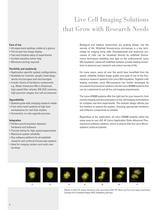
Live Cell Imaging Solutions that Grow with Research Needs Ease of use • All experiment settings visible at a glance • Full screen live image display • Fast and intuitive setup of experiments • Context sensitive online help • Minimum training required Biological and medical researchers are probing deeper into the secrets of life. Wideeld uorescence microscopy is a key technology for imaging living cells. Developmental and molecular processes of cells can be visualized directly by wideeld uorescence techniques shedding new light on the undiscovered. Leica Microsystems’ advanced wideeld systems...
Open the catalog to page 2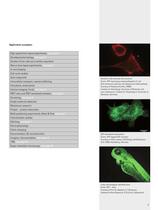
Application examples: High-speed time-lapse experiments, see page 6 Developmental biology, see page 6 Studies of live cells up to whole organisms Macro time-lapse experiments, see page 6 In vivo imaging Cell cycle studies Axon outgrowth Intracellular transport, vesicle trafcking Exocytosis, endocytosis Calcium imaging, Fura2, see page 8 FRET ratio and FRET sensitized emission, see page 8 Dendritic cells infected with bacteria Green: GFP expressing enteropathogenic E. coli Red membrane staining: Cy3 labeled anti Cd44 antibody Courtesy of Nadzeya Kramko, ZMBE, Institute of Infectiology, University...
Open the catalog to page 3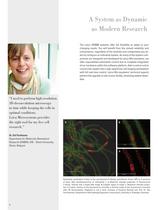
A System as Dynamic as Modern Research The Leica AF6000 systems offer full exibility to adapt to your changing needs. You will benet from the utmost reliability and convenience, regardless of the modules and components you select to congure an individual system. As many of the system components are designed and developed by Leica Microsystems, we offer unparalleled automation control due to complete integration of our hardware within the software platform. Add a control unit to convert the system into a high-speed live cell imaging workstation with full real-time control. Leica Microsystems’...
Open the catalog to page 4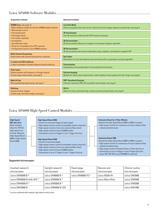
Leica AF6000 Software Modules Acquisition modules • Basic software module for all Leica AF6000 modular systems • Microscope control • Processing tools • Full image viewer • Full review capability • Quantification tools • Driver for compatible Leica DFC cameras • Configuration tool for Leica AF6000 systems Multi Channel Acquisition Experiments with several fluorescence channels Z-stack acquisition includes software based autofocus Define duration and frequency of image capture for time-lapse experiments, see page 6 Mark & Find Multi positioning experiments, see page 7 Acquire mosaic images Create...
Open the catalog to page 5
Leica AF6000 Time-Lapse Applications Superior live cell imaging • Stay in focus with hardware-based Adaptive Focus Control (AFC) • Software-based autofocus • Brilliant images under physiological conditions with dedicated 63x live cell objective • High-speed acquisition • Extensive range of live cell accessories 2D and 3D time-lapse experiments over several hours or even days require the highest level of stability, reproducibility, acquisition speed and system reliability. With the AF6000, Leica Microsystems offers an integrated modular system solution to meet these requirements. Leica microscope...
Open the catalog to page 6
Stitching Experiments The chances of observing a process of interest are much higher when several locations are observed. With the Mark & Find function, an unlimited number of user defined sample positions can be defined. This allows recording of many different cells within one time-lapse experiment, thus saving precious time and resources. At each stage position a cell specific Z-stack size can be defined. With the Pause and Relocate button, every single Mark & Find position can be corrected in its X, Y and Z location during the running experiment. The corrections can also be Such tools are...
Open the catalog to page 7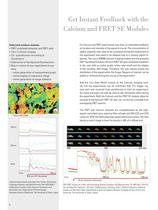
Get Instant Feedback with the Calcium and FRET SE Modules Dedicated analysis modules • FRET sensitized emission and FRET ratio • Subtraction of background fluorescence • Stay in control of your experiment at any - online generation of measurement graph - online display of ratiometric image - online generation of image statistics Cultured hippocampal astrocytes from 18-day-old embryos of Sprague-Dawley rats (Objective lens: Plan APO 20x0.7, 4 Ratio/sec) Courtesy of Drs. Kazunori Kanemaru and Masamitsu lino, Department of Pharmacology, Graduate School of Medicine, The University of Tokyo, Japan...
Open the catalog to page 8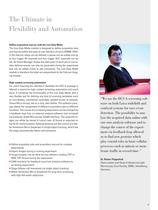
The Ultimate in Flexibility and Automation Dene acquisition macros with the Live Data Mode The Live Data Mode module is designed to dene acquisition jobs and macros within the easy-to-use interface of Leica AF6000. Within the macros, loops can be dened, a pause can be added and up to four trigger IN channels and four trigger OUT channels can be set. An Event Manager shows the start point of each job or macro. User dened events can also be generated during the experiment and can be edited online to add comments. The Live Data Mode module is therefore the ideal accompaniment to the Calcium Imaging...
Open the catalog to page 9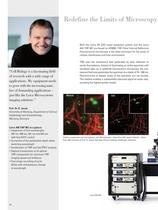
"Cell Biology is a fascinating field of research with a wide range of applications. My equipment needs to grow with the increasing num- just like the Leica Microsystems imaging solutions." University of Marburg, Department of Clinical Marburg, Germany Leica AM TIRF MC at a glance: • Integration of four wavelengths with fast AOTF control • Correction of the penetration depth when switching wavelength • Combination of TIRF and fast FRET analysis • Highest transmission of all optical TIRF components for maximum TIRF imaging speed and brilliance • Fast image recording of up to 30 fps with simultaneous...
Open the catalog to page 10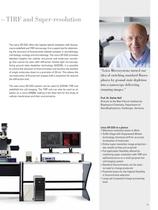
y – TIRF and Super-resolution The Leica SR GSD offers the highest lateral resolution with uorescence wideeld and TIRF microscopy. It is a superb tool for determining the structure of uorescently labeled samples in neurobiology, cell biology, virology and microbiology. The Leica SR GSD provides detailed insights into cellular structures and molecular sociology that cannot be seen with diffraction limited light microscopy. Using ground state depletion technology (GSDIM), it is possible to control the emission of uorochromes and localize the position of single molecules down to a precision of 20...
Open the catalog to page 11All Leica Microsystems catalogs and technical brochures
 M620 F20
8 Pages
 M844 F40/F20
16 Pages
 EnFocus
12 Pages
 M822 F40 / F20
12 Pages
 M320 for ENT
12 Pages
 ARveo 8
16 Pages
 M320 Dental Brochure
12 Pages
 Emspira 3
4 Pages
 EM RAPID
8 Pages
 EM ICE
12 Pages
 EM TXP
10 Pages
 EM RES102
12 Pages
 EM TIC 3X
16 Pages
 TL4000 BFDF
16 Pages
 F12 I floor stand
6 Pages
 XL Stand
4 Pages
 TL3000 Ergo & TL5000 Ergo
4 Pages
 KL300 LED
8 Pages
 LED1000
16 Pages
 LED3000 BLI
20 Pages
 LED5000 NVI
20 Pages
 LED3000 NVI
20 Pages
 LED3000 DI
20 Pages
 LED5000 HDI
20 Pages
 LED5000 CXI
20 Pages
 LED2500
8 Pages
 LED5000 MCI
20 Pages
 LED3000 MCI
20 Pages
 LED5000 SLI
20 Pages
 LED3000 SLI
20 Pages
 LED2000
8 Pages
 LED5000 RL
20 Pages
 LED3000 RL
20 Pages
 MZ10 F
4 Pages
 M165 FC
16 Pages
 M205 FCA, M205 FA
16 Pages
 M125 C, M165 C, M205 C, M205 A
12 Pages
 A60 F, A60 S
16 Pages
 M50, M60, M80
12 Pages
 DVM6
DVM616 Pages
 HCS A
HCS A20 Pages
 TCS SPE
20 Pages
 DFC450 C
6 Pages
 DFC295
6 Pages
 MC170 HD
6 Pages
 DFC3000 G
6 Pages
 DMC4500
4 Pages
 ICC50 W, ICC50 E
6 Pages
 DFC7000 T, DFC7000 GT
4 Pages
 DFC9000
2 Pages
 IC90 E
6 Pages
 DMC6200
8 Pages
 DMC5400
8 Pages
 SFL7000
4 Pages
 EL6000
4 Pages
 SFL100
4 Pages
 SFL4000
4 Pages
 DMi8 S Platform
2 Pages
 THUNDER Imager Live Cell
2 Pages
 DMi8 M / C / A
12 Pages
 DM IL LED
12 Pages
 DMi1
DMi16 Pages
 DM3 XL
7 Pages
 FS M
FS M4 Pages
 FS C
FS C4 Pages
 FS CB
FS CB4 Pages
 DM3000, DM3000 LED
16 Pages

Archived catalogs
 DM750 M
12 Pages
 DM750
DM75012 Pages
 DM500
DM50012 Pages
 DM300
DM3008 Pages
 DM12000 M
8 Pages
 DM8000 M
8 Pages
 DM1750 M
12 Pages
 DM4 M, DM6 M
12 Pages
 DM4 P, DM2700 P, DM750 P
12 Pages
 DM2000, DM2000 LED
16 Pages
 DM1000
16 Pages
 DCM8
DCM816 Pages
 DM1000 LED
16 Pages
 DM2500
16 Pages
 DM4 B & DM6 B
16 Pages
 DM6 M LIBS
2 Pages
 S9 Series
12 Pages
 Z6 APO
16 Pages
 Z16 APO
16 Pages
 Leica M530 OHX for ENT
4 Pages
 M220 F12
8 Pages
 Leica Application Suite X
4 Pages
 Proveo 8
16 Pages
 M525 F20
12 Pages
 EnVisu Leica Handheld OCT
8 Pages
 EM TRIM2
8 Pages
 EM UC7
16 Pages
 EM KMR3
8 Pages
 FLEXACAM C1
4 Pages
 Exalta
2 Pages
 PROvido
8 Pages
 Leica M530 OHX
16 Pages
 Leica TCS SP8 STED 3X
24 Pages
 Leica TCS SP8 Objective
24 Pages
 Leica AOBS
16 Pages
 Leica DMC2900
6 Pages
 Leica DMshare
2 Pages
 Leica_DMshare_ICC50-Flyer_en
2 Pages
 Leica_DMshare_EC3-Flyer_en
2 Pages
 Leica_SL801-Flyer
2 Pages
 Leica_SCN400-Flyer_Clinical
2 Pages
 DM2700 M
12 Pages
 Leica_SR_GSD-Brochure
10 Pages
 Leica motCorr-Flyer_EN
4 Pages
 Leica TCS SP8-Flyer
2 Pages
 Leica TCS SP8-Brochure
40 Pages
 Leica TCS SP8 X-Flyer
2 Pages
 Leica TCS SP8 STED-Flyer
2 Pages
 Leica TCS SP8 HyD-Flyer
2 Pages


- Leica optical microscope
- Leica laboratory microscope
- Leica benchtop microscope
- Leica sample preparation system
- Leica visualization software
- Leica automatic sample preparation system
- Control software
- Reporting software
- Windows software
- Leica laboratory software
- Laboratory sample preparation system
- CMOS camera
- Camera with USB port
- Leica LED microscope
- Benchtop sample preparation system
- Automated software
- Leica LED light source
- Acquisition software