
- Catalogs
- Leica Microsystems
- Leica_SR_GSD-Brochure


- Company
- Products
- Catalogs
- News & Trends
- Exhibitions
Leica_SR_GSD-Brochure

Leica_SR_GSD-Brochure
The Leica SR GSD is a cutting-edge super-resolution microscopy system that utilizes Ground State Depletion (GSD) technology to achieve a resolution of approximately 20 nm, surpassing the capabilities of standard light microscopy.
Key Features
- Resolution: Offers up to 20 nm resolution, exceeding the diffraction limit of traditional microscopy.
- Real-time Imaging: Enables online super-resolution image projection, allowing real-time visualization as images are acquired.
- Flexibility: Compatible with standard dyes and integrates into existing workflows, supporting various fluorochromes.
- Multi-purpose System: Combines super-resolution with TIRF and epifluorescence for versatile imaging techniques.
- Advanced Technology: Incorporates the SuMo Stage for reduced drift and precise molecule localization.
Applications
The system is ideal for fields like neurobiology, cell biology, virology, microbiology, and physiology, particularly for studying structures smaller than the diffraction limit, such as endosomes, exosomes, viruses, and nuclear pore complexes.
Technical Specifications
- Lasers: Features 488 nm, 532 nm, 642 nm, and 405 nm lasers for diverse fluorochrome selection.
- Imaging Modes: Supports GSD super-resolution, TIRF, EPI fluorescence, brightfield, and DIC/PH.
- Field of View: 18 x 18 μm in GSD mode and 50 x 50 μm in standard TIRF.
- Software: Provides comprehensive tools for configuration, acquisition, processing, and image analysis.
Conclusion
The Leica SR GSD system is a robust and adaptable solution for super-resolution microscopy, allowing researchers to uncover previously inaccessible details with precision and flexibility. It integrates smoothly into existing workflows and offers a full suite of imaging tools for advanced scientific research.
Catalog excerpts

Redefine the Limits of Microscopy Widefield super-resolution with ground state depletion
Open the catalog to page 1
Wideeld RCC-FG1 cells, immunouorescence staining against α tubulin with Alexa Fluor® 647. Wideeld Golgi body, B16 (Mouse melanoma cell line), Golgi targeting signal of β 1,4-galactosyltransferase, fused to EYFP. • Resolve more – down to ~ 20 nm • Resolve online – see your super-resolution image build up on screen as it is acquired • Resolve smartly – use standard dyes for highest exibility 2 Courtesy of Prof. Ralf Jacob. Philipps University Marburg, Germany GSD Dr. Yasushi Okada, Department of Cell Biology and Anatomy, Graduate School of Medicine, University of Tokyo, Japan Courtesy of Prof....
Open the catalog to page 2
Courtesy of Prof. Ralf Jacob. Philipps University Marburg, Germany ld GSD Wideeld MDCK cells: Microtubules, Alexa Fluor 642 (red) and TyrMicrotubules, Alexa Fluor® 488 (green). ® Bridging the Two Worlds of Light and Electron Microscopy Fluorescence microscopy has developed into one of the most important tools in life science research. The ultimate aim is to examine single molecule and sub cellular components – structures that are too small to be resolved using standard light microscopy. Pioneers always want to push the limits, striving to learn more and demanding to see further. But when the...
Open the catalog to page 3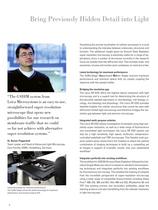
Bring Previously Hidden Detail into Light Visualizing the precise localization of cellular processes is crucial to understanding the interplay between molecules, structures and function. The additional insight given by Ground State Depletion super-resolution microscopy is extremely useful for a range of applications, since a number of structures currently in the research focus are smaller than the diffraction limit. This includes endo- and exosomes, viruses and nuclear pore complexes, to name but a few. Latest technology for maximum performance The SuMo Stage (Suppressed Motion Stage) ensures...
Open the catalog to page 4
New Technology Breaks the Diffraction Barrier How to resolve below the diffraction limit The resolution of a regular fluorescence microscope image is limited by diffraction to approximately half the wavelength of the emitted light. To separate fluorophores that are closer together, the solution is to ensure that not all illuminated fluorophores are able to emit simultaneously. To this end, the excitation light is used such that almost all fluorophores in the samples instantly turn dark. The continuously shining excitation light removes fluorophores from their ground state, leaving only a few,...
Open the catalog to page 5
Leica SR GSD – The Fast Way to S Your Benets • Maximum resolution down to 20 nm • The SuMo Stage, with Suppressed Motion technology, minimizes drift for accurate localization of molecules • Online super-resolution image projection – see results as they are acquired • Full application exibility offered by combining super-resolution with TIRF and epiuorescence on a multi-purpose live cell imaging system • Standard uorochromes can be used – no need to change protocols • Powerful lasers for the highest exibility in uorochrome selection • Large set of powerful image processing tools 6 Redene the limits...
Open the catalog to page 6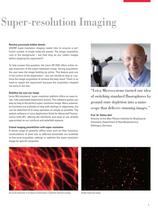
o Super-resolution Imaging Resolve previously hidden details GSDIM super-resolution imaging needs time to acquire a sufcient number of single molecule events. The image acquisition runs in the background – but how long do you collect images before stopping the experiment? To help answer this question, the Leica SR GSD offers online image projection of the super-resolution image. During acquisition, the user sees the image building up online. This feature puts you in full control of the experiment – you can decide to stop or continue the image acquisition to achieve the best result. There is no...
Open the catalog to page 7
Technical Specifications Lateral resolution* – Maximum 20 nm – Typical 40 nm Laser – 488 nm/300 mW – 532 nm/500 mW – 642 nm/500 mW – 405 nm/30 mW Imaging modes – GSD super-resolution – TIRF (also available with GSD) – EPI uorescence (also available with GSD) – Brighteld – DIC/PH Laser safety System class 1 Field of view – 18 x 18 μm (GSD mode) – 50 x 50 μm (standard TIRF) Supported dyes – Alexa Fluor® 488 – Rhodamine-6G – Atto 532 and 488 – Alexa Fluor® 532 – Alexa Fluor® 546 – Atto 565 and 568 – Alexa Fluor® 568 – Alexa Fluor® 647 – YFP Imaging Real-time image processing and display of results...
Open the catalog to page 8
GSD (Ground State Depletion) Microtubule-staining: anti-p-tubulin/Alexa Fluor® 647 Courtesy: Wernher Fouquet, Leica Microsystems in collaboration with Anna Szymborska and Jan Ellenberg, EMBL, Heidelberg, Germany. Resolving power of different microscopy techniques: The Leica SR GSD is advancing light microscopy to a new level of resolution.
Open the catalog to page 9
The statement by Ernst Leitz in 1907, "With the User, For the User," describes the fruitful collaboration with end users and driving force of nnovation at Leica Microsystems. We have developed five brand values to live up to this tradition: Pioneering, High-end Quality, Team Spirit, Dedication to Science, and Continuous Improvement. For us, living up to these values means: Living up to Life. Leica Microsystems operates globally in three divisions, where we rank with the market leaders. LIFE SCIENCE DIVISION The Leica Microsystems Life Science Division supports the imaging needs of the scientific...
Open the catalog to page 10All Leica Microsystems catalogs and technical brochures
 M620 F20
8 Pages
 M844 F40/F20
16 Pages
 EnFocus
12 Pages
 M822 F40 / F20
12 Pages
 M320 for ENT
12 Pages
 ARveo 8
16 Pages
 M320 Dental Brochure
12 Pages
 Emspira 3
4 Pages
 EM RAPID
8 Pages
 EM ICE
12 Pages
 EM TXP
10 Pages
 EM RES102
12 Pages
 EM TIC 3X
16 Pages
 TL4000 BFDF
16 Pages
 F12 I floor stand
6 Pages
 XL Stand
4 Pages
 TL3000 Ergo & TL5000 Ergo
4 Pages
 KL300 LED
8 Pages
 LED1000
16 Pages
 LED3000 BLI
20 Pages
 LED5000 NVI
20 Pages
 LED3000 NVI
20 Pages
 LED3000 DI
20 Pages
 LED5000 HDI
20 Pages
 LED5000 CXI
20 Pages
 LED2500
8 Pages
 LED5000 MCI
20 Pages
 LED3000 MCI
20 Pages
 LED5000 SLI
20 Pages
 LED3000 SLI
20 Pages
 LED2000
8 Pages
 LED5000 RL
20 Pages
 LED3000 RL
20 Pages
 MZ10 F
4 Pages
 M165 FC
16 Pages
 M205 FCA, M205 FA
16 Pages
 M125 C, M165 C, M205 C, M205 A
12 Pages
 A60 F, A60 S
16 Pages
 M50, M60, M80
12 Pages
 DVM6
DVM616 Pages
 HCS A
HCS A20 Pages
 TCS SPE
20 Pages
 DFC450 C
6 Pages
 DFC295
6 Pages
 MC170 HD
6 Pages
 DFC3000 G
6 Pages
 DMC4500
4 Pages
 ICC50 W, ICC50 E
6 Pages
 DFC7000 T, DFC7000 GT
4 Pages
 DFC9000
2 Pages
 IC90 E
6 Pages
 DMC6200
8 Pages
 DMC5400
8 Pages
 SFL7000
4 Pages
 EL6000
4 Pages
 SFL100
4 Pages
 SFL4000
4 Pages
 DMi8 S Platform
2 Pages
 THUNDER Imager Live Cell
2 Pages
 DMi8 M / C / A
12 Pages
 DM IL LED
12 Pages
 DMi1
DMi16 Pages
 DM3 XL
7 Pages
 FS M
FS M4 Pages
 FS C
FS C4 Pages
 FS CB
FS CB4 Pages
 DM3000, DM3000 LED
16 Pages

Archived catalogs
 DM750 M
12 Pages
 DM750
DM75012 Pages
 DM500
DM50012 Pages
 DM300
DM3008 Pages
 DM12000 M
8 Pages
 DM8000 M
8 Pages
 DM1750 M
12 Pages
 DM4 M, DM6 M
12 Pages
 DM4 P, DM2700 P, DM750 P
12 Pages
 DM2000, DM2000 LED
16 Pages
 DM1000
16 Pages
 DCM8
DCM816 Pages
 DM1000 LED
16 Pages
 DM2500
16 Pages
 DM4 B & DM6 B
16 Pages
 DM6 M LIBS
2 Pages
 S9 Series
12 Pages
 Z6 APO
16 Pages
 Z16 APO
16 Pages
 Leica M530 OHX for ENT
4 Pages
 M220 F12
8 Pages
 Leica Application Suite X
4 Pages
 Proveo 8
16 Pages
 M525 F20
12 Pages
 EnVisu Leica Handheld OCT
8 Pages
 EM TRIM2
8 Pages
 EM UC7
16 Pages
 EM KMR3
8 Pages
 FLEXACAM C1
4 Pages
 Exalta
2 Pages
 PROvido
8 Pages
 Leica M530 OHX
16 Pages
 Leica TCS SP8 STED 3X
24 Pages
 Leica TCS SP8 Objective
24 Pages
 Leica AOBS
16 Pages
 Leica DMC2900
6 Pages
 Leica DMshare
2 Pages
 Leica_DMshare_ICC50-Flyer_en
2 Pages
 Leica_DMshare_EC3-Flyer_en
2 Pages
 Leica_SL801-Flyer
2 Pages
 Leica_SCN400-Flyer_Clinical
2 Pages
 DM2700 M
12 Pages
 Leica_AF6000-Brochure
16 Pages
 Leica motCorr-Flyer_EN
4 Pages
 Leica TCS SP8-Flyer
2 Pages
 Leica TCS SP8-Brochure
40 Pages
 Leica TCS SP8 X-Flyer
2 Pages
 Leica TCS SP8 STED-Flyer
2 Pages
 Leica TCS SP8 HyD-Flyer
2 Pages


- Leica analysis software
- Leica optical microscope
- Leica laboratory microscope
- Leica benchtop microscope
- Leica sample preparation system
- Leica visualization software
- Leica automatic sample preparation system
- Control software
- Reporting software
- Windows software
- Leica laboratory software
- Laboratory sample preparation system
- CMOS camera
- Camera with USB port
- Leica LED microscope
- Benchtop sample preparation system
- Automated software
- Leica LED light source
- Acquisition software