- Products
- Catalogs
- News & Trends
- Exhibitions
LifeBot-MobileHealthCareTechnologyGuide
LifeBot-MobileHealthCareTechnologyGuide
The document addresses challenges and solutions in the EMS Mobile Healthcare sector, focusing on integrating telemedicine technologies to enhance care and reduce costs.
Acute care in the U.S. has shifted from general practitioners to emergency departments, causing inefficiencies and high costs. EMS Mobile Healthcare systems can address the misuse of emergency rooms for non-emergent issues.
EMS systems face high operational costs due to responding to both emergent and non-emergent calls, potentially costing up to $72 billion annually.
Medical errors impose financial burdens estimated between $17-29 billion annually, highlighting the need for improved decision-making processes.
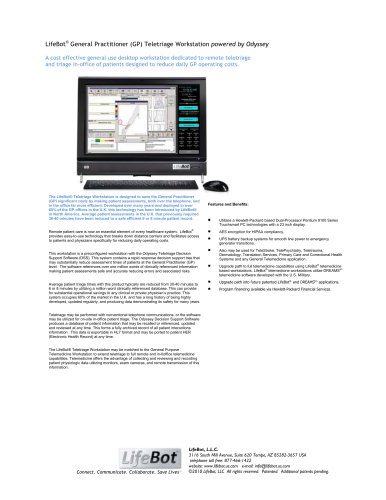
Adopting European models like tele-nursing and decision support software (DSS) can improve EMS efficiency. The Odyssey DSS in the UK is a successful model for triaging calls and reducing costs.
EMS Telemedicine offers "care at a distance," improving care quality and reducing costs through real-time patient data transmission, especially beneficial in emergencies and disasters.
Integrating telemedicine and decision support systems in EMS can transform response vehicles into "virtual hospitals," enhancing care quality and reducing costs.
The LifeBot® DREAMStm system, initially for the U.S. Military, is now commercially available for disaster relief and EMS, tested during hurricanes Katrina and Rita. It allows remote patient assessment, potentially reducing costs through 'treat and release' scenarios.
Advanced technologies in ambulances, including computers, cameras, and monitors, enable real-time data transmission, enhancing patient care. The Intelligent Communications Managertm (ICMtm) addresses wireless connectivity issues.
The LifeBot® system automates electronic health record updates, reducing medical professionals' workload and improving patient care.
Mobile Primary Care Units (MPCUs) for non-emergencies allow Advanced Life Support (ALS) units to focus on emergencies, reducing costs and improving response times.
Integrating EMS Mobile Healthcare with nurse call centers enhances emergency response capabilities, ensuring continuous support during emergencies.
The document discusses mobile healthcare, emphasizing tele-triage nurses and telemedicine hubs, highlighting qualifications needed for tele-triage nurses.
Telemedicine Hubs act as dispatch centers, connecting patients to medical expertise, improving response times and outcomes.
A case study of UCSF's telemedicine hub showcases its ability to connect providers to multiple telemedicine suites for immediate specialist access.
Telemedicine hubs have applications in home monitoring, school and nursing home care, and emergency response, offering potential cost savings.
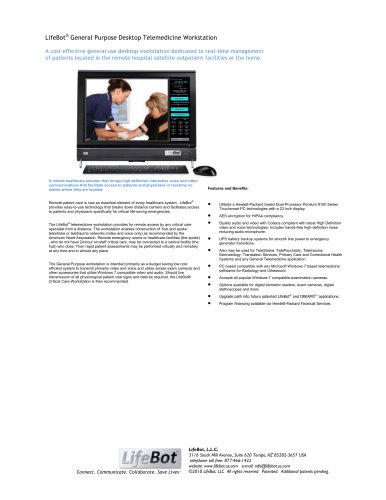
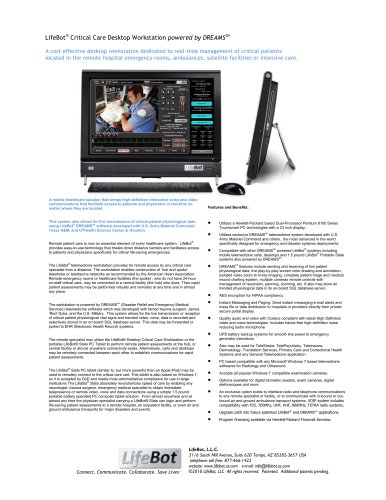
The LifeBot® Multi-Function Crash Cart is a mobile healthcare solution for routine and emergency care, functioning as a "virtual mobile ambulance."
Integrating telemedicine with decision support systems reduces costs and improves care quality, with LifeBot® as a model for Accountable Care Organizations (ACOs).
The LifeBot® DREAMStm system includes examination cameras, ultrasound compatibility, and tele-stration capabilities for real-time clinical instruction.
The document advocates for adopting mobile healthcare technologies to enhance EMS and community paramedicine, reduce costs, and improve patient care.
The LifeBot® Mobile Healthcare Design Guide focuses on telemedicine and tele-triage systems for EMS, detailing implementation stages, equipment requirements, and partnerships.
- Stage One - Tele-Triage and Telemedicine Origins: Setup of nurse tele-triage and EMS telemedicine at hospitals and call centers, emphasizing triaging non-emergency calls.
- Stage Two - ALS and MPCU Systems: Deployment of telemedicine systems in ALS ambulances and MPCUs, with options for additional equipment.
- Stage Three - Off-Site Specialists: Use of lightweight tablet PCs and desktops by specialists for remote support.
- Equipment and Technology Partners: Lists partners like TATRC, Hewlett Packard, and Vesalius Ventures involved in LifeBot® technologies.
- Contact and Deployment Information: Instructions for facilities to request quotes and details on deploying LifeBot® systems.
- Requirements: Facilities need to specify tele-triage and telemedicine workstations and vehicles equipped with telemedicine systems.
- Partnerships: Collaborations with major technology and healthcare organizations enhance telemedicine capabilities.
- Technological Advancements: Integration of advanced telemedicine technologies improves emergency response and reduces costs.
Catalog excerpts

Responding to the Needs of Community Paramedicine EMS Mobile Healthcare Systems LifeBot® Technology Design Guide Kit March 2012 Edition advanced telemedicine with continuity of care.tm LifeBot, LLC 2303 North 44th Street, Phoenix, AZ 85008-2442 USA telephone: 877-466-1422 website: www.lifebot.us.com email: [email protected] ©Copyright 2012 LifeBot, LLC Patented. Additional patents pending. All rights reserved.
Open the catalog to page 1
The Promise of EMS Mobile Healthcare By Roger Lee Heath Historically, general practitioners provided first-contact care in the United States. Today, however, only 42 percent of the 354 million annual visits for acute care—treatment for newly arising health problems—are made to patients’ personal physicians. The rest are made to emergency departments (28 percent), specialists (20 percent), or outpatient departments (7 percent). Although fewer than 5 percent of doctors are emergency physicians, they handle a quarter of all acute care encounters and more than half of such visits by the uninsured....
Open the catalog to page 2
Page 2 - Promise of the EMS Mobile Healthcare (continued) The Sky-Rocketing Costs of Medical Errors. First and foremost we have a far more litigious nation than most others. How do we minimize errors and risks for both providers and patients? How do we make fast accurate clinical and field decisions and at the same time document the quality and proficiency of delivered care? How do we do this in an era of such change and demand for accountability? The Institute of Medicine’s (IOM) 1999 report, To Err is Human, reveals that 44,000- 98,000 Americans die annually as the result of medical errors....
Open the catalog to page 3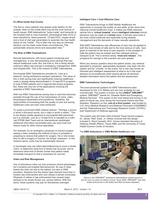
Page 3 - Promise of the EMS Mobile Healthcare (continued) Intelligent Care = Cost Effective Care. It’s What Inside that Counts: The fact is, many patients may appear quite healthy on the outside, when on the inside there may be the most serious of health issues. EMS telemedicine “looks inside” and transmits to the hospital what is most important, physiological data; ECG or heart waveforms, blood pressure, 12-lead ECG, oxygen levels and a host of vital sign parameters to ascertain the true health status on the “inside”. This is often the only way an informed decision can be made under these circumstances....
Open the catalog to page 4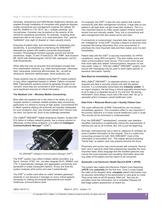
Page 4 - Promise of the EMS Mobile Healthcare (continued) Generally, ambulances and EMS Mobile Healthcare vehicles are enabled through installation of computers with graphical displays, mobile connectivity and management systems (for cellular 3G and 4G, WiMAX or LTE, Wi-Fi, etc.), multiple cameras, and microphones. Cameras may be placed on the exterior of the vehicle for situational awareness, for example, revealing what assets are still on the scene, or to view extrication “live”, and for “battlefield” over-sight of disaster or mass casualty events. Acquiring of patient data, and transmission...
Open the catalog to page 5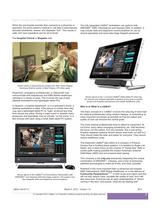
Page 5 - Promise of the EMS Mobile Healthcare (continued) When the pre-hospital provider then connects to a physician or specialist, the same patient’s medical or call data is automatically securely transferred, shared, and displayed “live”. This results in safer and more expedient care for all involved. The fully integrated LifeBot® workstation can perform both DREAMStm EMS Telemedicine and Odyssey DSS. In addition, it may include radio and telephone communications for use by clinical specialists and nurse tele-triage dispatch personnel. The Hospital Clinical or Dispatch side: Shown above is...
Open the catalog to page 6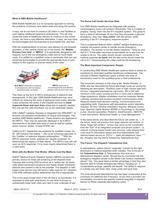
Page 6 - Promise of the EMS Mobile Healthcare (continued) What is EMS Mobile Healthcare? The Nurse Call Center Services Role. EMS Mobile Healthcare is a no nonsense approach to solving the problems of primary care nation-wide and doing this quickly. It says, we do not have to construct $2 trillion in new facilities or even deploy additional expensive ambulances. This will only cause the costs of healthcare delivery to continue to sky-rocket. It says, we have a cost effective alternative. It says, we now have the technologies and the expertise to accomplish this, and fast. With the implementation...
Open the catalog to page 7
Page 7 - Promise of the EMS Mobile Healthcare (continued) Can such a cart be made for tele-stroke, but be designed with “multi-function” capabilities so it may also respond to the needs for tele-trauma, tele-psychiatry, e-ICU, etc. and respond to an emergency? The answer is yes with the deployment of the MultiFunction Crash Cart system. This is an “all-in-one” cart design. Shown above is the University of California San Francisco Telemedicine Hub design connecting 15 remote facilities. A Telemedicine Hub may not only connect providers to telemedicine facilities at hospitals or clinics, but also...
Open the catalog to page 8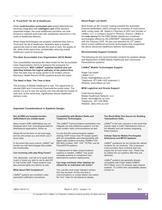
Page 8 - Promise of the EMS Mobile Healthcare (continued) About Roger Lee Heath: When multi-function connected care (smart telemedicine) becomes integrated with intelligent care (DSS decision supported triage), the more healthcare providers can look forward to reduced work-load with substantial reductions in the costs of healthcare delivery. Best known as the inventor making possible the Automatic External Defibrillator (AED) through his invention of noninvasive defib combo pads, Mr. Heath is Chairman & CEO and founder of LifeBot, LLC, a company based in Phoenix, Arizona. LifeBot is the sole...
Open the catalog to page 9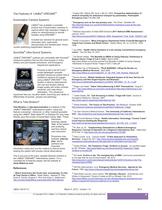
Gratton MC, Ellison SR, Hunt J, Ma OJ. 2003. Prospective determination of medical necessity for ambulance transport by paramedics. Prehospital Emergency Care 7(4):466–469. The Features of LifeBot DREAMS Examination Camera Systems: LifeBot has available a complete product line of examination cameras to capture either high resolution images or videos for retransmission to remote facilities using DREAMStm. Included are cameras for general exam, otoscopes (ear), eyescopes, dermoscopes and dentalscopes. Some contain polarizing magnification features. Emergency care as the new primary care - The Chart...
Open the catalog to page 10
LifeBot® Mobile Healthcare Design Guide Survey Please answer the initial questions below for us to research and quote your technology needs. Stage One: Hospitals, Dispatch Centers, and Call Centers are where Nurse Tele-triage and EMS Telemedicine originates. Stage Two: ALS = Acute Emergency + MPCU = Non-Acute Primary Care Stage Three: Off-Site Specialists LifeBot® Nurse Tele-Triage Operator’s Positions: Typically located at call centers, 911 dispatch these may also be installed into a call center adjoining an Emergency Room (this may reduce costs). Designed to triage non-emergency calls and retain...
Open the catalog to page 11All LifeBot catalogs and technical brochures
 LifeBot®5
2 Pages
 LifeBot ®
1 Page
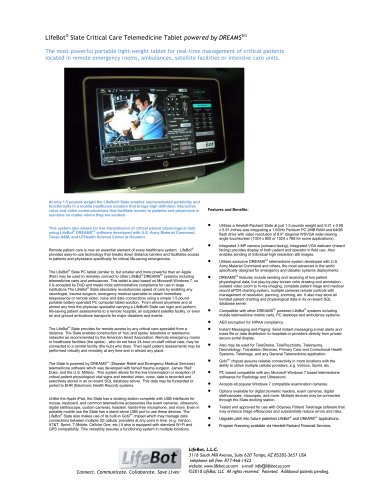 LifeBotSlate
1 Page