- Products
- Catalogs
- News & Trends
- Exhibitions
the LifeBot ® Multi - Function Telemedicine Crash Cart

the LifeBot ® Multi - Function Telemedicine Crash Cart
- Virtual Ambulance: Equipped with a flashing light system for emergencies and a Boot In-Route™ feature for immediate readiness.
- Tele-Presence: Enables remote access for healthcare professionals using tablets or desktop PCs.
- Robotics: Incorporates automated features to prioritize patient care over cart operation.
- DREAMS™ Technology: Developed with the U.S. Military, this technology allows live transmission of voice, video, and physiological data without separate servers.
- Unique Features: Includes a reinforced camera mast, secure electronics, a locking system, and various medical accessories.
- Dual-Bay Version – Model 2001: Suitable for major trauma rooms and general use.
- Single-Bay Version – Model 1001: Designed for smaller, restrictive environments.
Catalog excerpts

The most advanced Telemedicine Robot is now a Multi-Function Crash Cart. The LifeBot® Multi-Function Telemedicine Crash Cart A mobile telemedicine cart should be versatile enough to handle routine day-to-day procedures but capable enough to manage unexpected emergencies. One should be able to save money, ease budgets and not have to purchase multiple carts to fit multiple needs. Most importantly, it should save lives. Telemedicine Developed with the U.S. Military. Real-Time Physician Tele-Presence Completely Re-Defined. One cart should "do-it-all" or be an "all-in-one" solution. The Crash Carts utilize the exclusive LifeBot® DREAMS™ technologies developed with the U.S. Military making them the most advanced in the world. The DREAMStm Project utilized $14 million is research funding from Department of Defense agencies. The carts are the first and only such systems designed to transmit "live" voice, video and full patient physiological data. This is the data usually acquired by complete physiological monitoring systems that are connected directly to the patient. Physicians, intensivists, tele-nurses, or any specialist may use LifeBot® lightweight tablet or desktop PCs to login to carts for instant remote "tele-presence". The same PCs may be used to login and be "virtually" on-thescene to LifeBot® equipped ambulances. Since data is transmitted live, it is immediately usable. Care may be decisive and timely. Separate server systems, that could only delay critical care and increase costs, are not required. Solid – Tested - Proven. The LifeBot® DREAMStm system was tested and proven in over six years of use on-board pre-hospital paramedic ambulances. It was even successfully utilized for Disaster Telemedicine during the Katrina and Rita hurricane disasters. Video Tele-Conferencing is NOT Telemedicine. The “Robotics” Element. tm The first “Virtual Ambulance ” system. Featured is a flashing light system to clear the hallways similar to the way an ambulance clears the street. Its patent pending Boot In-Routetm feature means it is ready when you need it. Not only is the cart the most advanced, but it is also the very first Emergency Crash Cart with telemedicine, a “virtual ambulance” that may be easily deployed facility-wide. advanced telemedicine with continuity of care. The LifeBot® robotic telemedicine crash cart system has numerous automated features so one may worry less about operating the cart system and focus more upon the patient, the quality of care, and reducing costs. Physicians utilizing the LifeBot® Slate tablet or Desktop PCs, for example, have remote control of the pan, tilt, zoom cameras next to the patient. This is just one of the many features of the LifeBot® DREAMS™ telemedicine systems. LifeBot® systems are developed with decades of medical insight or applications experience. If one looks at the prominent telemedicine cart suppliers today, one may be shocked to realize that most have little or no experience in the healthcare field at all; little knowledge of medical devices and acquiring critical life-saving physiologic information. Most are dedicated to performing video teleconferencing only and have a history as only audio visual specialists. © Copyright 2012 LifeBot, LLC Patented. Additional patents pending. All rights reserved
Open the catalog to page 1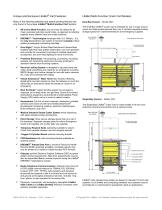
Unique and Exclusive LifeBot Cart Features: LifeBot Multi-Function Crash Cart Models: Many of the following patented and patent pending features are only found in the unique LifeBot® Multi-Function Cart System: Dual-Bay Version – Model 2001: All-in-One Multi-Function, one cart may be utilized for all major purposes reducing overall costs, as opposed to cobbling together many different carts and costly solutions. DREAMS™ Technologies developed with U.S. Military…it is the only telemedicine cart system to transmit complete critical patient physiological monitoring data live. Over-Sight™ Acrylic...
Open the catalog to page 2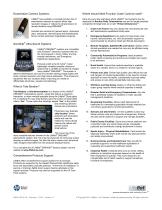
Examination Camera Systems: Where should Multi-Function Crash Carts be used? LifeBot® has available a complete product line of examination cameras to capture either high resolution images or videos for retransmission to remote facilities using DREAMStm. Here are just a few examples where LifeBot® cart systems may be deployed for Routine Daily Telemedicine use and to handle potential unexpected emergencies as on-site “Virtual Ambulancestm”: 1. Crash Cart Teams may now deploy the most advanced care with telemedicine capabilities facility-wide. Emergency Department may deploy for tele-stroke, teletrauma,...
Open the catalog to page 3
The LifeBot® Technologies Team LifeBot technologies were either funded, developed or are supported by this extraordinary group of technology and business partners: Telemedicine and Technology Research Center (TATRC) The Telemedicine & Advanced Technology Research Center (TATRC) performs medical reconnaissance and special operations to address critical gaps that are underrepresented in Department of Defense medical research programs. TATRC is an office of the headquarters of the US Army Medical Research and Materiel Command (USAMRMC). United States Army Medical Research and Material Command (USAMRMC)...
Open the catalog to page 4All LifeBot catalogs and technical brochures
 LifeBot®5
2 Pages
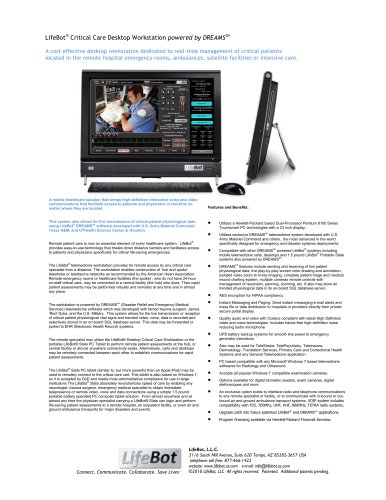 LifeBot ®
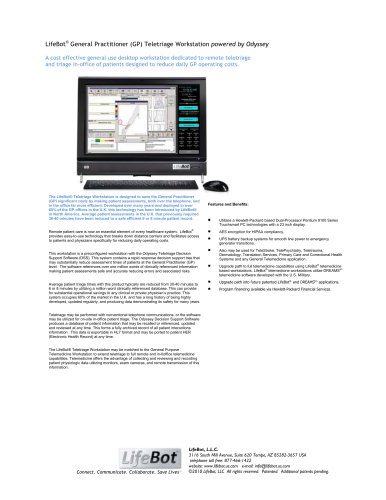
1 Page
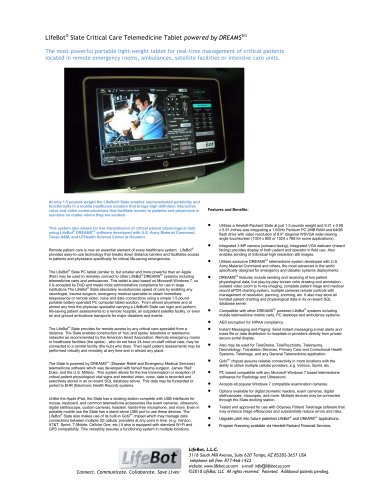 LifeBotSlate
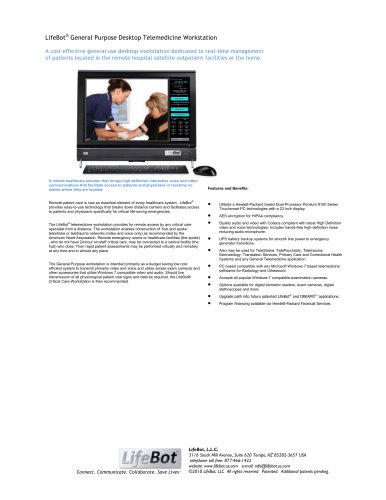
1 Page