
- Catalogs
- LifeSpan BioSciences
- LS-K297-100

LS-K297-100
LS-K297-100
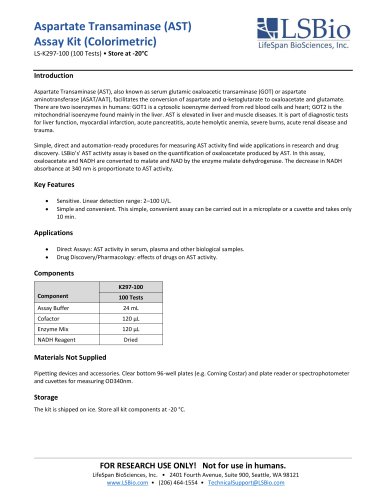
Aspartate Transaminase (AST), also known as serum glutamic oxaloacetic transaminase (GOT) or aspartate aminotransferase (ASAT/AAT), is an enzyme that facilitates the conversion of aspartate and α-ketoglutarate to oxaloacetate and glutamate. It has two isoenzymes: GOT1 (cytosolic) and GOT2 (mitochondrial). AST levels are elevated in liver and muscle diseases and are used in diagnostic tests for various conditions such as liver function, myocardial infarction, and acute pancreatitis.
Key Features
The assay kit offers a sensitive and linear detection range of 2–100 U/L. It is simple and convenient, suitable for use in microplates or cuvettes, and takes only 10 minutes to perform.
Applications
The kit is used for direct assays of AST activity in serum, plasma, and other biological samples, as well as in drug discovery to assess the effects of drugs on AST activity.
Components
The kit includes an assay buffer, cofactor, enzyme mix, and a dried NADH reagent. Additional materials required but not supplied include pipetting devices, clear bottom 96-well plates, and a plate reader or spectrophotometer.
Storage
All components should be stored at -20°C.
Assay Procedure
1. Equilibrate components to room temperature and reconstitute the NADH reagent with water.
2. Perform assays at 37°C or room temperature, ensuring samples are clear and free of particles.
3. For 96-well plates, transfer 20 μL of sample to each well, prepare working and blank reagents, and read OD340nm at 5 and 10 minutes.
4. For cuvettes, prepare working and blank reagents, add samples, and read OD340nm at 5 and 10 minutes.
Calculations
Calculate the rate of NADH consumption by subtracting the OD at 10 minutes from the OD at 5 minutes. Use the provided equation to determine AST activity. If AST activity exceeds 100 U/L, dilute the sample and repeat the assay.
Catalog excerpts
bSLSBio LifeSpan BioSciences, Inc. Aspartate Transaminase (AST) Assay Kit (Colorimetric) LS-K297-100 (100 Tests) • Store at -20°C Introduction Aspartate Transaminase (AST), also known as serum glutamic oxaloacetic transaminase (GOT) or aspartate aminotransferase (ASAT/AAT), facilitates the conversion of aspartate and a-ketoglutarate to oxaloacetate and glutamate. There are two isoenzymes in humans: GOT1 is a cytosolic isoenzyme derived from red blood cells and heart; GOT2 is the mitochondrial isoenzyme found mainly in the liver. AST is elevated in liver and muscle diseases. It is part of diagnostic tests for liver function, myocardial infarction, acute pancreatitis, acute hemolytic anemia, severe burns, acute renal disease and trauma. Simple, direct and automation-ready procedures for measuring AST activity find wide applications in research and drug discovery. LSBio's' AST activity assay is based on the quantification of oxaloacetate produced by AST. In this assay, oxaloacetate and NADH are converted to malate and NAD by the enzyme malate dehydrogenase. The decrease in NADH absorbance at 340 nm is proportionate to AST activity. Key Features • Sensitive. Linear detection range: 2-100 U/L. • Simple and convenient. This simple, convenient assay can be carried out in a microplate or a cuvette and takes only 10 min. Applications • Direct Assays: AST activity in serum, plasma and other biological samples. • Drug Discovery/Pharmacology: effects of drugs on AST activity. Materials Not Supplied Pipetting devices and accessories. Clear bottom 96-well plates (e.g. Corning Costar) and plate reader or spectrophotometer and cuvettes for measuring OD340nm. Storage The kit is shipped on ice. Store all kit components at -20 °C. FOR RESEARCH USE ONLY! Not for use in humans. LifeSpan BioSciences, Inc. • 2401 Fourth Avenue, Suite 900, Seattle, WA 98121 www.LSBio.com • (206) 464-1554 • [email protected]
Open the catalog to page 1
Aspartate Transaminase (AST) Assay Kit (Colorimetric) LS-K297-100 (100 Tests) • Store at -20°C Assay Procedure Equilibrate all components to room temperature. Reconstitute the NADH Reagent tube with 1000 μL dH2O (final 10 mM). Unused reconstituted NADH reagent is stable for three weeks when stored frozen at -20°C. Mix assay buffer well by vigorous shaking. Keep thawed enzyme on ice. Assays can be performed at 37°C or at room temperature. Prior to assay, bring the working reagents, microplate and spectrophotometer to the desired temperature. Assay is compatible with serum or plasma (heparin, EDTA)....
Open the catalog to page 2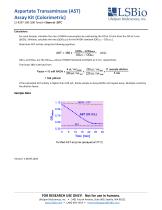
bSLSBio LifeSpan BioSciences, Inc. Aspartate Transaminase (AST) Assay Kit (Colorimetric) LS-K297-100 (100 Tests) • Store at -20°C Calculations For each Sample, calculate the rate of NADH consumption by subtracting the OD at 10 min from the OD at 5 min (AODs). Similarly, calculate the rate (AODnadh) for the NADH standard (OD5min - OD10min). Determine AST activity using the following equation, AODs - AODnadh (U/L) ODstd — ODblk ODstd and ODblk are the OD340nm values of NADH Standard and Blank at 5 min, respectively. The factor 388 is derived from ^ llllinil4 pL Vol.NADH 200 pL Vol.WR 11 (sample...
Open the catalog to page 3All LifeSpan BioSciences catalogs and technical brochures
 LS-K299-100
3 Pages
 LS-K318-100
3 Pages
 LS-K304-100
3 Pages
 LS-K311-100
3 Pages
 LS-K308-100
3 Pages
 LS-K301-100
3 Pages
 LS-K307-250
3 Pages
 LS-K306-100
3 Pages
 LS-K302-200
3 Pages
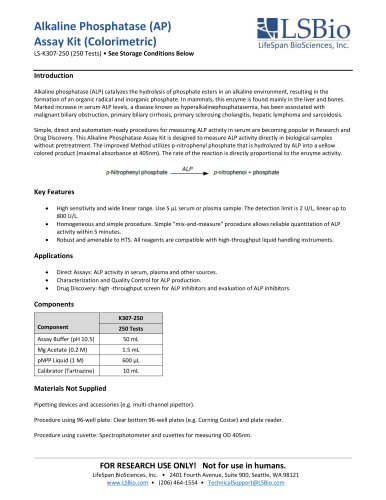 Assay Kit (Colorimetric)
3 Pages
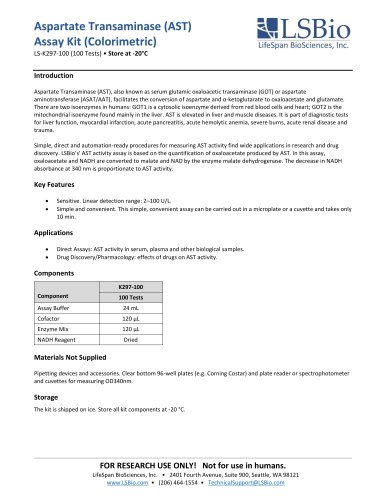 Aspartate Transaminase (AST)
3 Pages
- Detection kit
- Solvent reagent
- Blood detection kit
- Serum detection kit
- Immunoassay detection kit
- Plasma detection kit
- Research reagent
- Laboratory reagent
- Protein reagent
- Optical test kit
- Buffer solution reagent
- Fluorescence detection kit
- Immunoanalysis reagent kit
- ELISA detection kit
- Antigen detection kit
- Research detection kit
- Cell detection kit
- Urine detection kit
- Laboratory assay kit
- Electrolyte reagent