
- Catalogs
- Lifeward GmbH
- Powered Exoskeleton Published Research Summary

Powered Exoskeleton Published Research Summary
Powered Exoskeleton Published Research Summary
Catalog excerpts
Powered Exoskeleton Published Research Summary
Open the catalog to page 1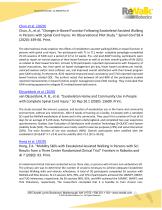
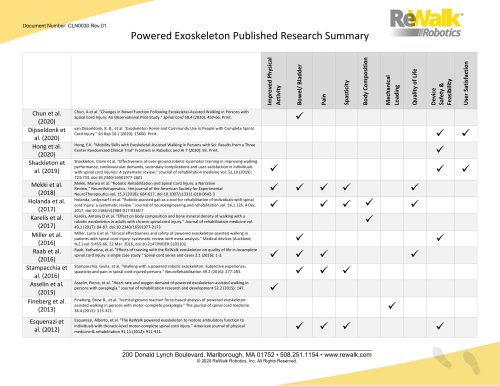
Chun et al. (2020) Chun, A., et al. "Changes in Bowel Function Following Exoskeletal-Assisted Walking in Persons with Spinal Cord Injury: An Observational Pilot Study." Spinal Cord 58.4 (2020): 459-66. Print. The observational study explores the effects of exoskeleton-assisted walking (EAW) on bowel function in persons with spinal cord injury. Ten participants with T1 to T11 motor- complete paraplegia completed 25–63 sessions of EAW over a period of 12 to 14 weeks. Pre- and post-EAW training, participants were asked to report on various aspects of their bowel function as well as on their overall...
Open the catalog to page 2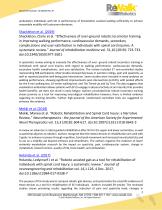
ambulatory individuals with SCI in performance of Exoskeleton assisted walking sufficiently to achieve reasonable mobility skill outcome milestones. Shackleton et al. (2019) Shackleton, Claire et al. “Effectiveness of over-ground robotic locomotor training in improving walking performance, cardiovascular demands, secondary complications and user-satisfaction in individuals with spinal cord injuries: A systematic review.” Journal of rehabilitation medicine vol. 51,10 (2019): 723-733. doi:10.2340/16501977-2601 A systematic review aiming to evaluate the effectiveness of over- ground robotic locomotor...
Open the catalog to page 3
proprioception, sensitivity to temperature, vibration, pressure, reflex behavior, electrical activity at muscular and cortical level, classification of the injury level. Some studies also show benefits of increase in walking speed, step length and distance traveled; improvements in sitting posture, intestinal, cardiorespiratory, metabolic, brain and psychological functions. This systematic review shows a significant progress in the area of robotic devices as “an innovative and effective therapy for the rehabilitation of individuals with SCI”. Karelis et al. (2017) Karelis, Antony D et al. “Effect...
Open the catalog to page 4
time during training was 4.4%, all occurring while tethered using a first-generation exoskeleton and none resulting in injury. The incidence of bone fracture during training was 3.4%. These risks have since been mitigated with newer generation exoskeletons and refinements to patient eligibility criteria. The authors conclude that powered exoskeletons allow patients with SCI to safely ambulate in real-world settings at a physical activity intensity conducive to prolonged use and known to yield health benefits. Raab et al. (2016) Raab, Katharina, et al. "Effects of training with the ReWalk exoskeleton...
Open the catalog to page 5
Asselin et al. (2015) Asselin, Pierre, et al. "Heart rate and oxygen demand of powered exoskeletonassisted walking in persons with paraplegia." Journal of rehabilitation research and development 52.2 (2015): 147. The aim of this prospective, single-group observational study was to investigate energy expenditure and heart rate (HR) during powered exoskeletal-assisted use while participating in seated rest, exoskeletonassisted standing, and exoskeleton-assisted walking. Oxygen uptake (VO2) while using the powered exoskeleton was compared to other reports that have investigated the use of passive...
Open the catalog to page 6
Esquenazi et al. (2012) Esquenazi, Alberto, et al. "The ReWalk powered exoskeleton to restore ambulatory function to individuals with thoracic-level motor-complete spinal cord injury." American Journal of Physical Medicine & Rehabilitation 91.11 (2012): 911921. This open, non-comparative, non-randomized study was performed to assess the safety and performance of the ReWalk powered exoskeleton in enabling people with paraplegia to ambulate. This study comprised 12 subjects with paraplegia due to spinal cord injury who completed the active intervention. Subjects were trained for up to 24 sessions...
Open the catalog to page 7All Lifeward GmbH catalogs and technical brochures
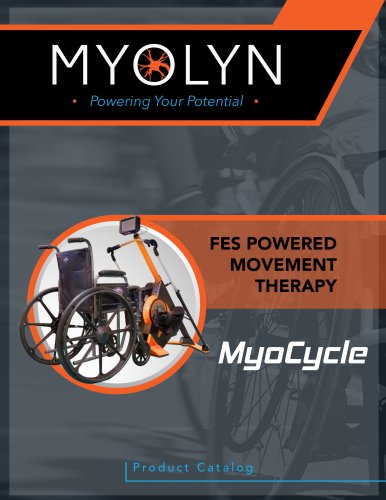 Myolyn_Catalog
8 Pages
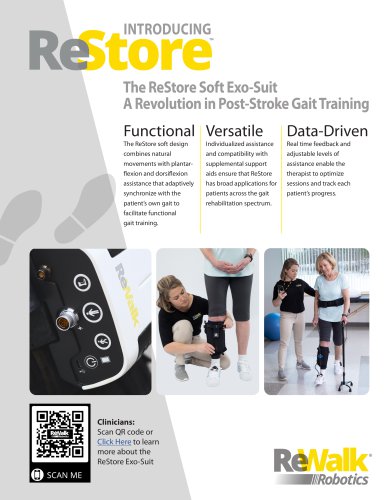 ReStore-Exo-Suit_Info
8 Pages
 ReWalk-Clinic-Day-Value
1 Page
 ReWalk
2 Pages