

"Wins" in Outcomes
"Wins" in Outcomes
Winning in athletic medicine shares core concepts with collegiate competition, such as commitment, preparation, focus, and execution. Successful programs are innovative, open to change, and emphasize teamwork.
Care Collaboration
At Duke University, the focus is on providing top diagnostic care and treatment for student-athletes, starting with injury prevention and sports performance. Athletes are assessed for range of motion, strength, and movement patterns, leading to personalized intervention programs. The goal is to maintain athlete health and performance.
Innovation in Treatment
Duke University regularly evaluates new treatment methodologies, seeking advantages over conventional approaches. Deep-tissue laser therapy has proven effective for treating musculoskeletal conditions, reducing inflammation, increasing range of motion, and addressing chronic conditions.
Impact of Laser Therapy
Initially skeptical, Duke University found high-powered lasers to be effective, providing consistent results and improving tissue interaction. Laser therapy has become a staple in treating various conditions, including musculo-tendinous issues, sprains, strains, and post-surgical cases.
Efficiency and Time Management
Given the busy schedules of student-athletes, efficient treatment is crucial. Laser therapy is fast and effective, often used first to prepare the body for further treatment. It enhances mobility and aids in range of motion, complementing other therapies.
Future Plans
Duke University plans to expand the use of laser therapy, exploring new applications such as treating headaches and TMJ cases. The goal is to make laser therapy more accessible and integrate it further into treatment protocols.
Conclusion
The medical role in collegiate athletics is demanding but rewarding. Duke University is committed to evaluating new therapies to benefit student-athletes. Laser therapy has become a valuable tool, and the university will continue to explore its applications.
Catalog excerpts
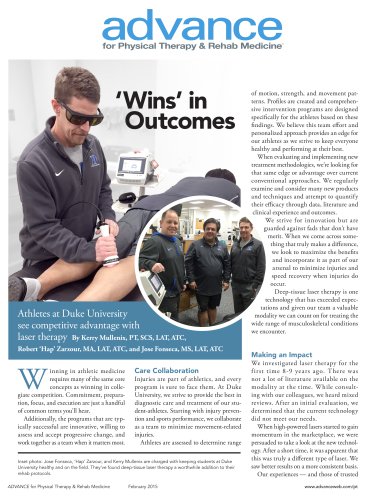
Athletes at Duke University see competitive advantage with laser therapy By Kerry Mullenix, PT, SCS, LAT, ATC, Robert ‘Hap’ Zarzour, MA, LAT, ATC, and Jose Fonseca, MS, LAT, ATC inning in athletic medicine requires many of the same core concepts as winning in collegiate competition. Commitment, preparation, focus, and execution are just a handful of common terms you’ll hear. Additionally, the programs that are typically successful are innovative, willing to assess and accept progressive change, and work together as a team when it matters most. Care Collaboration Injuries are part of athletics, and every program is sure to face them. At Duke University, we strive to provide the best in diagnostic care and treatment of our student-athletes. Starting with injury prevention and sports performance, we collaborate as a team to minimize movement-related injuries. Athletes are assessed to determine range Inset photo: Jose Fonseca, ‘Hap’ Zarzour, and Kerry Mullenix are charged with keeping students at Duke University healthy and on the field. They’ve found deep-tissue laser therapy a worthwhile addition to their rehab protocols. ADVANCE for Physical Therapy & Rehab Medicine of motion, strength, and movement patterns. Profiles are created and comprehensive intervention programs are designed specifically for the athletes based on these findings. We believe this team effort and personalized approach provides an edge for our athletes as we strive to keep everyone healthy and performing at their best. When evaluating and implementing new treatment methodologies, we’re looking for that same edge or advantage over current conventional approaches. We regularly examine and consider many new products and techniques and attempt to quantify their efficacy through data, literature and clinical experience and outcomes. We strive for innovation but are guarded against fads that don’t have merit. When we come across something that truly makes a difference, we look to maximize the benefits and incorporate it as part of our arsenal to minimize injuries and speed recovery when injuries do occur. Deep-tissue laser therapy is one technology that has exceeded expectations and given our team a valuable modality we can count on for treating the wide range of musculoskeletal conditions we encounter. We investigated laser therapy for the f irst time 8-9 years ago. There was not a lot of literature available on the modality at the time. While consulting with our colleagues, we heard mixed reviews. After an initial evaluation, we determined that the current technology did not meet our needs. When high-powered lasers started to gain momentum in the marketplace, we were persuaded to take a look at the new technology. After a short time, it was apparent that this was truly a different type of laser. We saw better results on a more consistent basis. Our experiences — and those of trusted www.advanceweb.com/pt
Open the catalog to page 1
colleagues — led us to the conclusion that results and outcomes were directly related to dosing parameters. Delivering enough energy to the area was important. Higher power allowed us to deliver the energy effectively and efficiently. With higher power, players feel something happening. It’s like the cells are getting excited; they feel warmth. There is a much better interaction with the tissue, and benefits are felt immediately. Making the switch to a higher-power laser provided us with “wins” we can count on. It’s helping us reduce inflammation, increase range of motion, accomplish more with...
Open the catalog to page 2All LiteCure catalogs and technical brochures
 Medical Corporate Brochure
2 Pages
- Medical kit
- Laboratory centrifuge
- Tabletop laser
- Benchtop centrifuge
- Class 4 laser
- Automatic centrifuge
- Sterile medical kit
- Physical therapy laser
- Physical biostimulation laser
- Veterinary physiotherapy
- Diagnostic medical kit
- Veterinary laser
- Surgery medical kit
- Diode veterinary laser
- Veterinary biostimulation laser
- Tabletop veterinary laser
- Pet veterinary physiotherapy
- Veterinary medical kit
- General surgery medical kit
- Veterinary cryotherapy unit