
- Catalogs
- Mano Medical
- Doppler Vet BP

- Company
- Products
- Catalogs
- News & Trends
- Exhibitions
Doppler Vet BP
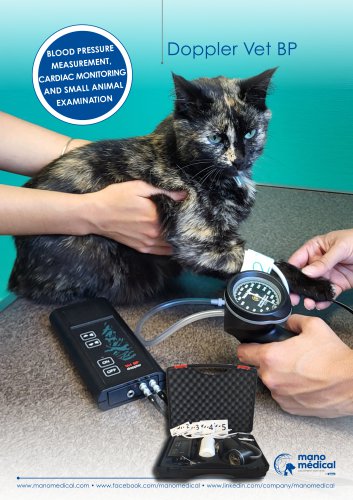
Doppler Vet BP
This document provides guidelines for using the Doppler Vet BP device for blood pressure measurement, cardiac monitoring, and small animal examination. It is particularly useful for detecting hypertension in older animals, especially cats and dogs.
Blood Pressure Measurement Procedure
- Place the cuff above the vessel to be examined.
- Shave or wet the area where the probe will be positioned.
- Apply gel to the probe and place it in contact with the vessel without applying pressure.
- Adjust the probe until a clear Doppler sound is heard.
- Secure the probe with a finger or adhesive tape.
- Inflate the cuff to block the artery until no sound is heard.
- Slowly deflate the cuff; the returning sound indicates systolic pressure.
- Diastolic pressure is indicated by a change in Doppler tonality, requiring experience to detect.
- Validate results by measuring pressure multiple times.
Importance of Blood Pressure Measurement
Early detection of arterial hypertension is crucial as symptoms are often subtle. Regular checks, including blood analysis and blood pressure measurement, are recommended for older animals to detect conditions like chronic kidney insufficiency.
Monitoring with the Doppler
The Doppler device measures arterial flow and can be used during anesthesia or intensive care. It provides auditory feedback of heart rate and pulse.
Equipment Included
The Doppler set includes an 8 MHz blood pressure probe, battery charger, sphygmomanometer, four cuffs of varying sizes, a headset, and a tube of gel, all packed in a robust carrying case.
Technical Features
- Ultrasonic frequency: 8 MHz
- Audio output: 200mW
- Frequency response: 300Hz - 6kHz
- Battery: 3 x 1.2V, 1500mAh
- Operating time: +/- 6 hours
- Charging time: 15 hours
- Dimensions and weight: 7’’x3’’x1’’ (175 x 80 x 25 mm) - 11 oz. (300 g)
- Headset acoustic output: mini jack
Catalog excerpts
#^BLOOD PRESSURE^ r MEASUREMENT, ^ CARDIAC MONITORING i AND SMALL ANIMAL^ V EXAMINATION J
Open the catalog to page 1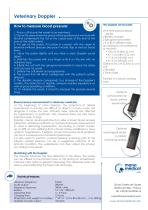
How to measure blood pressure: 1. Place cuff above the vessel to be examined. 2. Shave the area where the probe will be positioned or wet hair with alcohol (underneath the tail or the carpal pad at the end of the paw or the radial artery). 3. Put gel on the probe. Put probe in contact with the vessel to examine (without pressure because it would stop or reduce blood flow). 4. Move the probe slightly until you hear a clear Doppler sound signal. 5. Maintain the probe with your finger or fix it on the skin with an adhesive tape. 6. Inflate the cuff with the sphygmomanometer to block the artery until...
Open the catalog to page 2All Mano Medical catalogs and technical brochures
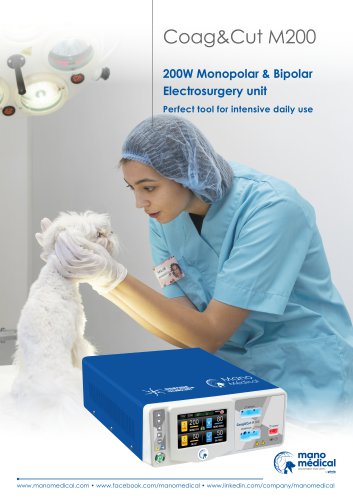 Coag&Cut M200
2 Pages
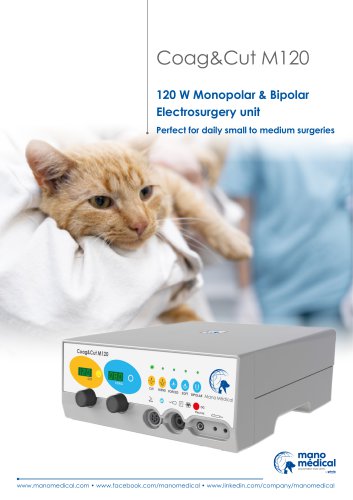 Coag&Cut M120
2 Pages
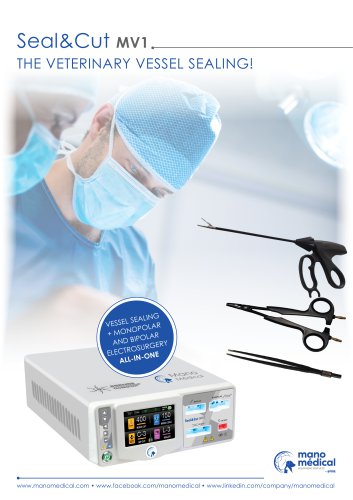 Seal&Cut mv 1
8 Pages
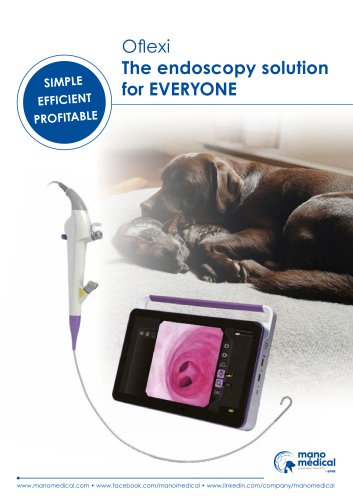 Oflexi
4 Pages
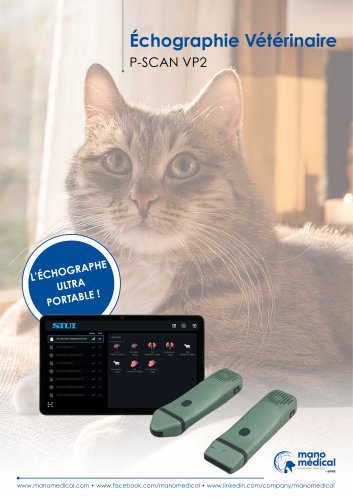 P-SCAN VP2
2 Pages
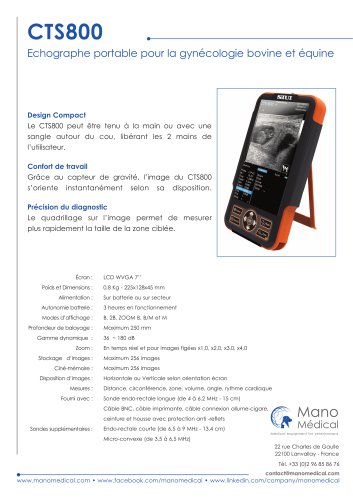 CTS800
1 Page
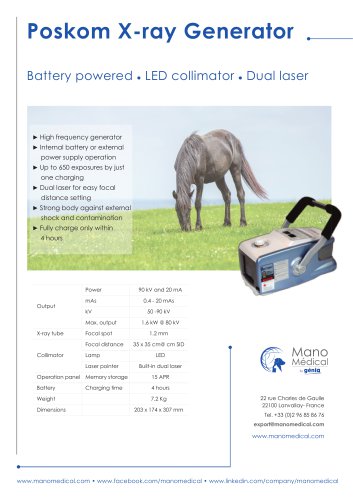 Poskom X-ray Generator
1 Page
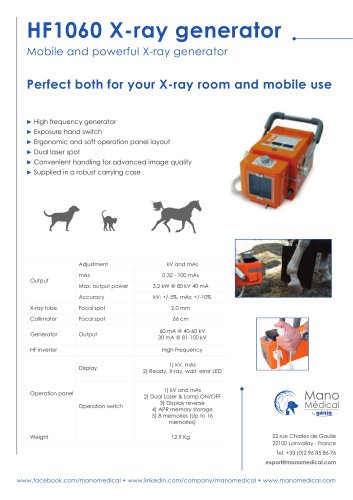 HF1060 X-ray generator
1 Page
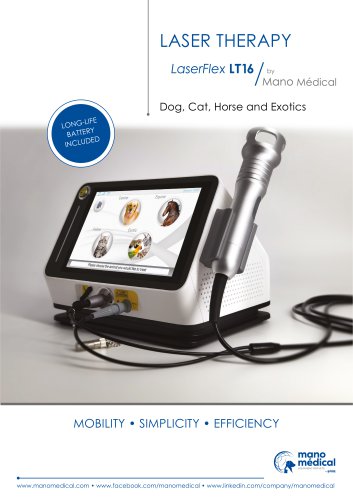 LT16 Laser Therapy
8 Pages
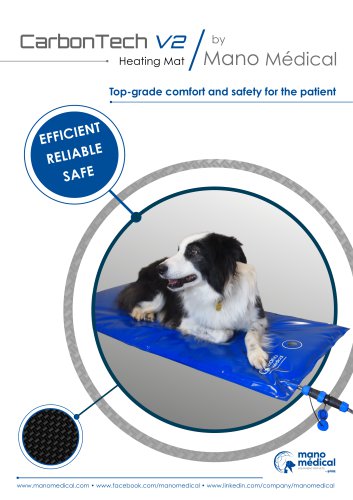 Carbon Tech V2 heating mat
4 Pages
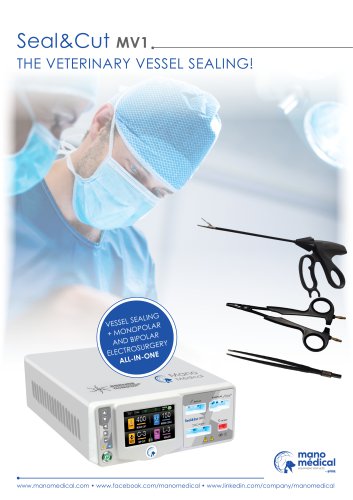 Seal&Cut mv1
8 Pages
 Catalogue 2025
44 Pages
- Examination couch
- Height-adjustable examination couch
- Electric examination couch
- Mobile examination table
- Examination couch on casters
- Surgical system
- Cutting electrosurgical system
- Tablet computer software
- Coagulation surgical system
- Tablet PC software
- Fixed-height treatment table
- Mayo table
- Radiofrequency electrosurgical unit
- Acquisition software
- Waterproof mattress
- 1-section treatment table
- High-frequency surgical system
- Bipolar cutting electrosurgical unit
- Treatment table with storage unit
- Washable mattress