
- Catalogs
- Master Bond
- Top Adhesives for Medical Device Applications


- Company
- Products
- Catalogs
- News & Trends
- Exhibitions
Top Adhesives for Medical Device Applications
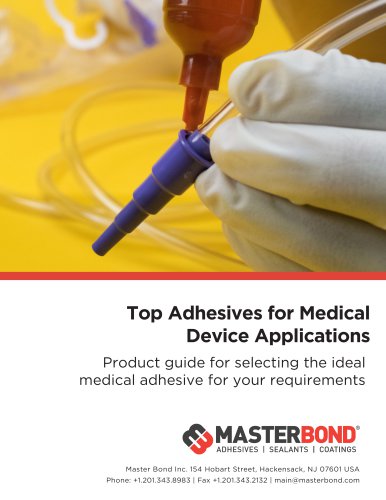
Top Adhesives for Medical Device Applications
- EP42HT-2Med: High-temperature resistant epoxy for endoscopes and surgical instruments, compliant with USP Class VI and ISO 10993-5.
- UV17Med: UV curable adhesive for TPU bonding, known for high elongation and chemical resistance.
- EP62-1Med: Resistant to sterilization and chemicals, suitable for repeated autoclaving.
- EP3HTMed: One-part, heat-curing epoxy with excellent sterilization resistance.
- EP21LVMed: Low viscosity, two-component epoxy with excellent thermal cycling resistance.
- EP30Med: Optically clear epoxy for sensor encapsulation in prosthetic devices.
- LED405Med: LED curable adhesive with nanosilica filler for dimensional stability.
- EP41S-5Med: Two-component epoxy resistant to solvents and sterilants.
Catalog excerpts
Top Adhesives for Medical Device Applications Product guide for selecting the ideal medical adhesive for your requirements ADHESIVES I SEALANTS I COATINGS Master Bond Inc. 154 Hobart Street, Hackensack, NJ 07601 USA Phone: +1.201.343.8983 | Fax +1.201.343.2132 | [email protected]
Open the catalog to page 1
How to select the right medical adhesive Picking the right adhesive almost always entails a balancing act as engineers attempt to find products that meet conflicting end-use and manufacturability requirements. Medical device engineers, who also have to contend with a strict regulatory environment, often have the toughest time striking that balance. Like engineers in less regulated industries, device engineers have to contend with difficult application requirements—such as high bond strength, thermal performance and chemical resistance. On top of these challenges, they have the added burden of...
Open the catalog to page 3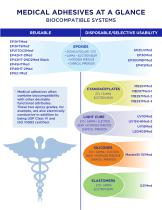
REUSABLE DISPOSABLE/SELECTIVE USABILITY EP3HTMed • GAMMA • ELECTRON BEAM • HYDROGEN PEROXIDE • CHEMICAL IMMERSION * Medical adhesives often combine biocompatibility with other desirable functional attributes. These two epoxy grades, for example, are also electrically conductive in addition to being USP Class VI and ISO 10993 certified. ETO •GAMMA ELECTRON BEAM LIGHT CURE ETO • GAMMA • ELECTRON BEAM • HYDROGEN PEROXIDE CHEMICAL IMMERSION ETO • GAMMA • ELECTRON BEAM • HYDROGEN PEROXIDE CHEMICAL IMMERSION ETO • GAMMA ELECTRON BEAM
Open the catalog to page 4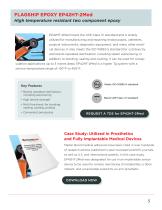
EP42HT-2Med meets the USP Class VI standard and is widely utilized for manufacturing and repairing endocscopes, catheters, surgical instruments, diagnostic equipment, and many other medical devices. It also meets the ISO 10993-5 standard for cytotoxicity and resists repeated sterilization, including steam autoclaving. In addition to bonding, sealing and coating, it can be used for encapsulation applications up to 3 inches deep. EP42HT-2Med is a higher Tg system with a service temperature range of -60°F to 450°F. Key Features • Resists repeated sterilization, including autoclaving • High tensile...
Open the catalog to page 5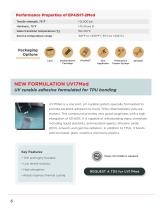
Performance Properties of EP42HT-2Med Tensile strength, 75°F Glass transition temperature (Tg) Service temperature range Packaging Options Cans Double Barrel Cartridge Premixed & Frozen Syringe NEW FORMULATION UV17Med UV curable adhesive formulated for TPU bonding UV17Med is a one part, UV curable system specially formulated to provide excellent adhesion to many TPUs (thermoplastic polyurethanes). This compound provides very good toughness with a high elongation of 50-60%. It is capable of withstanding many chemicals including liquid sterilants, antimicrobial agents, ethylene oxide (EtO), e-beam,...
Open the catalog to page 6
See UV17Med in action in this video demonstration WATCH NOW What biocompatibility tests can be performed on an adhesive, to be considered for use in a medical device applications? It is important to not only be aware of the location of the adhesive, sealant, or encapsulant within the medical device but also the nature of the medical device in question. As a rule of thumb, in choosing such compounds, the adhesive must exhibit non-leaching characteristics. Biocompatibility is of utmost importance when there is skin or body contact involved, while in some non-contact type applications, this biocompatibility...
Open the catalog to page 7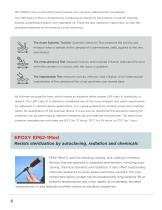
ISO 10993-5 test on the other hand involves non-cytotoxic deterministic procedures. The USP Class VI test is conducted by producing an extract of the product in sodium chloride, alcohol, polyethylene glycol, and vegetable oil. These are also injected in specimens, so that the biological response to the extracts can be observed. The Acute Systemic Toxicity (Systemic Injection) Test measures the toxicity and irritation when a sample of the compound is administered orally, applied to the skin, and inhaled. The Intracutaneous Test measures toxicity and localized irritation (between the skin) when...
Open the catalog to page 8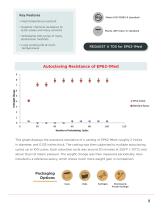
• High temperature resistant • Superior chemical resistance to acids, bases and many solvents • Withstands 100 cycles of many sterilization methods • Long working life at room temperatures This graph displays the autoclave resistance of a casting of EP62-1Med, roughly 2 inches in diameter, and 0.125 inches thick. The casting was then subjected to multiple autoclaving cycles up to 100 cycles. Each autoclave cycle was around 20 minutes at 250°F (~121°C) and about 15 psi of steam pressure. The weight change was then measured periodically. Also included is a reference epoxy, which shows much more...
Open the catalog to page 9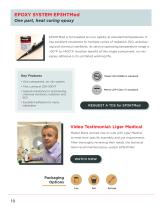
EP3HTMed is formulated to cure rapidly at elevated temperatures. It has excellent resistance to multiple cycles of radiation, EtO, autoclaving and chemical sterilants. Its service operating temperature range is -60°F to +400°F. Another benefit of this single component, no mix epoxy adhesive is its unlimited working life. • Superb resistance to autoclaving, chemical sterilants, radiation and EtO • Excellent adhesion to many substrates Video Testimonial: Liger Medical Master Bond worked one-on-one with Liger Medical to meet their specific assembly and use requirements. After thoroughly reviewing...
Open the catalog to page 10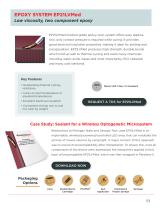
Low viscosity, two component epoxy EP21LVMed medical grade epoxy resin system offers easy application, only contact pressure is required while curing. It provides good electrical insulation properties, making it ideal for potting and encapsulation. EP21LVMed produces high strength, durable bonds which hold up well to thermal cycling and resist many chemicals including water, acids, bases and most importantly, EtO, radiation and many cold sterilants. Key Features • Outstanding thermal cycling resistance Meets USP Class VI standard • Cures at room temperature or elevated temperatures • Excellent...
Open the catalog to page 11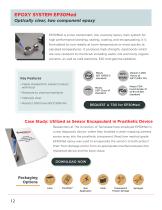
Optically clear, two component epoxy EP30Med is a two component, low viscosity epoxy resin system for high performance bonding, sealing, coating, and encapsulating. It is formulated to cure readily at room temperature or more quickly at elevated temperatures. It produces high strength, rigid bonds which are very resistant to chemicals including water, oils and many organic solvents, as well as cold sterilants, EtO and gamma radiation. Key Features • Meets standard for indirect contact with food • Resistant to chemical sterilants Meets USP Class VI standard Meets FDA Food Grade 21 CFR 175.105...
Open the catalog to page 12All Master Bond catalogs and technical brochures
 Master_Bond-Adhesives-Sensors
10 Pages
 EP42HT-2Med
4 Pages
Archived catalogs
- Curing light
- LED curing light
- MasterBond plastic medical adhesive
- MasterBond medical device medical adhesive
- MasterBond biocompatible medical adhesive
- MasterBond metal medical adhesive
- Low-viscosity medical adhesive
- MasterBond glass medical adhesive
- Rubber medical adhesive
- Ceramic medical adhesive
- MasterBond medical industry medical adhesive
- Silicone medical adhesive
- Epoxy resin medical adhesive