
- Catalogs
- MCQ Instruments
- Create and control hypercapnia conditions. Life Science - Pharma: Cell Cultures Studies


Create and control hypercapnia conditions. Life Science - Pharma: Cell Cultures Studies

Create and control hypercapnia conditions. Life Science - Pharma: Cell Cultures Studies
The project is a collaboration between the Institute of Technology in Lausanne (EPFL) and focuses on cell culture studies within the life sciences and pharmaceutical sectors. The School of Life Sciences, specifically the Laboratory of Microbiology and Microtechnology (LMIC), is leading the project under the guidance of Prof. John McKinney. The primary role of MCQ Instruments is to create and control specific hypercapnia conditions essential for the research.
EPFL is a renowned research institute and university in Lausanne, Switzerland, specializing in natural sciences and engineering. It is ranked among the top universities globally, particularly in engineering and technology.
The project investigates the dynamics of Mycobacterium tuberculosis under various conditions using quantitative time-lapse microscopy. The study aims to understand bacterial dormancy and persistence, which are critical in tuberculosis infections and relapses post-chemotherapy. The research highlights the heterogeneity of single-cell dynamics under stress conditions, such as nutrient limitation and intracellular replication.
Traditional methods for creating hypercapnia conditions are cumbersome, requiring multiple mass flow controllers and extensive setup. In contrast, EPFL utilizes the MCQ Instruments Gas Blender 100 Series and its Pro Software version, which simplifies the process, reduces time and effort, and enhances experimental outcomes. The Gas Blender allows precise control of gas mixtures, facilitating a stable flow even at lower ranges.
- Flow Stability: The revolutionary method ensures stable gas flow, crucial for consistent experimental conditions.
- Time Savings: The Gas Mixer allows quick setting of calibration points, eliminating the need for multiple calibration cylinders.
- Micro Flows: The GB100 Series controls flow across a wide range without cut-off, from 0.1 ml/min to 500 ml/min.
- Software Automation: The Pro Software version enables automated experiments, enhancing efficiency.
- Compact Design: The Gas Mixer is more compact and specifically calibrated for the required gas mixtures, unlike traditional mass flow controllers.
The collaboration with MCQ Instruments has significantly advanced EPFL's research capabilities, allowing for more efficient and effective experimentation in cell culture studies related to tuberculosis.
Catalog excerpts
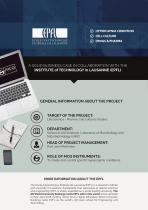
HYPERCAPNIA CONDITION CELL CULTURE DRUGS & PHARMA A SOLID BUSINESS CASE IN COLLABORATION WITH THE INSTITUTE of TECHNOLOGY in LAUSANNE (EPFL) GENERAL INFORMATION ABOUT THE PROJECT Life Science - Pharma: Cell Cultures Studies School of Life Sciences, Laboratory of Microbiology and Microtechnology (LMIC) HEAD OF PROJECT MANAGEMENT: Prof. John McKinney To create and control specific hypercapnia conditions. MORE INFORMATION ABOUT THE EPFL The École polytechnique fédérale de Lausanne (EPFL) is a research institute and university in Lausanne, Switzerland, that specializes in natural sciences and engineering. EPFL is widely regarded as a world leading university. The QS World University Rankings ranks EPFL 12th in the world across all fields in their 2017/2018 ranking, whilst Times Higher Education World University Rankings ranks EPFL as the world's 11th best school for Engineering and Technol
Open the catalog to page 1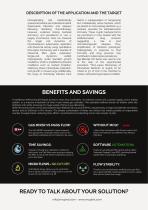
DESCRIPTION OF THE APPLICATION AND THE TARGET Nonreplicating and metabolically quiescent bacteria are implicated in latent tuberculosis infections and relapses following ‘‘sterilizing’’ chemotherapy. However, evidence linking bacterial dormancy and persistence in vivo is largely inconclusive. Here we measure the single cell dynamics of Mycobacterium tuberculosis replication and ribosomal activity using quantitative time-lapse microscopy and a reporter of ribosomal RNA gene expression. Single-cell dynamics exhibit heterogeneity under standard growth conditions, which is amplified by stressful conditions...
Open the catalog to page 2All MCQ Instruments catalogs and technical brochures
 GB NANO 3
4 Pages
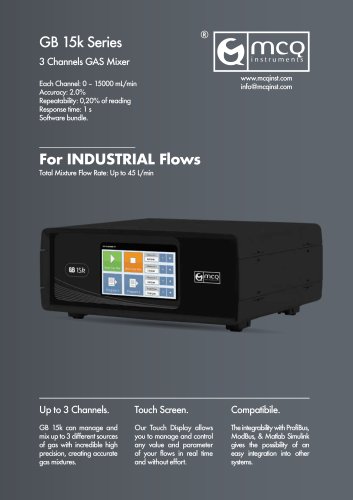 GB 15k
2 Pages
 GB 2000
4 Pages
 GB 3000
4 Pages
 GB 4000
4 Pages
 GB 6000
4 Pages
 GB 100
4 Pages
 GB 100 plus
4 Pages
 SensorModule
7 Pages
 Sensor Module
7 Pages
 Gas Blender Advantages
4 Pages




Archived catalogs
 Gas Blender 106 Series
4 Pages
 Data acquisition board
4 Pages
 Flow Board
11 Pages




- Control software
- Automated software
- Oxygen gas mixer
- Air gas blender
- Communication software
- Digital gas blender
- Laboratory gas blender
- CO2 gas blender
- 3-channel gas blender
- Gas blender with touchscreen
- USB gas blender
- Dinitrogen gas blender
- Carbon dioxide gas blender
- Medical gas control and monitoring system
- Continuous control and monitoring system
- Helium gas blender
- Laboratory control and monitoring system