
- Catalogs
- MCQ Instruments
- Gas Flow Control - High sensitive reduced graphene oxide-based room temperature ionic liquid electrochemical gas sensor with carbon-gold nanocomposites amplification


Gas Flow Control - High sensitive reduced graphene oxide-based room temperature ionic liquid electrochemical gas sensor with carbon-gold nanocomposites amplification

Gas Flow Control - High sensitive reduced graphene oxide-based room temperature ionic liquid electrochemical gas sensor with carbon-gold nanocomposites amplification
The project focuses on developing a high-sensitive reduced graphene oxide-based room temperature ionic liquid electrochemical gas sensor, enhanced with carbon-gold nanocomposites. This collaboration involves Zhejiang University, a prestigious institution in China, and aims to improve gas detection for environmental monitoring, industrial manufacturing, and human safety.
The project is managed by Ping Wang from the Biomedical Engineering department. MCQ Instruments plays a crucial role in controlling the flow rate and mixing gases efficiently.
The sensor utilizes carbon-gold nanocomposites synthesized through glucose carbonization and gold nanoparticle deposition. Reduced graphene oxide is electrochemically deposited on a gold electrode, modified with CGNs. A thin-film room temperature ionic liquid serves as the electrolyte, offering negligible evaporation and a large potential window.
The sensor is calibrated for oxygen detection ranging from 0.42% to 21%, demonstrating good sensitivity and linearity. The use of cyclic voltammetry, chronoamperometry, and transient double potential amperometry (DPA) highlights the performance enhancement due to the synergistic application of RGO and CGNs.
The project achieves significant time savings with easier hardware and software setup, reducing setup time by 70%. The MCQ GB100 Series allows precise flow control from 0.1 ml/min to 500 ml/min without cut-off, ensuring stable gas flows even at lower ranges. Software automation further facilitates experimental processes.
This study introduces a novel approach to high-sensitive electrochemical gas sensors, paving the way for rapid gas exposure monitoring. The compact GAS MIXER channels offer specific calibration advantages over traditional flow controllers.
Catalog excerpts
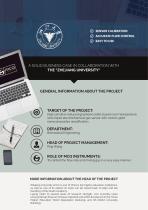
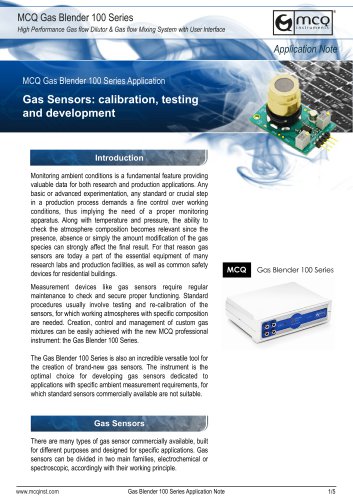
SENSOR CALIBRATION ACCURATE FLOW CONTROL EASY TO USE A SOLID BUSINESS CASE IN COLLABORATION WITH THE “ZHEJIANG UNIVERSITY“ GENERAL INFORMATION ABOUT THE PROJECT High sensitive reduced graphene oxide-based room temperature ionic liquid electrochemical gas sensor with carbon-gold nanocomposites amplification Biomedical Engineering HEAD OF PROJECT MANAGEMENT: Ping Wang To control the flow rate and mixing gas in a very easy manner. MORE INFORMATION ABOUT THE HEAD OF THE PROJECT Zhejiang University (ZJU) is one of China’s top higher education institutions, as well as one of its oldest; its roots can be traced back to 1897 and the founding of the Qiushi Academy. Laying claim to several areas of research strength, ZJU currently ranks among the top three on Chinese mainland and within the top 100 in the Times Higher Education World Reputation Rankings and QS World University Ra
Open the catalog to page 1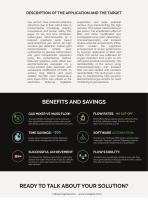
DESCRIPTION OF THE APPLICATION AND THE TARGET Gas sensors have received extensive attractions due to their critical roles in environmental monitoring, industry manufacture and human safety. This paper for the first time introduces carbon-gold nanocomposites on a reduced graphene oxide based electrochemical gas sensor for high sensitive gas detection. Carbon-gold nanocomposites (CGNs) were synthesized by glucose carbonization and gold nanoparticles deposition using the hydrothermal method. Reduced graphene oxide (RGO) was electrochemically deposited on a screen-printed gold electrode with subsequent...
Open the catalog to page 2All MCQ Instruments catalogs and technical brochures
 GB NANO 3
4 Pages
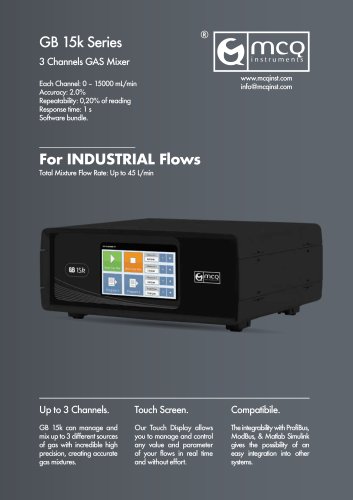 GB 15k
2 Pages
 GB 2000
4 Pages
 GB 3000
4 Pages
 GB 4000
4 Pages
 GB 6000
4 Pages
 GB 100
4 Pages
 GB 100 plus
4 Pages
 SensorModule
7 Pages
 Sensor Module
7 Pages
 Gas Blender Advantages
4 Pages




Archived catalogs
 Gas Blender 106 Series
4 Pages
 Data acquisition board
4 Pages
 Flow Board
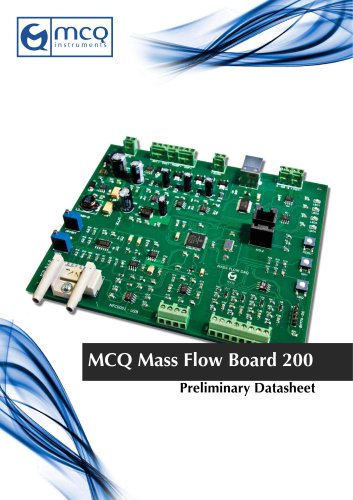
11 Pages




- Control software
- Automated software
- Oxygen gas mixer
- Air gas blender
- Communication software
- Digital gas blender
- Laboratory gas blender
- CO2 gas blender
- 3-channel gas blender
- Gas blender with touchscreen
- USB gas blender
- Dinitrogen gas blender
- Carbon dioxide gas blender
- Medical gas control and monitoring system
- Continuous control and monitoring system
- Helium gas blender
- Laboratory control and monitoring system