
- Catalogs
- MCQ Instruments
- The use of gas mixtures dynamically created in the hemoglobin study


The use of gas mixtures dynamically created in the hemoglobin study

The use of gas mixtures dynamically created in the hemoglobin study
The document discusses the significance of hemoglobin research in understanding human physiology and its role in molecular medicine. Hemoglobin's function in oxygen transport and its interaction with gases like CO2, CO, and NO are highlighted.
MCQ Gas Blender 100 Series Application
The MCQ Gas Blender 100 Series is a high-performance gas flow dilutor and mixing system used in hemoglobin studies. It allows for precise control of gas mixtures, essential for experiments involving hemoglobin. The system supports dynamic mixture management with high accuracy and repeatability.
The Role of Hemoglobin
Hemoglobin is a macromolecule crucial for oxygen transport in vertebrates. It consists of four protein molecules and is responsible for the red color of blood. Hemoglobin's interaction with gases is vital for its function.
MCQ Solution
The MCQ Gas Blender 100 Series provides a controlled atmosphere for hemoglobin experiments, allowing for precise gas mixture adjustments. It is adaptable to various lab applications and comes with the MCQ Gas Mixer Manager software for easy control.
Hemoglobin Research Applications
Research on hemoglobin covers diseases like sickle cell disease and thalassemia, as well as applications in tumor research, cardiovascular disease, diabetes, and carbon monoxide poisoning.
Gas Mixture Composition
An example gas mixture includes 85% nitrogen, 10% oxygen, and 5% carbon dioxide, with an oxygen partial pressure of 75 mmHg.
Experimental Set-up
The document describes a typical hardware configuration for the MCQ Gas Blender 100 Series, emphasizing its adaptability to different experimental setups.
Catalog excerpts

High Performance Gas flow Dilutor & Gas flow Mixing System with User Interface Application Note MCQ Gas Blender 100 Series Application: The use of gas mixtures dynamically created in the hemoglobin study Introduction Over the last century, the hemoglobin study has been, and still is, the keystone in our understanding of human physiology. The importance of the role of hemoglobin and the studies undertaken over this molecule have allowed, starting from the pioneering works of enlightened minds such as Linus Pauling, Max Perutz and many others until today worldwide research, the birth and maturation of a new scientific branch: the molecular medicine. Being a fundamental component in the complex respiratory system of all the vertebrates, the hemoglobin has always been a high interesting scientific subject, widely researched by using physical, chemical, physiological, and genetic methods. All these intense efforts allow modern medicine to have an unparalleled knowledge of hemoglobin molecular basis, DNA relations, structure-related functions and more importantly its related diseases and their treatment. Nevertheless, hemoglobin study constantly proves new and deeper connections between this molecule and other complex biological systems that then require new experimental approaches to be developed. www.mcqinst.com The Role of Hemoglobin Hemoglobin is a macromolecule made up of four protein molecules, the globulin chains called myoglobin, connected together. The normal adult hemoglobin molecule contains 2 alpha-globulin chains and 2 beta-globulin chains. The dry content of the red blood cells, the most abundant cells in vertebrate blood, is composed up to 97% of hemoglobin. Its main function is to transport oxygen (O2) from the lungs to tissues (taking role of oxygen binding protein, the hemoglobin increases the total blood oxygen capacity seventyfold) and to return carbon dioxide (CO2) from the tissues to the lungs or gills. Each globulin chain contains an iron ion embedded in a porphyrin molecule called heme, which directly binds the oxygen molecule and which is also responsible for the red color of blood. The heme also specifically interact with the two other gases, carbon monoxide (CO) and nitric oxide (NO), both with important biological roles. The interaction between carbon dioxide and hemoglobin is instead carried out by the amino-terminal residues of the protein. Hemoglobin Gas Blender 100 Series Application Note
Open the catalog to page 1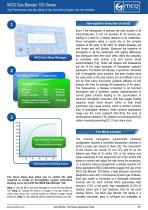
High Performance Gas flow Dilutor & Gas flow Mixing System with User Interface Hemoglobin branches of study Gas Mixer Manager Configuration Gas Mixture Composition Nitrogen: Oxygen: Carbon dioxide: Oxygen partial pressure: (correspondig to 10% in total flow) 170 sccm 20 sccm 10 sccm 75 mmHg Even if the hemoglobin is perhaps the best studied of all macromolecules, it has not revealed all its secrets yet, leading to a need for a deeper research to be undertaken. Since hemoglobin takes a crucial role in the complex systems at the base of life itself, its related diseases are well known and well...
Open the catalog to page 2
High Performance Gas flow Dilutor & Gas flow Mixing System with User Interface many different lab-application. The instrument works with dry, non-aggressive gas media and the channels are always calibrated with native gases following customer’s request. MCQ also provide software for the gas mixture management, the MCQ Gas Mixer Manager. Easy to use, compatible with any common desktop or laptop pc, MCQ Gas Mixer Manager allow taking a complete control over the instrument and its functions, letting the user to start working with dynamic gas mixtures immediately. coming out mixture can be adjusted...
Open the catalog to page 3
High Performance Gas flow Dilutor & Gas flow Mixing System with User Interface equilibrium curves and DPG binding – Respir. Physiol. 68, 2 (1987) 227-238. [5] N. A. Mayr, J. Z. Wang, D. Zhang, J. F. Montebello, J. C. Grecula, S. S. Lo, J. M. Fowler, W. T.C. Yuh, Synergistic effects of hemoglobin and tumor perfusion on tumor control and survival in cervical cancer - Int. J. Radiat. Oncol. Biol. Phys. 74, 5 (2009) 1512-1521. [6] M. Yamamoto, Y. Izumi, H. Horinouchi, Y. Teramura, H. Sakai, M. Kohno, M. Watanabe, M. Kawamura, T. Adachi, E. Ikeda, S. Takeoka, E. Tsuchida, K. Kobayashi, Systemic Administration...
Open the catalog to page 4All MCQ Instruments catalogs and technical brochures
 GB NANO 3
4 Pages
 GB 15k
2 Pages
 GB 2000
4 Pages
 GB 3000
4 Pages
 GB 4000
4 Pages
 GB 6000
4 Pages
 GB 100
4 Pages
 GB 100 plus
4 Pages
 SensorModule
7 Pages
 Sensor Module
7 Pages
 Gas Blender Advantages
4 Pages




Archived catalogs
 Gas Blender 106 Series
4 Pages
 Data acquisition board
4 Pages
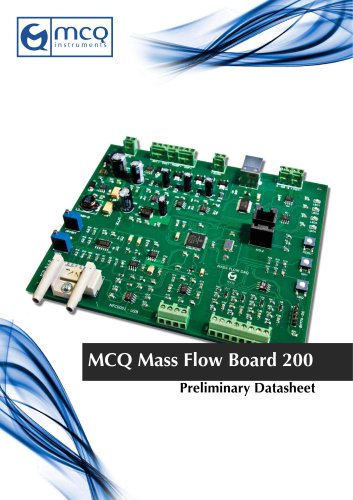 Flow Board
11 Pages





- Control software
- Automated software
- Oxygen gas mixer
- Air gas blender
- Communication software
- Digital gas blender
- Laboratory gas blender
- CO2 gas blender
- 3-channel gas blender
- Gas blender with touchscreen
- USB gas blender
- Dinitrogen gas blender
- Carbon dioxide gas blender
- Medical gas control and monitoring system
- Continuous control and monitoring system
- Helium gas blender
- Laboratory control and monitoring system