
- Catalogs
- MDE Technologies
- whole organ perfusion system_liver and kidney

whole organ perfusion system_liver and kidney

whole organ perfusion system_liver and kidney
The document describes the LF-31 whole organ perfusion system designed for in vitro experiments on isolated liver and kidney perfusion. This system is particularly suitable for small animals, such as rats, and is used to maintain organ function without deformation or increased intravascular pressure.
Advantages of the Isolated Organ Perfusion System
- The system maintains organ function in a horizontal evaporation chamber, preventing deformation and excessive pressure.
- Online software monitors intravascular pressure, allowing for immediate detection of changes.
- Suitable for studying the effects of drugs and toxins on the vascular system.
- Prevents thrombosis, embolism, and cardiovascular failure, ensuring longevity of organ functions.
- Allows collection of bile, urine, and buffer fractions for qualitative analysis.
System Specifications
- Includes a precision roller pump and a pump controller for constant pressure and flow.
- Temperature control unit ensures precise temperature management of the perfusion fluid and organ environment.
- Compatible with various data acquisition software, with a recommendation for the SPEL Advanced system.
Fields of Application
- Kidney preparation involves inserting cannulas into the ureter, renal vein, and artery, followed by placement in the perfusion chamber.
- Liver preparation requires cannulas in the portal vein and inferior vena cava, with the liver placed in the perfusion chamber.
System Components
- Organ bath, vaporizing chamber (CH1), perfusion fluid tempering chamber (CH2), and measuring baths for liver and kidney.
- Temperature sensors and heaters connected to temperature controllers for precise environmental control.
Conclusion
The LF-31 system offers a novel design that maintains organs in a carbogen-rich moisture vapor, ensuring optimal physiological conditions for extended viability and accurate experimental results.
Catalog excerpts
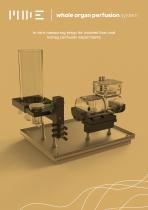
whole organ perfusion system In vitro measuring setup for isolated liver and kidney perfusion experiments
Open the catalog to page 1
whole organ perfusion system ADVANTAGES OF ISOLATED ORGAN PERFUSION SYSTEM: • The system maintains the isolated organ function in an evaporation chamber lying horizontally. It means that the whole isolated organ is not mounted, there fore its tions, e.g. hepatic metabolism, bile secretion, urine se- vasculature is not deformed by an artificial position. cretion out of the body. The organ preparations are Additionally, the organ is not immersed in a buffer liq- not endangered by thrombosis or embolism, or any uid thus extra hydrostatic pressure does not increase cardiovascular failure of the experimental...
Open the catalog to page 2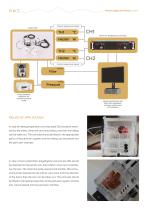
whole organ perfusion system Control temperature sensor Control temperature sensor fields of application In case of kidney preparation cannulas sized 23G should be inserted into the ureter, renal vein and renal artery, and then the kidney can be taken out. The cannulas should be fitted to the appropriate parts of the perfusion system and the kidney can be placed into the perfusion chamber. In case of liver preparation polyethylene cannula size 18G should be inserted into the portal vein, then inferior vena cava is tied below the liver. The chest should be opened and another 18G cannula should...
Open the catalog to page 3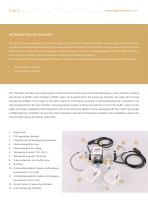
whole organ perfusion system INTRODUCTION OF THE BATH The aim of the unique design of the of the organ bath is to keep the perfused organs alive as long as it possible. Thus valuable metabolites and biomarkers can be released with the help of contamination free perfusion solution for further analyses. The novelty of the technical design is that the organ is not kept in the physiological solution in order to survive, but in a 35.40C carbogen rich moisture vapor made from physiological solution. To ensure that the correct physiological conditions two hermetically separated chambers were made within...
Open the catalog to page 4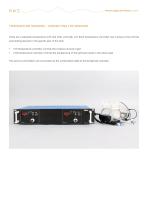
whole organ perfusion system TEMPERATURE SENSORS - CONNECTING THE SENSORS There are 2 separate temperature (CHl and CH2) controller unit. Each temperature controller has 2 sensors and controls one heating element in the specific part of the tank. • CH1 temperature controller controls the moisture around organ CH2 temperature controller controls the temperature of the perfusion liquid in the silicon pipe The sensors and heaters are connected via the combinated cable to the temperate controller
Open the catalog to page 5
[email protected] www.mdegmbh.eu MDE GmbH- Schwanthaler str. 5. 80336 Munchen, Germany Podmaniczky Street 87, 1064 Budapest, Hungary
Open the catalog to page 6All MDE Technologies catalogs and technical brochures
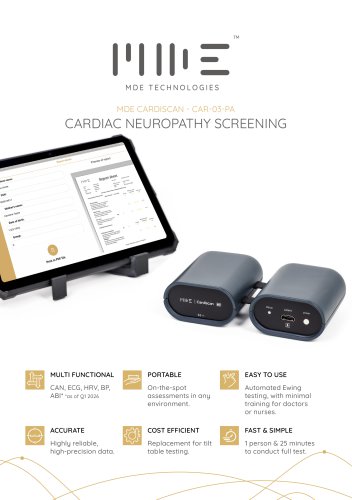 MDE CardiScan
2 Pages
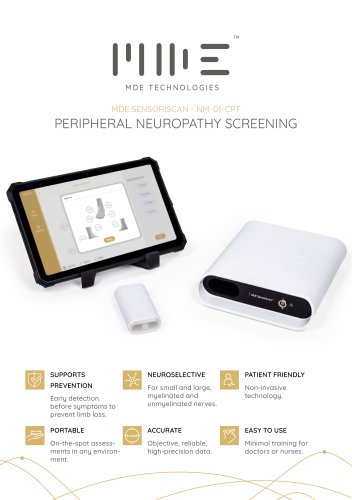 MDE SensoriScan -
2 Pages
 Heart Cell Isolation setup
10 Pages
 Working Heart Perfusion setup
15 Pages
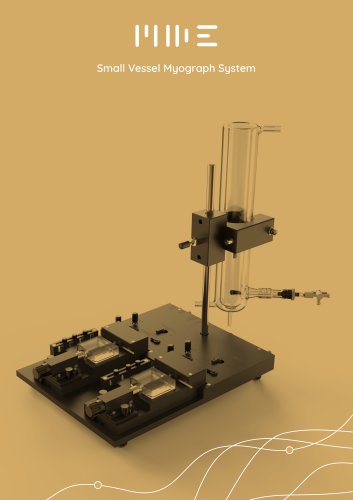 Wire Myograph System
22 Pages
 Langendorf_heart
14 Pages
 Isolated nerve tissue system
7 Pages
 Amplifiers and stimulators
9 Pages
 Cardiofish ECG device
16 Pages


- Laboratory bath
- Benchtop laboratory bath
- Vitals monitor
- Blood pressure vital signs monitor
- Circulating laboratory bath
- Intensive care vital signs monitor
- Compact vital signs monitor
- ECG vitals monitor
- Heart organ perfusion system
- Animal research organ perfusion system
- Small animal organ perfusion system
- Wearable vital signs monitor
- Veterinary electrical stimulator
- Cardiology organ perfusion system
- Animal research veterinary electrical stimulator
- Myograph
- Preclinical research myograph